Do Parents Need to Be Wary of COVID Toes in Kids?
Among one of the more peculiar reported symptoms of COVID-19 has been the mysterious “COVID toes.” In the last six months, there have been multiple reported cases of people with red, sore, itchy, and discolored toes, generally, with no or limited other symptoms, that would suggest they were sick with COVID-19.
For
many, this condition feels like chilblains, where one gets red or
purple tender bumps on the fingers or toes. Generally, this condition
occurs as a reaction to cold temperatures. However, when reports of
people experiencing the condition began rolling in even from warm
regions, experts were taken by surprise.
"COVID toes" could be a clue for kids without any other symptoms
Health
professionals say that the infection is painful to the touch and could
have a hot burning sensation. Interestingly, however, COVID toes seem to
be appearing in COVID-19 patients who haven’t displayed any other
symptoms related to the disease. “This is a manifestation that occurs
early on in the disease, meaning you have this first, then you
progress,” said Dr. Ebbing Lautenbach, chief of infectious disease at
the University of Pennsylvania's School of Medicine to USA Today.
“Sometimes this might be your first clue that they have COVID when they
don’t have any other symptoms.”
Curiously, the symptom of COVID toes appears to be affecting many children and young adults, too, apart from adults.
So
far, the coronavirus didn’t seem to have much of an effect on kids or
babies as much as it has adults. In cases where children or teens did
get the virus, they generally had mild symptoms and recovered relatively
quickly. However, COVID toes could be a clue for young people without
any apparent symptoms.
Apparently,
the discoloration appears in children before they get any other
symptoms. This means that if you notice a red or purplish kind of rash
on your child’s toes, then it may be an indicator of them having
contracted the coronavirus and it would be better to get them checked
immediately.
Earlier this year, a new study from Spain recently published in the British Journal of Dermatology
looked at 7 children with painful chilblain-like symptoms on their
toes. The experts took a tiny biopsy sample from the toes to look at and
found coronavirus particles within the tiny blood vessel cells of the
feet. This provides the strongest evidence that the virus may be
directly responsible for this symptom.
Symptoms of “COVID toes”
As of now, those with COVID toes appear to have the following symptoms:
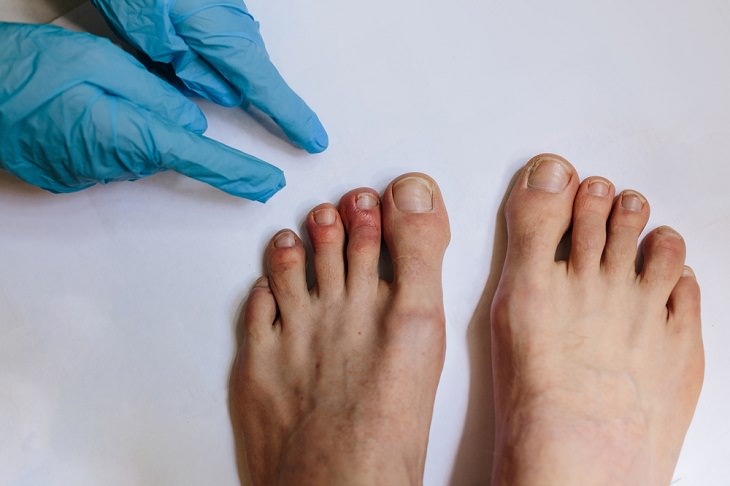
* Red or purple tender bumps on the fingers or toes.
* A burning sensation, often with pain and tenderness.
* In a few cases, there have been small colorful circles on the bottom of the foot or the big toe.
No
one knows exactly why the novel coronavirus might cause chilblain-like
lesions. But if one does develop them, it is important to not panic.
“The
good news is that the chilblain-like lesions usually mean you’re going
to be fine,” says Dr. Lindy Fox, a dermatologist in San Francisco.
“Usually it’s a good sign your body has seen COVID and is making a good
immune reaction to it.”
Be cautious but don’t panic
Do
note that dermatologists have been trying to understand COVID toes for
the last six months and still aren’t completely sure about it. There
have been a few conflicting studies in the past couple of months on this
subject - a few that support the link between COVID-19 and COVID toes
and other ones that deny it. Moreover, there’s still confusion and
mystery of whether or not people who develop COVID toes are actually
infected with the virus.
“We
are still trying to figure out the exact relationship between "COVID
toes" and the virus with regards to whether a person is infectious or
will develop immunity as a result. Other causes of chilblains still
exist, so we recommend a person see their primary care doctor or
dermatologist if they notice these skin findings,” says Roxana
Daneshjou, MD, Ph.D., Dermatologist, and Clinical Scholar at Stanford
Dermatology.
Thus,
more scientific evidence and analysis will be required to understand
its symptoms and confirm if it’s related to COVID-19. Furthermore, in
most cases of children with COVID toes, the symptoms seem to go away
after about 2-3 weeks. That being said, there’s no harm being a little
cautious if you notice your child having similar symptoms and consulting
your primary care doctor or a dermatologist to rule out other possible
causes.