Sunday, September 21, 2025

Nutritionist shares 10 protein-rich foods for muscle strength: From Greek yogurt to quinoa

Building muscle isn’t just about sweating it out at the gym; what’s on your plate matters just as much. In a conversation with Mint, nutritionist and founder of DtF, Sonia Bakshi, broke down the role of food in muscle strength, recovery and overall fitness. From protein-packed staples to smart pre- and post-workout meals, here’s her guide to eating for strength.

Why protein matters

“Nutrition and regular exercise are both very important for muscle building. A well-balanced diet that includes carbs, protein and healthy fats is the best for optimal results,” Bakshi explained. For most adults, she recommends 1–1.2 grams of protein per kilo of body weight per day. Spread across meals, that means around 15–20 grams of protein per meal.

10 high-protein foods for stronger muscles

Bakshi lists 10 everyday foods that can significantly boost muscle strength if included wisely in your diet:

  • Eggs: Two eggs provide 12 g of protein. Add black pepper for better nutrient absorption.
  • Chicken breast: One piece packs about 40 g protein. Marinate and grill or stir-fry for the best results.
  • Greek Yogurt: 100 g offers 10 g protein. Strain homemade curd for a fresh batch; use leftover whey in smoothies.
  • Quinoa: Not a complete protein alone, but combine it with dals or beans for a balanced meal.
  • Chickpeas: One cup has 14 g protein. A chickpea salad with lemon and pepper aids absorption.
  • Peanuts: 25 g protein per 100 g serving, plus healthy fats. Stick to unsalted versions.
  • Buckwheat (Kuttu): Gluten-free, amino-acid rich. Ideal as porridge or cheela — avoid frying.
  • Tofu: A complete protein that also keeps you full longer, reducing snack cravings.
  • Nuts (Almonds, Pistachios, Cashews): Soaked nuts in the morning or raw ones on-the-go make for powerful snacks.
  • Lentils: 9 g protein per 100 g cooked. Pair with rice (without starch) for a complete meal.

Can vegetarians build enough muscle?

According to Bakshi, absolutely. “It’s a misconception that vegetarian food lacks protein. Nature has given us abundant plant-based protein; we just need to combine them wisely,” she said. Options like soya, sprouts, curd, legumes, paneer, chickpeas, rajma, lobhia, nuts, seeds, quinoa, amaranth, and peas all provide high-quality protein. The only gap vegetarians must watch for is Vitamin B12, which requires supplementation.

Do you really need protein powders?

Bakshi believes most active people don’t. “Dals, paneer, eggs, fish — these are excellent protein sources. If each meal has 15–20 g protein, your daily requirement is met easily. Protein powders are only needed by bodybuilders and should be taken under a doctor’s guidance,” she explained.

What to eat before and after a workout

Before workout:

No gap before exercise? Eat a banana or a handful of soaked nuts.

40 minutes before exercise? Try a smoothie with yoghurt, fruit, seeds, and honey, or a banana shake.

After workout:

  • Boiled eggs
  • Chicken salad
  • Chickpea salad
  • Oatmeal with berries
  • Dal cheela or besan cheela

The bottom line

Bakshi sums it up simply: strength is built in the gym but fuelled in the kitchen. The right mix of protein-rich foods, balanced meals, and smart snacking can help you build muscle sustainably — without the need for shortcuts.


This is only for your information, kindly take the advice of your doctor for medicines, exercises and so on.   

https://gscrochetdesigns.blogspot.com. one can see my crochet creations  
https://gseasyrecipes.blogspot.com. feel free to view for easy, simple and healthy recipes    
https://kneereplacement-stickclub.blogspot.com. for info on knee replacement
https://GSiyers home remedies.blogspot.com   is the latest addition to my blogs

Labels: , , , , , , , , , ,

Monday, July 08, 2024

90% of the Population are Deficient in This Nutrient - Choline

Being vegan or vegetarian is more popular than ever and having a low cholesterol diet on a whim is practically synonymous to leading a healthy lifestyle. Unfortunately, both of these diet trends may harm our health if we're not careful, as they are indirectly making us deficient in one key nutrient, choline, with an estimated 90% of Americans being deficient in this essential nutrient. 
 
Never heard of choline? We’re not surprised, as, unlike vitamin C or omega-3 fatty acids, choline is not getting nearly as much publicity, but it doesn’t make it any less important to our health and well-being. In fact, a deficiency in this essential nutrient is associated with a sluggish brain, a poorer progression of Alzheimer’s, impaired brain and spinal cord development in children, and fatty liver disease. In this article, we discuss what choline is, what it does for our bodies, and which foods contain this vital nutrient.


What is CHOLINE?
Choline is a nutrient comparable to vitamins in its importance for the body, and it plays a key role in regulating cholesterol levels, maintaining brain and mental health, as well as being a building block for cell membranes. Apart from that, choline is crucial for brain development of children, which is why pregnant and breastfeeding women, as well as young children, are often required to monitor choline levels.

Like many other vitamins and nutrients, our bodies naturally produce choline in our livers, but never in sufficient amounts, which is why doctors recommend the following regulated daily intake of choline for adults:

550 mg for men
425 mg for women
450 mg for women during pregnancy
55- mg for women during breastfeeding
 
Why is choline deficiency dangerous?
 
As we mentioned at the beginning of the article, according to the National Health and Nutrition Examination Survey, 90% of kids, pregnant women, and other adults aren’t meeting their daily recommended intake of choline. But what does it mean for their health?

A choline deficiency contributes to the following health conditions
 
Neurological disorders. 
A low intake of choline in adults has been associated with decreased memory, brain fog, and cognition. Some researchers have even suggested that choline helps maintain the structural integrity of neurons and so it may be beneficial in supporting cognitive sharpness in older adults, particularly among dementia and Alzheimer’s sufferers. 
 
Finally, a choline deficit at an early age may result in neurodevelopmental deficiencies, so sufficient choline intake is particularly important for pregnant and breastfeeding women, as well as infants and young kids. 
 
Nonalcoholic fatty liver disease (NAFLD)
An adequate intake of choline is essential for preventing liver damage and NAFLD, the most common liver disease affecting the majority of overweight individuals and patients with obesity. NAFLD is particularly dangerous, as it increases one’s risk of liver cancer, liver failure, and cirrhosis quite significantly. Choline helps prevent a fatty liver and is thus essential for liver health. 
 
 Finally, there is also some recent scientific evidence suggesting choline can be beneficial for the heart, as it can decrease the levels of the bad kind of cholesterol in the blood, but there isn’t sufficient proof to back that claim just yet.


Which foods contain choline?
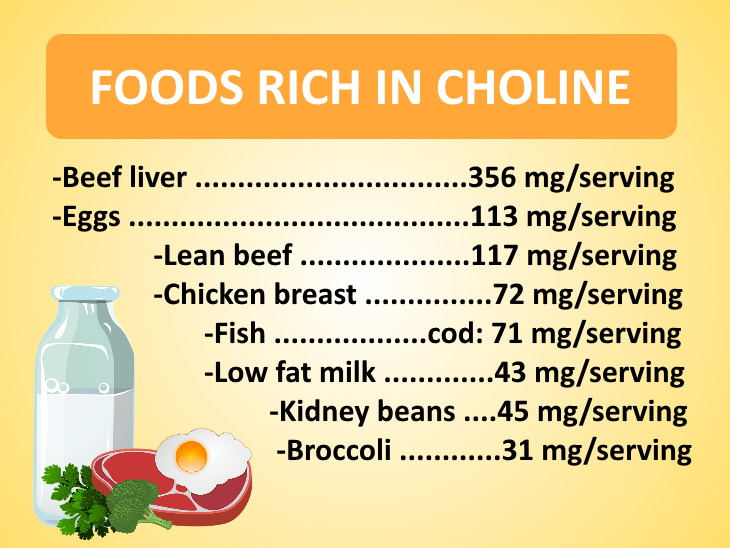
choline deficiency list of foods rich in choline

With the exception of some cruciferous vegetables and beans, choline-rich foods are limited to those that are animal-derived, which is why persons who have a vegetarian or vegan diet, as well as a low-cholesterol diet are more prone to be deficient in choline.
 
The table above features several food types particularly rich in choline, with liver, eggs, and red meat being some of the most choline-dense food choices out there. If you’re following a low-cholesterol diet as per the recommendations of your doctor, we advise you to discuss the option of a choline supplement with your health provider. 
 
Supplementation is also an option to consider for vegans and vegetarians, as choline is difficult to get from veggies only. For example, these is roughly as much choline in 1 boiled egg (113 mg) as in 2 cups of broccoli (123 mg), which is less than a quarter of the recommended intake per day for men. 
 
In the end, what this story of mass choline deficiency can really teach us all is that we shouldn't submit to dieting trends in a thoughtless manner and have a balanced nutrient intake no matter what, even if means supplementing.


This is only for your information, kindly take the advice of your doctor for medicines, exercises and so on.   

https://gscrochetdesigns.blogspot.com. one can see my crochet creations  
https://gseasyrecipes.blogspot.com. feel free to view for easy, simple and healthy recipes    
https://kneereplacement-stickclub.blogspot.com. for info on knee replacement
https://cancersupportindia.blogspot.com  for infor on cancer and health related topics
https://GSiyers home remedies.blogspot.com   is the latest addition to my blogs. I'm going to add posts there, do give me your valuable feed back on my blogs. Thanks a lot, take care, be healthy and be happy.


Labels: , , , , , , , , ,

Wednesday, July 01, 2020

What are some foods you must include in your diet if you’re trying to build muscle?

Your diet plays a crucial role in helping you lose weight, and maintain it. However, very few people realise that diet also plays a very important role in building muscle. Building muscle and getting a toned, muscular body, is not just about how many pushups you do in a day, or how many hours you spend in the gym. It is also about what you eat to supplement the process.
 
The role of diet in building muscle
Certain nutrients that we receive from our food are extremely important in building muscle. We hear about people drinking huge tumblers of protein shake, and take other supplements to build muscles. However, these are not always healthy, and trying to change your diet or body so drastically can have certain adverse health effects.
Nutrients such as protein, one of the key nutrients for building muscle, can be obtained from food as well. Here are 5 foods you must include in your diet, as you exercise rigorously to build muscle.
  1. Eggs: Boiled eggs are one of the most common foods eaten by those who exercise at the gym. This is because eggs are a great source of protein, and when you exercise, the protein in your body is used up in the right place to build muscles.
  2. Salmon: Salmon is a rich source of nutrients like protein, omega 3 fatty acids, etc. Salmon is a great choice for muscle building and overall health.
  3. Chicken breast: This food is not only rich in protein, but also in vitamins such as vitamin B12. These nutrients are very important if you are active. The vitamins make sure that the body processes run efficiently, and that helps in the process of gaining muscle.
  4. Soyabeans: One of the most nutritious vegetarian foods out there, soyabeans can be a part of your muscle-building diet if you are vegetarian or vegan. This food is rich in phosphorous, and iron, two extremely important nutrients for health and fitness.
  5. Cottage cheese: Cottage cheese is considered a replacement for meat in every vegetarian household, in terms of taste. However, cottage cheese is also a great replacement for meat in terms of nutrition. It is rich in protein, vitamins, and is rich in muscle-building amino-acid leucine.

This is only for your information, kindly take the advice of your doctor for medicines, exercises and so on.     

https://gscrochetdesigns.blogspot.com. one can see my crochet creations  
https://gseasyrecipes.blogspot.com. feel free to view for easy, simple and healthy recipes    
https://kneereplacement-stickclub.blogspot.com. for info on knee replacement


Labels: , , , , , , , ,

Saturday, April 11, 2020

20 Delicious High Protein Foods

Labels: , , , , , , , , , , , , , , , , ,