Saturday, July 03, 2021

5 Relaxing Yoga Exercises for Just Before Bedtime

You're already in bed and there's nothing you want more than a deep sleep, but you know that today you haven’t gotten in any exercise to help you maintain your body and mood, and you probably aren’t going to. It’s likely that you’ve often had such thoughts and were sure that there is no solution to the problem, but it turns out that this isn’t true.
Just before you turn off the lights and try to sleep, we have great news for you! Nutritionist and yoga teacher Liel Cheri has a series of great yoga exercises that can be done in bed before bedtime, and they’ll help you relax, do some fitness and improve your health and appearance! We have prepared a detailed guide for 5 of these exercises that’ll make you sleep well and feel great. 
 
1. The child's pose 
 yoga poses
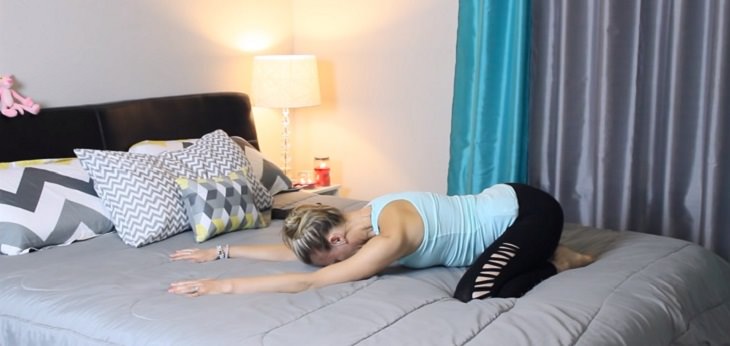
The child's pose is a wonderful way to start with stretching your whole back and releasing the waist. Use deep breaths to relax and connect to the regular posture in the exercise to get yourself into the right mood.
How to: 
Start with sitting on your knees - bring your feet together and your knees apart. 
 
Move your hands away and continue to stretch your buttocks toward your heels, as shown above. 
 
Place your head down on the mattress and close your eyes. 
 
Relax the muscles of the jaw and face, and draw deep breaths through the nose. 
 
Stay in this position for a few minutes. 
 
2. Cow and cat pose  
yoga poses
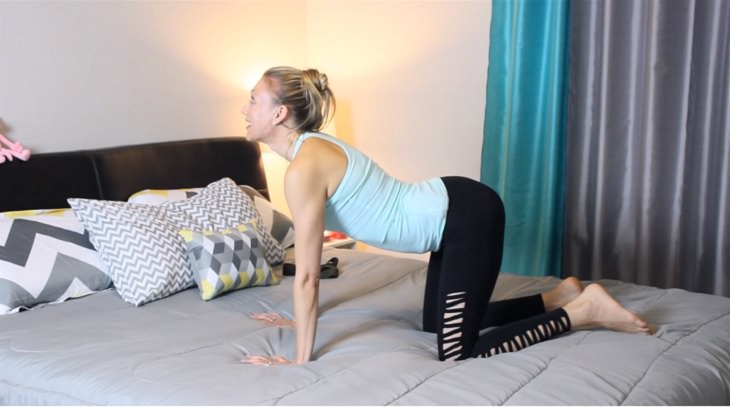
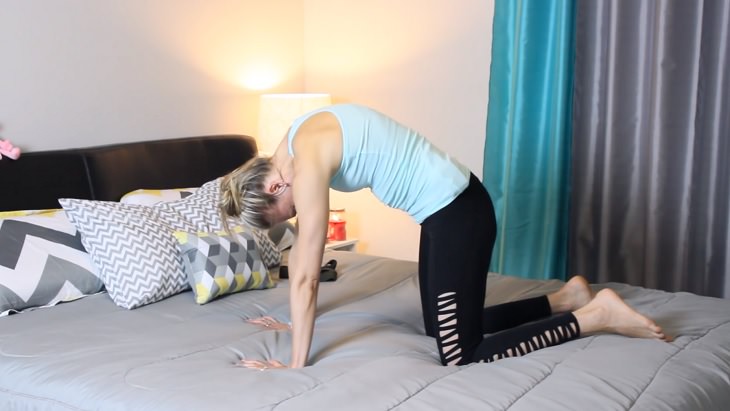
The next exercise consists of two positions that we move between while we imagine the concave stance of a cow and the convex stance of a cat. The exercise is great for those who have back pain and it can also help reduce stress.

How to: 
Start in the tabletop pose, shoulders above palms, waist above knees, and back straight. 
 
Take a breath, let your stomach fall, and curve your back. 
 
Turn your head and eyes upward to the cow position, as illustrated in the image above.
yoga poses
After about a minute, suck your stomach in, arch your back outwards and bring your gaze toward your navel to the position of a cat, as illustrated in the image above. 
 
Alternate between the poses 5 times each while deeply inhaling and exhaling.
3. Downward facing dog 
yoga poses
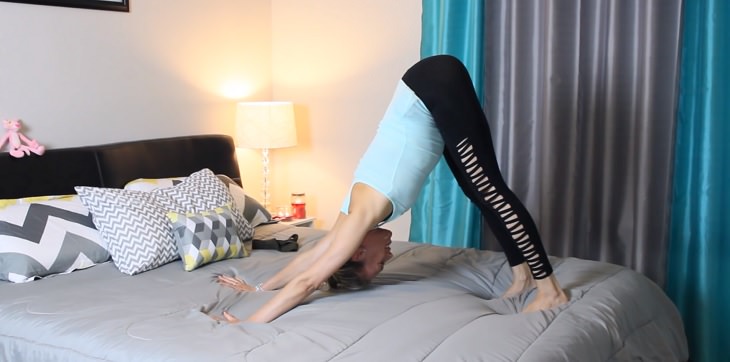
Downward facing dog lengthens and relaxes the spine, helps breathing and opens the chest. The posture strengthens the muscles of the lower back and provides the necessary release to enter sleep.
How to: 
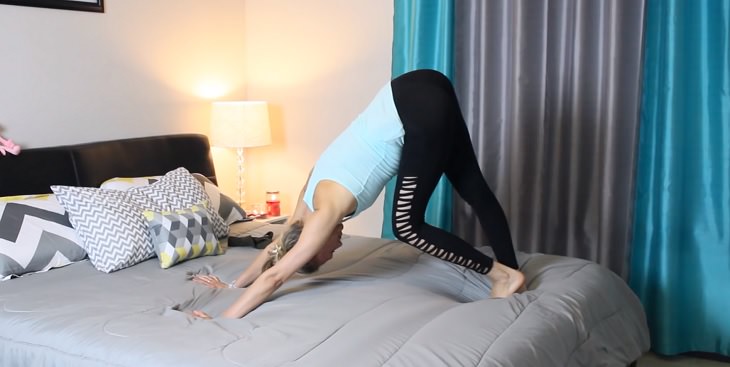
From the last step of the previous exercise (cow and cat pose), fold your toes inward and lift your buttocks upwards, placing your palms and feet on the mattress. 
 yoga poses
Put your head between your arms and look at your stomach, as shown in the image above.
 
Bend one leg while deepening the tread of the heel on the other leg as in a stepping motion) 
 
Switch between the legs, and bend the other leg as well. 
 
Repeat the exercise several times. 
 
To increase the traction, lift one leg toward the ceiling while maintaining a stable, upright second leg, head down, and palms supported by the mattress. 
 
Repeat the lift with the other leg and try to stay in position for a few minutes.

4. Pigeon Pose   yoga poses
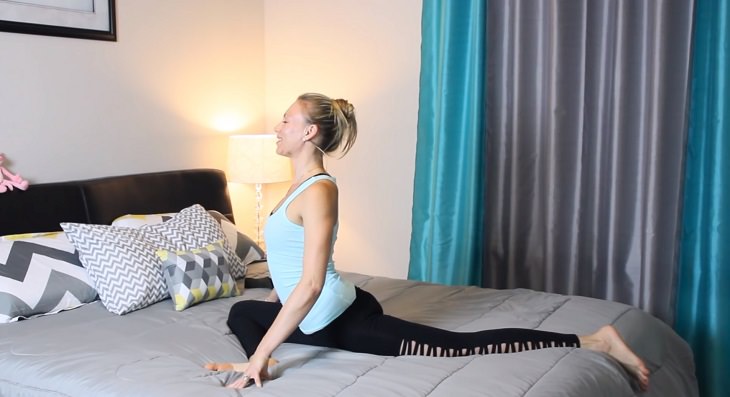
The pigeon pose is called this because during the exercise we fill our chest, just as the pigeon does. The pose is good for stability, back strengthening, and hip joints.
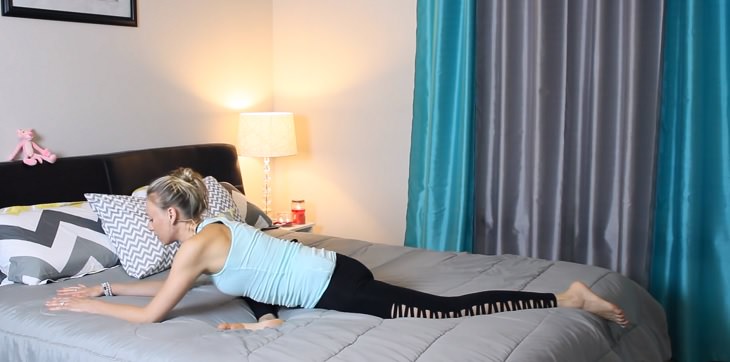
How to: 
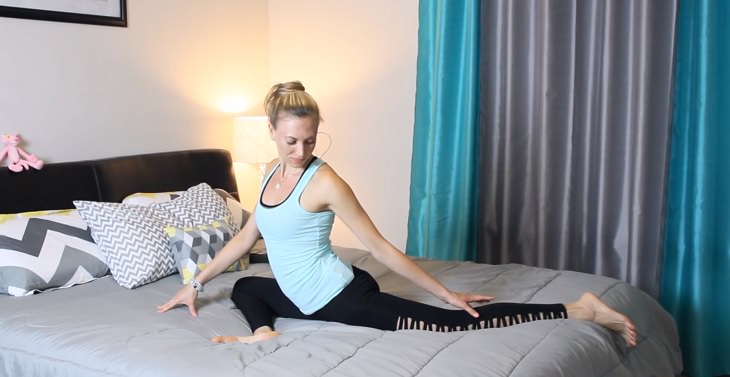
Sit on the mattress with one straight leg stretched back, and your other leg bent with a heel close to the groin, or a little more forward – whatever is comfortable for you. (You can enter this position from the downward facing dog pose.) 
 
Place your foot in a flex position and balance the weight at the waist evenly with the palms placed on the mattress. 
 
Inhale, fill the chest with the air and lift it, using your palms, as Liel demonstrates in the picture above.
yoga poses
Exhale and send your arm back toward the heel, placing your hand on your right calf and turning your head toward the shoulder of the outstretched arm as seen above. 
 
Return to the starting position, refill your chest and lift it. 
 
Bend your arms forward, lean them on the mattress, and lower your back to them, as can be seen in the picture above. 
 
You may feel that the pose is difficult for you – don’t push yourself past your endurance limit, and make sure that you’re mostly feeling tension rather than pain.
yoga poses
If you can challenge your body more, reach your hands straight forward making your chin come into contact with the mat - for a deeper stretch. After a few minutes, lift your back to the starting position. Perform the exercise on the other side as well – switching the bent leg. If you continue to the next position, do the two poses (4 + 5) one by one, on one side of the body and then do them both on the other side of the body. 
 
5. Mermaid Pose 
yoga poses
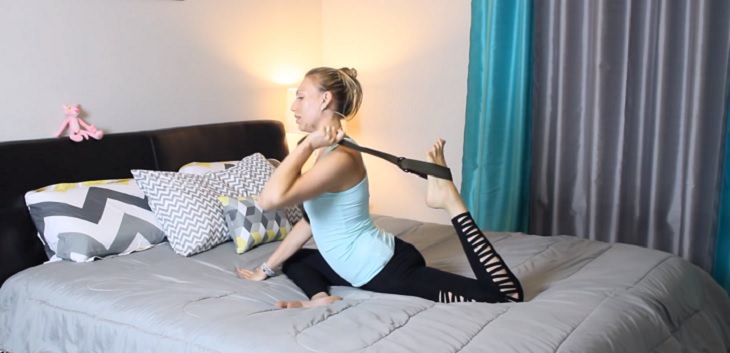
The Mermaid pose should continue from the point at which you stopped the previous exercise. Because the position may be challenging for beginners, it is recommended to use a rubber exercise band with a loop, which will allow you to get a good stretch, when you first start practicing this pose.

How to:  
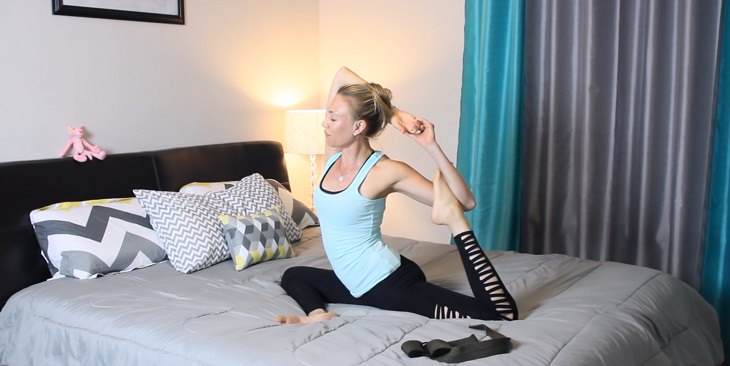
From the final position of the previous exercise, lift the straight leg from the mattress and bring it to your bottom. 
 
You can use your hand, or a band, around the arch of the foot, so that you can pull it with your hand, as Liel demonstrates in the picture above. 
 
Observe the stretch in the quadriceps, and try to bring the foot into the inside of your elbow (this stage is suitable for someone who can perform the stretch without the help of a band).
yoga poses
Send the other hand up, bend it and join both hands behind the neck, as shown above. 
 
Close your eyes, concentrate on your breath, and stay in position for a minute to several minutes. 
 
Repeat the exercise with the other leg.
 

This is only for your information, kindly take the advice of your doctor for medicines, exercises and so on.   

https://gscrochetdesigns.blogspot.com. one can see my crochet creations  
https://gseasyrecipes.blogspot.com. feel free to view for easy, simple and healthy recipes    
https://kneereplacement-stickclub.blogspot.com. for info on knee replacement


Labels: , , , , , , , , , ,

Thursday, June 10, 2021

Why You Should Take More Time Off from Work

Americans generally believe that they need to “deserve” their vacations—that they should work hard, even push themselves, before they actually take a break. 

Consider these statistics:  

·         There may be cultural reasons for this phenomenon. Countries most influenced by the Protestant work ethic, like the United States, place a lot of value on industriousness and proving oneself—as opposed to countries influenced by Catholicism, which is a salvation-based religion. In Catholic-influenced France, for example, 90 percent of people take all of their vacation days (despite having more than twice as many—30!—as most Americans).

·         Ironically, while Americans may pride themselves on their hard work and dedication, research suggests that we will actually work harder, perform better, and have greater health, stamina, and enthusiasm for our work if we take time off. 

·         Three ways vacation is good for you

·         Research suggests that leisure is an important predictor of our well-being and satisfaction with life, including our health, work engagement, creativity, and even marital satisfaction.

·         1. Vacation is relaxing. We often take vacations in order to relax, but do they actually work? Scientists out of the University of California, San Francisco, examined this question with a rigorous study: They looked at the impact of a resort vacation and a meditation retreat on biological measures of stress and immune function. The data showed that a resort vacation not only makes us feel more energetic and less stressed than we were before we took the vacation, it also leads to a strong and immediate impact on molecular networks associated with stress and immune function. Participants who attended the meditation retreat also showed a boost in antiviral activity.

·         So pick your favorite leisure activity: surfing in the sun and hanging under the cabana, or sitting on a zafu and taking yoga. 

·         2. Breaks make you more productive. Another personal and professional advantage of taking vacations is the ability to detach from work.

·         Sabine Sonnentag, professor of organizational psychology at the University of Mannheim in Germany, finds that the inability to detach from work comes with symptoms of burnout, which of course impact well-being and productivity. However, disengaging from work when you are not at work, she finds, makes us more resilient in the face of stress and more productive and engaged at work. Even a short weekend getaway can provide significant work-stress recovery, while longer trips away provide even more relief.

·         After a vacation, 64 percent of people say that they are ”refreshed and excited to get back to my job.” It’s a win-win both for employees and organizations alike, especially given the fact that unused vacation costs U.S. business $224 billion per year.  

·         3. A change of pace boosts creativity. Another professional advantage from taking time off is a boost in creativity. Across countries and industries, CEOs rate creativity as the #1 most important trait for all incoming employees. Yet researcher Kyung Hee Kim, author of The Creativity Challenge, has shown that we are facing a dramatic “creativity crisis,” with creativity scores dropping significantly in younger generations. Here again, more vacations and leisure may help. 

·         Many workers tend to specialize in their own field, and fail to explore new areas or diversify their interests. Yet research shows that being exposed to new and different experiences actually boosts your creativity. For example, one study showed that hiking in nature disconnected from all devices for four days—a very unusual experience in our day and age—led to a 50 percent spike in creativity. 

·         Brain imaging studies show that doing nothing, being idle, daydreaming, and relaxing create alpha waves in the brain that are key to creative insights and innovative breakthroughs. And research by Dr. Barbara Fredrickson has shown that positive emotions—the kind we feel on a relaxing, playful vacation—make us more inventive and able to think outside the box.

·         How to make the most of your vacation

·         When planning your time off, keep in mind that all leisure activities are not created equal. A German study comparing different leisure activities showed that while spending time with friends, doing sports, and vacationing boost your well-being substantially, other leisure activities including Internet browsing and TV watching do not; in fact, they lead to lower satisfaction with life. That means that your couch isn’t necessarily the best vacation destination.

·         Depending on your age and gender, research by Iva Sverko and colleagues has shown, different leisure activities may lead to greater well-being—but for people of all ages, leisure activities like visiting friends and family and going to church are positively linked to well-being. Later in life, for example, social activities seem to be particularly important. This finding makes sense since a large and growing body of research shows that the degree to which we are socially connected across our lifespan significantly improves our physical and psychological health, and even our longevity.

·         When should you schedule your time away from work? Some of us are so good at delayed gratification that we’re constantly putting off our vacations, thinking we’ll enjoy our “well-deserved” leisure more later—after we write that report, finish that big project, or get a promotion. But this is not necessarily true: A new study shows that fun times are fun times no matter what, and we enjoy them just as much whether they come before or after hard work. Also, the professional and personal benefits that we get from leisure time may help us succeed at our work goals. 

·         So plan your vacation now. Better yet, don’t get caught up in too much planning. Another recent study suggests that spontaneous leisure activities are more rewarding than planned ones. So let your hair down, play hooky, and let loose once in a while. There’s still some summer left, so enjoy!

This is only for your information, kindly take the advice of your doctor for medicines, exercises and so on.   

https://gscrochetdesigns.blogspot.com. one can see my crochet creations  
https://gseasyrecipes.blogspot.com. feel free to view for easy, simple and healthy recipes    
https://kneereplacement-stickclub.blogspot.com. for info on knee replacement


Labels: , , , , , ,