Thursday, February 03, 2022

Fluoride vs. Fluoride-Free Toothpaste: Which Should You Choose?

In recent years, many chemicals that have been in long use in the hygiene industry have been trialed and deemed hazardous. Widely known examples are preservatives like parabens, other ingredients like SLS, and many other chemicals. Some of them are rightfully cast away and some are demonized in vain. 
 
While using natural ingredients is almost always a healthy choice, even they are sometimes deemed dangerous or unnecessary. Such is the case with fluoride, giving rise to a market of fluoride-free toothpaste. We set out to find all about fluoride.  
 
What Is Fluoride?
It is a naturally occurring mineral found in small and large bodies of water, both fresh and salt. It is a form of the chemical element fluorine. In toothpaste, it is most beneficial in quantities of 1,350 to 1,500 ppm (parts per million), for the prevention and reduction of cavities on any type of natural tooth. Other uses for it include the treatment of gingivitis (in a topical treatment) or osteoporosis when taken internally. Dosage for the treatment of osteoporosis should not exceed 20 mg per day. 
 
It is widely considered safe for use in oral products and the low amount added to drinking water in some countries. However, in high doses (higher than 20 mg per day) is it possibly unsafe and may weaken bones and muscles. In most cities in the US, fluoride is found in drinking water in a concentration of 0.7 to 1.2 ppm. 
 
 
It is safe for pregnant and breastfeeding women in doses of 10 mg per day. For infants under the age of 6 months, it is advisable to use water without fluoride when preparing a bottle of formula. 
 
It is also safe for children when used in dental products. Children shouldn't swallow it in high amounts, thus it is recommended to only brush using a pea-size amount of paste and opt for a flavorless toothpaste, which they're less likely to want to swallow.  
 
Remineralization and demineralization

fluoride vs fluoride free, oral products
Did you know your teeth lose and gain minerals from their enamel surface every single day? This all happens in the mouth, and not through the bloodstream. Enamel loses minerals in contact with acids in plaque. It gains minerals from foods and water rich in calcium, fluoride, and phosphate. Fluoride will make your enamel resistant to demineralization. Since this is a daily process, it is recommended to use fluoride toothpaste every single day. 

Fluorosis
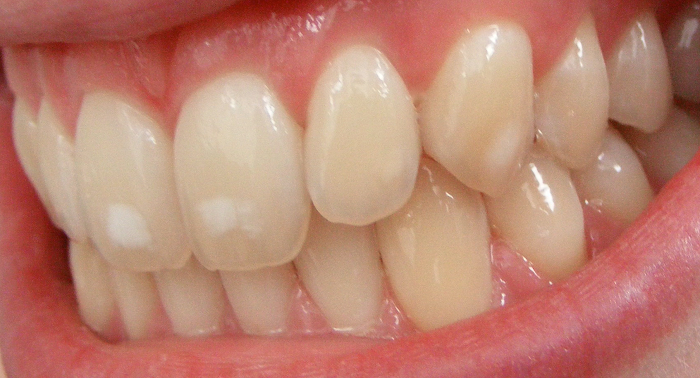
fluoride vs fluoride free, mild fluorosis
Fluorosis is the cosmetic result of overexposure to fluoride. In mild cases, it will appear as small white specs on the teeth, while in severe cases the stains will be large and brown. Fluorosis happens to children up to the age of 8, when permanent teeth form. 
 
According to experts, "Fluorosis affects nearly one in every four Americans ages 6 to 49". But only 2% of these cases will go noticed since the majority of them are too mild to be seen by the naked eye. Moreover, these numbers have been in decline since the 1980s. 
 
As it is rather hard to fully remove, it is better to prevent it altogether. If you're concerned about high amounts of fluoride in your tap water you can contact local authorities to find out the exact amounts, or simply drink filtered or bottled water, making sure that your nutrition gives your sufficient minerals.

Foods that contain fluoride 
Foods that contain fluoride will help the mineralization process. These are: 
 
Grapes - Any form of grape, including raisins and wine, contains fluoride. The highest amounts are in raisins and white wine. 
 
Vegetables: spinach and potatoes 
 
Black tea 
 
But your teeth require more than just fluoride to thrive. They also benefit from calcium and phosphorus . 
 
You'll find your calcium in dairy and green leafy vegetables, and your phosphorus in meats, poultry, fish, nuts, beans, and dairy products. 
 
The reasoning behind fluoride-free toothpaste
The main reason to use fluoride-free toothpaste would be if you already receive more than enough fluoride from your diet. Otherwise, there isn't much reason in avoiding it. 
 
In a conversation with The Scope, a health podcast from the University of Utah Health, Dr. David Okano has even stated that toothpaste isn't such a necessity. "You really do not need toothpaste to remove dental plaque from your teeth. Purely the mechanical action of the toothbrush bristles and your dental floss disrupts the dental plaque that ultimately leads to tooth decay and gum disease." That is not to say that toothpaste does not have its benefits. Dr. Okana mentioned whitening ingredients and fresh breath, along with fluoride. "fluoride will help reduce the demineralization process", he says, "which is the first stage to tooth decay". 
 
Regarding fluoride-free toothpaste, however, Dr. Okano clearly says that the only benefits they can offer are a temporarily fresh breath, but in no way will they prevent tooth decay as fluoride does. 
 

This is only for your information, kindly take the advice of your doctor for medicines, exercises and so on.   

https://gscrochetdesigns.blogspot.com. one can see my crochet creations  
https://gseasyrecipes.blogspot.com. feel free to view for easy, simple and healthy recipes    
https://kneereplacement-stickclub.blogspot.com. for info on knee replacement


Labels: , , , , , , , ,

Friday, February 28, 2020

Brain Scans Reveal a New Schizophrenia Type That Almost Looks Like a 'Healthy' Brain

Not all people with schizophrenia show the same abnormal brain structure, a new study has found.

Scanning the brains of over 300 schizophrenia patients, researchers now think they've identified two neuroanatomical subtypes of this mysterious neurological disorder; one of them has never been detected before, according to the team.


Today, the neurobiology of schizophrenia is poorly understood, but historically, it's been linked to a reduction in grey matter volume, the type of brain tissue that contains the main body of neurons.

This is a typical pattern of the disease that keeps popping up in research, but while the majority of patients in this new study also showed these deficits, a large chunk had surprisingly healthy grey matter levels.

"Numerous other studies have shown that people with schizophrenia have significantly smaller volumes of brain tissue than healthy controls," explains radiologist Christos Davatzikos from the University of Pennsylvania.

"However, for at least a third of patients we looked at, this was not the case at all - their brains were almost completely normal."

The only thing that stood out was an increase in basal ganglia volume, the part of the brain primarily responsible for motor control. Although schizophrenia is a disorder of the mind that interferes with the consistent processing of reality, it can also lead to physical problems like slow movements and tics.

But these brain patterns are not exactly in line with the current consensus on schizophrenia. In fact, the idea of 'neuroanatomical heterogeneity' - where some people may show brain deficits while others don't - has only recently been considered.


"These results challenge the conventional notion that brain volume loss is a general feature of schizophrenia," the authors conclude.

Using machine learning, the team analysed the brain scans of 307 schizophrenia patients and 364 healthy controls, categorising them into neuroanatomical subtypes.

In total, nearly 40 percent of the participants with schizophrenia did not show the typical pattern of reduced grey matter. In some cases, they actually showed more brain volume in the middle of the brain, in a part called the striatum.

No clear explanation could be found for the results - not medication, age, or any other demographic factors.

"This is where we are puzzled right now," Davatzikos says.

"We don't know. What we do know is that studies that are putting all schizophrenia patients in one group, when seeking associations with response to treatment or clinical measures, might not be using the best approach."

Patients that fell into either brain subtype had experienced similar levels of symptoms and were medicated at roughly the same dose. Previous research has linked reduced cortical volumes to antipsychotic drugs, but the researchers did not detect such differences between the two subtypes.

The team notes that brain differences between the subtypes could still be influenced by the consequences of taking medication, for example, higher treatment resistance in subtype 1 compared to subtype 2, whose cortical volumes did not appear to be reduced. But other aspects - such as no difference in symptom severity - don't seem to support this explanation.


Other recent studies have also hinted at a more diverse presentation of schizophrenia in the brain; given how variable symptoms of schizophrenia can be, and how few people respond to treatment, this idea that one size does not fit all is not without merit.

But connecting these symptoms to patterns in the brain has proved extremely difficult, especially since animal models aren't useful in a disorder that is largely diagnosed through self-reporting.
"The main message is that the biological underpinnings of schizophrenia - and actually many other neuropsychiatric disorders - are quite heterogeneous," Davatzikos told ScienceAlert.

The latest classification of schizophrenia in the DSM-V categorises the condition as a spectrum based on symptoms alone, having moved away from behavioural subtypes such as paranoid and catatonic.

But Davatzikos thinks that observations of neural diversity in such disorders could ultimately take diagnostic categories much further.

"In the future, we're not going to be saying, 'This patient has schizophrenia,' We're going to be saying, 'This patient has this subtype' or 'this abnormal pattern,' rather than having a wide umbrella under which everyone is categorised."

We'll have to wait for even more research in the neuroanatomy of various disorders to see whether such a categorisation goal is attainable.

The study was published in Brain.


This is only for your information, kindly take the advice of your doctor for medicines, exercises and so on.     

https://gscrochetdesigns.blogspot.com. one can see my crochet creations  
https://gseasyrecipes.blogspot.com. feel free to view for easy, simple and healthy recipes    
https://kneereplacement-stickclub.blogspot.com. for info on knee replacement
 

Labels: , , , , , , , , , , ,

Sunday, January 12, 2020

iRhom2 protein involved in obesity detection

The researchers have found in a study that the loss of iRhom2 protein in mice contributes to a reduction in fat in the body and increases energy intake of fatty deposits known as adipose.

Obesity is lately increasing in the global range, a disease that has been seen to be a serious public health issue. Nearly half of the population in Portugal is overweight and nearly 1 million adults have obesity. Known as a cardiovascular and diabetes risk factor, obesity is associated with chronic fat tissue inflammation.


The principal investigator says, during the research, we found that iRhom2 protein is strongly present in metabolic tissues and organs, which made us decide to study the role  of iRhom2 in obesity in more detail.


The study demonstrates how the researchers reached the results. They used an animal model, comparing groups with iRhom2 deletion to controls, and feeding them with a normal diet versus a high-fat diet.


Surprisingly, they found that during obesity, iRhom2 protein levels increasae specifically in brown adipose tissue in obese animals compared to controls. Following up on this, they found that on a high-fat diet, the animals lacking iRhom2 protein were metabolically more healthy than their wild type counterparts.


The main author of the paper explained, that the deletion of iRhom2 led to enhanced energy consumption in adipose tissue, which protected animals from fat accumulation and inflammation, fatty liver and insulin resistance when the animals were placed on a diet that predisposed them to obesity.


Furthermore, the researchers found that at the cellular level deletion of iRhom2 leads to an increase in thermogenesis ( heat production) in brown adipose tissue. Thermogenesis in brown adipose tissue is an important physiological mechanism to consume excess  body energy.


Interestingly no deleterious side effects were found in the animals with iRhom2 deletion, indicating that blocking iRhom2 may potentially be beneficial in the treatment of obesity and associated complications. 


However, researchers intend to further explore the mechanisms and types of cells involved in obesity control iRhom2 and to identify the specific targets involved in the protection against obesity-associated with loss of iRhom2. 


this is only for your information, kindly take the advice of your doctor for medicines, exercises and so on.     
https://gscrochetdesigns.blogspot.com. one can see my crochet creations  
https://gseasyrecipes.blogspot.com. feel free to view for easy, simple and healthy recipes    
https://kneereplacement-stickclub.blogspot.com. for info on knee replacement
 

Labels: , , , , , , , , ,