Wednesday, February 05, 2020

Engineering Students Create Waterproof and Lightweight Arm Cast to Replace Plaster Casts


If you've ever had to wear a plaster cast, you'll know what a pain it is. They're heavy, you have to put a plastic bag over them when you shower, and when they're eventually taken off the smell is something else.

But if a Chicago-based startup has its way, the pain of plaster would be a thing of the past. Cast21 is looking to change the way we mend broken bones and it's about time.

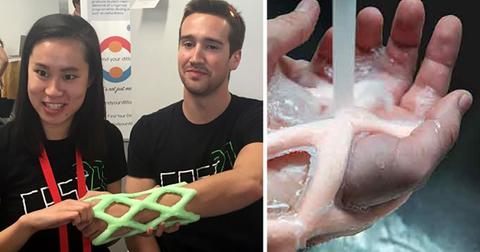
Cast21's wide mesh sleeve can be slipped onto the patient's wrist and is then filled with a liquid resin that quickly hardens and sets the bone in place.

Jason Troutner, biomedical design engineer Ashley Moy, and electrical engineer Justin Brooks from the University of Illinois came up with the idea after partnering up for an engineering design class according to ZME Science.

They want to replace the plaster cast, which can make a patient's skin feel itchy. Itching underneath the unhygienic plaster cast can cause sores and even lead to infection.

This wouldn't be an issue with Cast21 as it's far more breathable and hygienic.

Veronica Hogg, Cast21's vice president of engineering, told the Daily Mail: "We have this radical notion that you can enjoy your healing experience. You don't need to be restrained from daily activities."

According to the Daily Mail, fitting a cast could take as little as ten minutes.

First, a doctor or nurse would measure the limb. Once they've selected the right sized cast, they put it on the limb and fill it with a mix of resins. After the sleeve is full, it only takes about three minutes for the cast to become malleable.

Doctors can then mold the cast to fit the patient's limb, and then wait another five minutes for the resin to harden fully.

It's also far easier to remove than traditional casts, which requires doctors to use a circular saw.

Hogg added: "The majority of fractures happen in children, adolescents and the elderly."

"Those saws are very loud and all this debris flies off and it's very messy, it can be extremely frightening. The cast saw also presents a risk of burns to the patient."

"Our product does not require that at all. It's designed so that a physician can take clinical shears, snip through the tabs and pull it open easily."

"It was designed to completely eliminate the use of a cast saw and make the healing process far more pleasant for the patient."

Hogg explained that the device isn't painful to apply, and the resin hardening can even provide benefits.

 "It feels soothing," Hogg added. "It reaches about the same temperature as a hot tub."

"Another bonus is that no electricity or water is needed to apply our cast, so it's very portable."

"It has potential for use in the military and for at-home first aid."

"I'm from Colorado and I like to go hiking, the equipment needed to administer our cast is so small and lightweight that hikers and climbers could carry it with them in their backpacks."

The cast is still a ways off, with the company only designing a forearm model in a medium size. They hope to be able to create casts for legs as well.

Hogg added: "The idea is to prove that this technology works right now, we are past the prototype stage and have a fully functioning model in place for the forearm."

"We hope this technology can span across the entire body. We are looking forward to having a lower limb model for ankle fractures soon."

"With the technology, we can also do a longer arm model or a model that goes up to the fingers as well."

While there's currently no price, they hope to be able to make it as available to as many people as possible.

"We don't want this to be a luxury product," Hogg explained. "We are still conducting research in price sensitivity, and the final cost to the patients will be depending on their insurance and doctor."

cast21_600px-1574775012659.jpg                     

This is only for your information, kindly take the advice of your doctor for medicines, exercises and so on.     
https://gscrochetdesigns.blogspot.com. one can see my crochet creations  
https://gseasyrecipes.blogspot.com. feel free to view for easy, simple and healthy recipes    
https://kneereplacement-stickclub.blogspot.com. for info on knee replacement
 

Labels: , , , , , , , ,

Tuesday, December 24, 2019

14 Important Items to Have During an Emergency

If you're heading out with children, you need to keep some essential items in hand to ensure a pleasant outing. Below are essential items for your family emergency kid recommended by the American Red Cross and FEMA which will help protect yourself and your family during an emergency.

1. A prearranged meeting place

While technically not included in the kit, communication is the first thing to take into consideration when preparing for an emergency. During a natural disaster or a terrorist attack, cell phone signals and landlines can be jammed or out of order. In which case, it is ideal to have a prearranged spot where everyone in the family knows to meet. It may be somewhere close to the children's school or at a centrally located family member's house. Just in case be sure to keep a contact sheet of important numbers.

2. A favorite toy or stuffed animal
It's not only about the clinical items that you will need to keep your family alive. You will also need to think about comfort and security. In the event of an emergency, grab a nearby toy to throw in your kit. This will hopefully keep kids distracted. 


3. Nonperishable food
FEMA advises that you plan a three-day supply of food for the whole family. Opt for staples like canned meats, canned fruit and vegetables, hot and cold cereal, powdered milk and high energy foods like peanut butter, dried fruits, and granola bars. Don't forget the can opener!

4. Fun food
Kids don't always eat what we give them. While canned green beans are convenient for storage and serving, a four-year-old might refuse to eat them - even in an emergency. So, having a few treats on hand could make all the difference with a hungry child. Opt for fruit snacks, cheese or peanut-butter sandwich crackers, ready-made gelatin pudding and things of the sort. 


5. Water
Water is at the top of the list for an emergency kit. Store about one gallon per person, per day (for drinking and hygiene) and storing enough for two weeks at home. Bear in mind that young children and older adults are especially vulnerable to dehydration, so it's better to overstock water than be under-supplied. Don't forget that just like canned food, you cannot keep bottled water around for too long before the quality is compromised. Be sure to have fresh water replaced every six months.

6. Vitamins and medications

In an emergency, access to medications may be limited. So pack a one-month supply of chewable vitamins and the prescriptions your family relies on. 


7. Disposable plates, utensils and paper towels

A disaster may result in tainted tap water. So stock your kit with disposable plates and utensils. It will feel more like camping and less like chaos.

8. Fleece blankets  or zip-up pajamas

Stock up a blanket per person. Remember that small children have a tougher time regulating their body temperature than adults do so make sure you prepare adequate blankets or sleeping bags to keep them comfortable. You'd also need hats and gloves for each child, which will help against cold weather. 


9. Hand crank flashlights

Natural disasters would likely mean a loss of power, possibly for weeks. But if you have manually powered flashlights, lighting up your home after sundown won't be an issue.

10. Hand-crank radio


You'll be thankful that you don't have to rely on batteries to power a radio that delivers important information, like whether it is safe to go outside. 


11. Whistle to signal for help

A good, old-fashioned whistle will make kids feel empowered. Just be sure to have a talk with young children about when to use the whistle and where to find it.

12. Matches in a waterproof container

Your emergency kit should most definitely include all-weather matches which can be used to light a cooking device, sterilize first aid implements and light candles. 


13. First aid with medications

A good first-aid kit is paramount in an emergency situation. It should include items to treat and clean minor wounds, stop serious bleeding and secure broken bones and sprains, as well as a comprehensive first aid manual.

14. Waterproof document storage

In the event of a flood or a fire, you want to make sure that your important documents are safe. So invest in a water and fireproof file storage system to ensure your insurance papers, birth certificates and so on can escape the damage. 


this is only for your information, kindly take the advice of your doctor for medicines, exercises and so on.     
https://gscrochetdesigns.blogspot.com. one can see my crochet creations  
https://gseasyrecipes.blogspot.com. feel free to view for easy, simple and healthy recipes    
https://kneereplacement-stickclub.blogspot.com. for info on knee replacement


Labels: , , , , , , , , , , , , , , , , ,