Thursday, October 13, 2022

Researchers develop new 3D technique: Innovation to treat Diabetic Foot Ulcer

Diabetes, a lifelong condition that causes a person's blood sugar level to become too high, is among the top ten causes of deaths worldwide. Diabetic foot ulcer (DFU), is a serious complication of diabetes, affecting approximately 25% of diabetic patients. When identified, over 50 per cent are already infected and over 70 per cent of cases result in lower limb amputation. Queen's University Belfast has come out with a new bandage treatment, known as a scaffold, to treat diabetic foot ulcers & also cost-effective while improving patient outcomes.

The 3D printing method was first demonstrated in the 1980s, and since then, the field of 3D printing (3DP) and bioprinting has grown rapidly in recent years due to technological developments and a greater understanding of the capabilities using these technologies, particularly in the development of scaffolds for tissue engineering applications. In the fabrication of 3D (bio) printed scaffolds, the user is firstly required to design a scaffold using computer-aided design (CAD).

Specialist software can then be used to slice the design prior to printing, providing a set of printing instructions for the printer; each 3DP manufacturer provides the software. A wide range of advantages is offered by 3DP, including the capability to rapidly produce elaborate (scaffold) designs of various sizes at low cost. Moreover, 3D-bioprinted scaffolds have shown the ability to achieve high cell loading and maintain high levels of cell viability while also providing structural support to the wound. 

The treatment strategy required for the effective healing of diabetic foot ulcer (DFU) is a complex process that is requiring several combined therapeutic approaches. As a result, there is a significant clinical and economic burden associated in treating DFU. Furthermore, these treatments are often unsuccessful, commonly resulting in lower-limb amputation. 

Graphical abstract
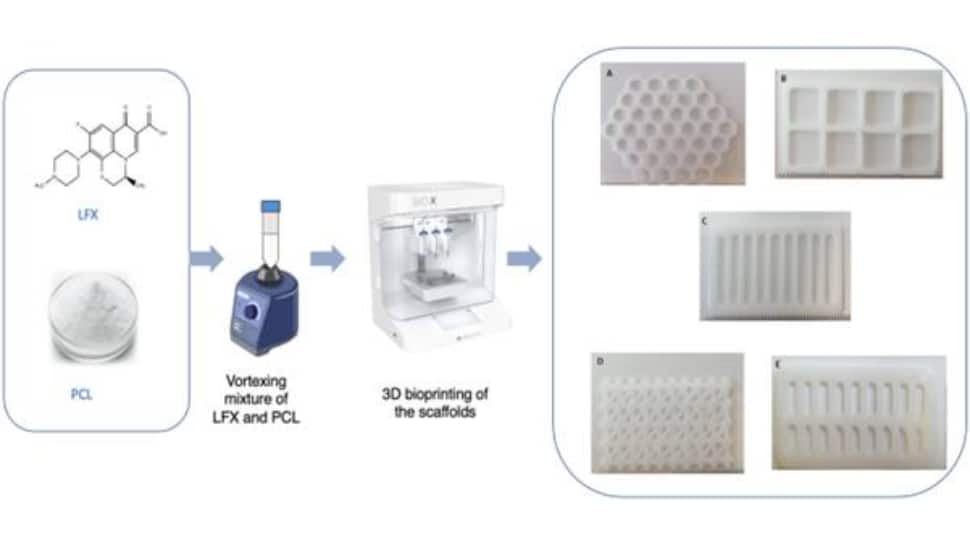
file photo

This new research demonstrates outcomes with significant implications for patient quality of life, as well as decreasing the costs and clinical burden in treating DFU. Recent research has focused on drug-loaded scaffolds to treat DFU. The scaffold structure is a novel carrier for cell and drug delivery that enhances wound healing.

Springler Link Research 

The research, published in Springer Link, was presented by Professor Lamprou at the Controlled Release Society (CRS) Workshop Italy.

Professor Dimitrios Lamprou, a Professor of Biofabrication and Advanced Manufacturing at Queen's School of Pharmacy and corresponding author, explains: "These scaffolds are like windows that enable doctors to monitor the healing constantly. This avoids needing to remove them constantly, which can provoke infection and delay the healing process.
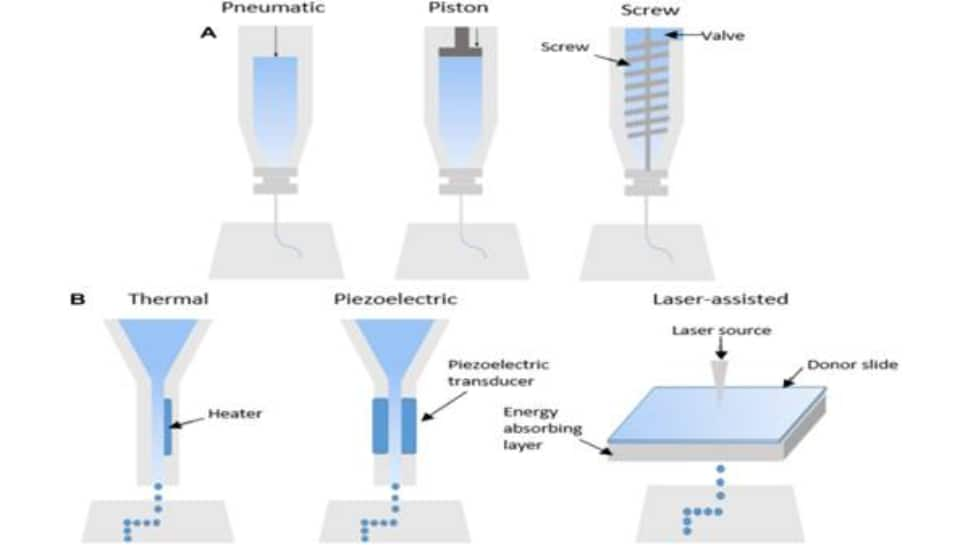
file photo

Schematics showing (a) extrusion-based, (b) inkjet-based, and (c) laser-assisted bioprinting technologies

"The 'frame' has an antibiotic that helps to 'kill' the bacteria infection, and the 'glass' that can be prepared by collagen/sodium alginate can contain a growth factor to encourage cell growth. The scaffold has two molecular layers that both play an important role in healing the wound."

What experts say

According to expert Ashok Jhingan , Sr Phycisian & Sr director BLK Max, "the annual incidence of diabetic foot ulcer worldwide is between 9.1 to 26.1 million. Around 15 to 25% of patients with diabetes mellitus will develop a diabetic foot ulcer during their lifetime.

The majority of patients with diabetes who develop foot ulcers are male (more than two-thirds). Furthermore, most of them are between 40 and 70 years of age. Older patients face significantly more complications than younger ones.

Diabetic peripheral neuropathy is a precipitating factor in almost 90% of diabetic foot ulcers. Chronically high glucose (blood sugar) levels damage nerves, including the sensory, motor and autonomic nerves. Diabetic neuropathy also damages the immune system and impairs the body's ability to fight infection.

Infection is a frequent (40%-80%) and costly complication of these ulcers and represents a major cause of morbidity and mortality. It is estimated to be the most common cause of diabetes-related admission to hospital and remains one of the major pathways to lower-limb amputation.

Dr. Jhingan also states that the most common risk factors for ulcer formation include diabetic neuropathy, structural foot deformity and peripheral arterial occlusive disease.New bandage therapy, called scaffold, has been created to treat diabetic foot ulcers (DFT) that is less expensive while also providing better patient outcomes by researchers at Queen's University Belfast.

The scaffolds, which are created by 3D bioprinting, gradually release antibiotics over a period of four weeks to cure the wound. The Journal of Drug Delivery and Translational Research published the study.Diabetes is counted among the top 10 causes of death worldwide. It is a lifelong condition that raises a person's blood sugar levels.

A devastating consequence of diabetes, diabetic foot ulcers (DFU) affect about 25 per cent of diabetic patients. More than 50 per cent of cases when discovered are already infected, and more than 70 per cent of them require lower limb amputation.In order to effectively treat DFU, a complex treatment plan comprising several combined therapeutic approaches is required. As a result, treating DFU entails a severe clinical and financial burden. Amputation of the lower limbs is frequently required since these treatments are often unsuccessful.

This new study shows results that have significantly affected patients' quality of life and reduced the expense and clinical burden of treating DFU. Drug-loaded scaffolds have been the subject of recent research to cure DFU. The scaffold structure is a novel carrier for cells and medications that improves wound healing.

Advantages And Disadvantages Of Commonly Used Bioprinting Technologies

Bioprinting technology

Advantages Disadvantages
Inkjet-based bioprinting
  • Low cost
  • High cell loading and viability
  • High resolutions (upto 100 micrometre)
  • Suitable for scale-up activities
  • Allows direct printing of cells and other biologics
  • Suitable for in situ bioprinting applications
  • Additional processing steps may be required (eg chemical crosslinking)
  • Polymer degradation has been associated with continuous inkjet bioprinting
Extrusion-based bioprinting 
  • Low cost 
  • Higher cell seeding than inkjet-based technologies
  • High cell viabilities
  • Moderate (300-600 micrometre) to high (200 mucrometre)
  • Suitable for production of large scale scaffolds
  • Allows direct printing of cells and other biologics
  • Generally requires low printing temperature and pressures
  • Capable of printing high viscocity materials
  • High temperatures may be required for high viscocity materials, ruiling out the loading of biologics
  • Additional processing steps may be required (eg chemical crosslinking)
Laser-assisted bioprinting
  • High-speed printing
  • High resolution (10 micrometre)
  • High cell loading
  • No nozzle required which avoids clogging issues
  • Suitable for in situ bioprinting purposes
  • Time-consuming preparation of the ribbon for printing
  • More expensive than inkjet and extrusion-based technologies
  • Laser source is a potential disruption to cell viability


How to prevent foot ulcers?

Dr. Ashok Jhingan states - wearing clean, dry socks that don't have tight elastic bands, which may restrict blood flow to the foot. Doctors advise people with diabetes to avoid walking barefoot and wearing sandals, which expose your feet to splinters, concrete, or sand, which may scrape or irritate the foot.
Keeping your diabetic wounds clean and free from infection is order number one. Some simple diabetic wound healing products include regular antibiotic ointments like Polysporin or Neosporin.

This is only for your information, kindly take the advice of your doctor for medicines, exercises and so on.   

https://gscrochetdesigns.blogspot.com. one can see my crochet creations  
https://gseasyrecipes.blogspot.com. feel free to view for easy, simple and healthy recipes    
https://kneereplacement-stickclub.blogspot.com. for info on knee replacement

https://GSiyers home remedies.blogspot.com     will be latest addition to my blogs. I'm going to add posts there, do give me your valuable feed back on my blogs. Thanks a lot, take care, be healthy and be happy.


Labels: , , , , ,

Saturday, September 25, 2021

How Does EMDR Treat Trauma? Psychologists Explain

Eye Movement Desensitization and Reprocessing (EMDR) therapy was developed in the 1980s to help people with post-traumatic stress disorder (PTSD). Since then, use of the treatment has grown—and so has the evidence behind it. Nancy J. Smyth, Ph.D., a dean and professor at the University at Buffalo School of Social Work, uses EMDR with patients coping with trauma; here, she explains how it works.  

What is EMDR, and why does it help with PTSD?

Smyth: Trauma can overwhelm our minds’ natural information processing system, leaving the memory stuck as though the experience is still happening. When people have PTSD, rather than remembering the trauma, recognizing that it was disturbing, and knowing that it’s over, they can feel as if they’re reliving it. EMDR is a type of psychotherapy in which a therapist uses bilateral dual attention stimulation (such as side-to-side eye movements) to help change the way memories are stored.

What happens during EMDR treatment?


Smyth: First, you’ll talk to your therapist about the reason you’re seeking out therapy and about events in your past that have been distressing for you. Next, you’ll do preparation, during which your therapist will see if you have the skills and tools you’ll need to cope with difficult emotions. If you don’t, they will help you learn them (possibly using other types of therapy). Then the therapist will ask questions to make sure you’re both on the same page about the target of treatment.

During treatment, the therapist will prompt you to start by focusing on a traumatic memory as you follow their fingers or an object as it moves from side to side. (Sometimes sounds on the sides of the body—the “bilateral” part of the stimulation—are used instead.) Throughout this, your therapist will ask you to notice thoughts, feelings, or sensations you’re experiencing. They won’t do a lot of talking, but will ask questions like “What comes up now?” The idea is that the bilateral stimulation activates the body’s natural adaptive information processing system in a safe environment, letting you stay in the present moment as you’re simultaneously remembering a distressing experience so your mind can reprocess that memory as a neutral one.

Is there evidence that it works?

Smyth: Yes, research indicates that compared with other types of therapy, like trauma-focused cognitive behavioral therapy or prolonged exposure, EMDR is just as effective for addressing PTSD or perhaps more so.

How quickly does it work?

Smyth: It varies. If you have healthy coping skills for managing stressors, the prep phase of treatment may be shorter.
If you’re seeking treatment for an isolated traumatic experience, the history-taking and stimulation parts of treatment may be shorter than if you’ve experienced a lot of trauma. Typically, the process takes at least three to 12 sessions.

How can I find a provider?

Smyth: You’ll want a licensed mental health professional who is trained in EMDR. The EMDR International Association is the major professional organization that certifies therapists; you can search the group’s directory at emdria.org.

Is this the same therapy Mel B used?

Yes, in 2018, the Spice Girls singer (whose full name is Melanie Brown) told British tabloid The Sun that she was checking herself into rehab for alcohol and sex issues and undergoing treatment for post-traumatic stress disorder. Brown revealed that working on her book, Brutally Honest, surfaced "massive issues" that she suppressed following her divorce from film producer Stephan Belafonte, whom she has claimed physically and emotionally abused her for years. The singer told The Sun she was diagnosed with PTSD and had begun EMDR. "After trying many different therapies, I started a course of therapy called EMDR, which in a nutshell works on the memory to deal with some of the very painful and traumatic situations I have been through," said Brown. "I don’t want to jinx it, but so far it’s really helping me," she said. "If I can shine a light on the issue of pain, PTSD and the things men and women do to mask it, I will."

As an addiction and relationship therapist, Paul Hokemeyer, Ph.D., a psychotherapist based in New York City and Telluride, Colorado, says he recommends EMDR frequently. “Its success, however, depends of the integrity of the therapeutic relationship the patient has with the clinician providing the actual EMDR treatment and me, the primary therapist making the referral,” he says. “This heightened level of care is essential because EMDR requires the patient to reprocess their original trauma.” If you have symptoms of PTSD and are not yet seeking treatment, the U.S. Department of Veterans Affairs provides a PTSD Treatment Decision Aid to help you learn more about the various treatment options. You can use this as a jump-off point to start the conversation with your mental health provider. 


This is only for your information, kindly take the advice of your doctor for medicines, exercises and so on.   

https://gscrochetdesigns.blogspot.com. one can see my crochet creations  
https://gseasyrecipes.blogspot.com. feel free to view for easy, simple and healthy recipes    
https://kneereplacement-stickclub.blogspot.com. for info on knee replacement


Labels: , , ,