Wednesday, December 29, 2021

7 Dementia-Friendly Activities All the Family Will Enjoy

Connecting with a family member with dementia is extremely important for their own sake, but can also be challenging, especially when memory loss is accompanied by speech difficulties and changes in mood or personality. If you have a family member or close friend suffering from dementia and you’re struggling to stay connected with them, know that you’re not alone. There are over 55 million dementia sufferers in the world, and the majority of those people have family and friends.

Remember that there are many ways you can spend quality time with a loved one with dementia, even if you can’t engage in activities you once enjoyed together today. In this post, we list a few excellent dementia-friendly family activities and provide tips that will help you decide what would work best for your family. How to Choose the Best Activities

When it comes to choosing the best types of activities for your friend or family member, there’s no universal answer or prepared list. We’re all individuals with our own character, preferences, hobbies, and lifestyle, and the kinds of activities that bring joy and meaning to your family member should fit their personality. Here are a few tips to consider when choosing a family activity with someone suffering from dementia: 
 
*Take your family member’s unique skills into account. Did your spouse travel a lot or worked in a field that required specific skills before their diagnosis? Do they have hobbies, sports, or social interests they cherish? The answers to these questions can give you a clue as to what kinds of activities they would probably enjoy most. Don’t be in a rush. Give the person time and space to complete the activity on hand at their own pace. If necessary, break down each activity into actionable and simple steps, and remind each step as they progress. 
 
*Be ready to change course. Your family member’s abilities may change from time to time. One day they may enjoy or be successful at a specific activity, but they can find it difficult or stressful to do so the next day. If that happens, switch gears and focus on a different activity. 
 
*Focus on activities that are realistic but not boring. A key to real connection and fun is balance. Both boredom and frustration can kill your family member’s interest in an activity. Ideally, they should find meaning and value in the activity while also being capable to complete the tasks it requires. 
 
*Tap into activities that activate motor memory. Actions and movements tend to stick around in the human brain for a really long time. Training and maintaining such actions, even if it’s small things like household chores, walking, or gardening, is often very beneficial for dementia sufferers, as it helps them feel capable, useful, and more connected to others. 
 
* Adapt to your family member’s daily schedule. If you can only meet with your loved one in the afternoon but you know that they’re most active during the morning hours, don’t drag them on a walk. Choose a different, more relaxing activity like puzzle-solving instead. 
 
Now, let’s move on to the recommended family activities you can enjoy with a loved one with dementia. We list 7 of such activities in this article and explain why they’re beneficial, but you can find many other suggestions here on the Alzheimer’s Association Website. 
 
1. Open the trusty family photo archiveFamily Friendly Dementia Activities photo album

It doesn’t matter if it’s a physical photo album or a digital one, taking the time to sit down and look through cherished family memories captured on film can be a meaningful experience for the entire family. Old memories have the tendency to be retained for a longer time, so even a family member with advanced dementia can sometimes tap into these long-term memories through visual stimuli like photos or videos. Remembering the fun and memorable occasions together can help strengthen your family bonds. 
 
2. Listen to music

Family Friendly Dementia Activities women listening to music
On a similar note, listening to music together or watching live performances of your loved one’s favorite musician can tap into old memories. Nostalgia is a powerful force. If there is a special song or artist you always listen to or dance to together, turn it on whenever your loved one needs to lift their mood. You can even compile a playlist of your loved one’s favorite songs and play them regularly. 
 
In fact, there’s even research suggesting that music can help dementia sufferers evade depression and slow down cognitive decline. Dancing to upbeat nostalgic tunes is also extremely helpful, as many dementia sufferers tend to retain a sense of rhythm longer than many other abilities.
 
3. Plan a movie night
Do you have a family tradition of watching the same movie with your sibling at Christmastime? Or maybe, one of the first dates you went with your spouse included a trip to the cinema… Just like dancing, photos, and music, familiar films can rekindle seemingly lost memories. Rewatching cinema classics with the entire family is a terrific tradition and relaxing activity everyone will enjoy.

4. Do housework or cook together

Family Friendly Dementia Activities women doing housework
Housework may not sound particularly exciting to you, but your family member with dementia may find comfort and confidence in such regular activities. These regular activities will keep your family member moving and provide tactile experiences that feel familiar. Instead of feeling depressed, this can make your loved one feel useful. 
 
The best suitable household tasks are simple, repetitive, and such that can be done together, for example: 
-Folding laundry 
- Sweeping 
- Vacuuming 
- Organizing the wardrobe 
- Doing dishes 
- Wiping down countertops 
- Cooking family recipes.  
 
5. Take a walk

Family Friendly Dementia Activities seniors on a walk
The benefits of walks are plenty, and it’s a simple activity you can practice with your loved one year-round. When the weather is sunny, you can go on a nature walk or a walk through the park or the neighborhood, and when it’s overcast, you can walk through the local mall or enjoy a trip to the botanical garden. 
 
Even if your loved one is in a wheelchair, getting some fresh air will be beneficial for them, and it can spark a conversation about the weather and the surroundings. Remember that spending time with your loved one with dementia or Alzheimer’s outdoors is quite important, as they cannot go on walks and trips on their own.

 6. Enjoy a fun board game or card game
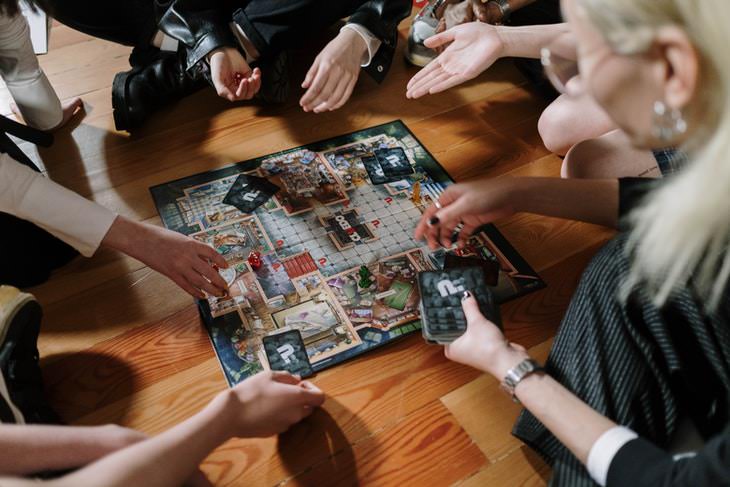
Family Friendly Dementia Activities board game
Brain teasers and intellectual games are the perfect fit for dementia patients. According to professionals, incorporating mental stimulation together with social activities in daily life can help dementia and Alzheimer’s patients retain their cognitive abilities for a longer time. 
 
Whenever choosing a game, it’s best to focus on familiar and simple ones like Scrabble, Chutes and Ladders, Dominoes, Bingo, or classic card games like Go Fish. New games may confuse your loved ones with dementia or make them frustrated or stressed. Similarly, don’t be hard on a family member if they make an odd mistake in the rules or forget someone’s name. It’s best to just let small errors like these slide. 
 
7. Have family fun with puzzles
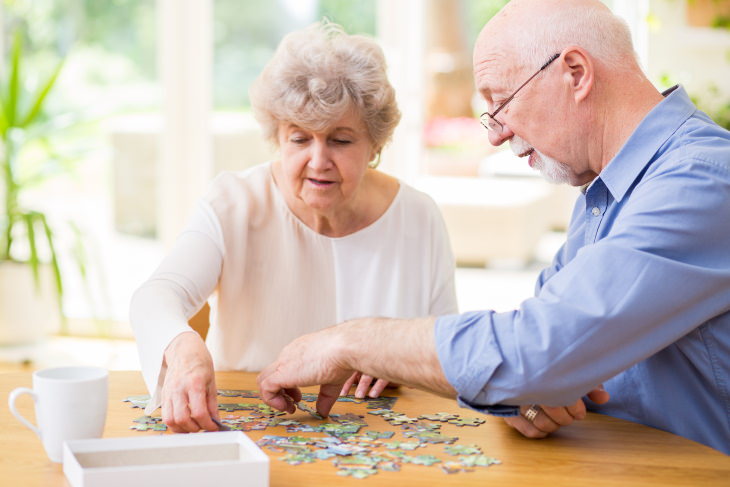
Family Friendly Dementia Activities solving puzzles
If you’ve got more than an hour or two of family time available, working on a puzzle is an activity you should definitely consider. These can be traditional picture puzzles, crosswords, or even 3D puzzle toys - there’s a huge variety of puzzles available these days both in stores and online. Like other games, puzzles are a great mental workout that will preserve your loved one’s cognition for a longer time. Plus they’re fun for both kids and adults, so the entire family will be able to enjoy an evening with puzzles.
 

This is only for your information, kindly take the advice of your doctor for medicines, exercises and so on.   

https://gscrochetdesigns.blogspot.com. one can see my crochet creations  
https://gseasyrecipes.blogspot.com. feel free to view for easy, simple and healthy recipes    
https://kneereplacement-stickclub.blogspot.com. for info on knee replacement


Labels: , , , , , , , , , ,

Monday, January 27, 2020

15 Simple Ways to Improve Brain Performance

The human brain is a 3 kg computer - it is the command and control center that runs our lives and is involved in everything we do, so there is no shadow of a doubt that it is very important to protect and upkeep. Our brain determines the way we think, feel, act, and how well we get along with other people, our brain also determines what kind of person we are - are we considerate or polite, or otherwise rude? Optimizing your brain function is necessary for maximizing your abilities, whether at work, leisure or in relationships with the people closest to you. Therefore, we recommend that you familiarize yourself with the following tips to improve your brain's performance. 

1. Exercise for your brain cells


Many studies have shown that when people engage in physical activity, the level of brain function improves. Scientists at the Salk Institute for Biological Studies in La Jolla, Calif., Found adult mice on the wheel had twice as many new hippocampal cells as mice who did not want to use the wheel. Researchers are unsure why the rodent's brain responded to physical activity in this way, but they hypothesized that exercise reduced stress and caused the rest of the body's functions, including those in the brain, to work more efficiently.


2. Train your mind

Just like exercising, activating different parts of the brain also trains them. Professor Lawrence Katz, a neurobiologist at Duke University, argues that finding simple ways to activate different parts of the brain that are not normally used is beneficial in keeping neurons and dendrites, which are short extensions protruding from nerve cells that are their input devices. Just as a new weight-building exercise builds muscles we rarely use, so a new worldview or recreational activity can improve the function of parts that are less used in the brain. Try new flavors and smells, do things with your weaker hand, take a different route to work, or travel to new places. In short, try to do new things that will take you out of your comfort zone, and your brain will enjoy and grow stronger.


3. Ask 'Why?'

Our minds are very curious, but as we grow older, many of us ignore or deny our natural curiosity. Let yourself be curious and wonder why things happen the way they do and ask someone who knows. The best way to exercise our curiosity is to ask "Why?" At least 10 times a day. Your brain will be more active and you will be amazed at the number of opportunities and solutions that will appear in your life and at work.


4. Laugh

Scientists say laughter is good for health because it releases endorphins and other positive chemicals to our systems. While we don’t really need scientists to tell us that laughter makes us feel good ... laughter is just like the quick claim of energy to our brain. Click here to read about the many benefits of laughter.

5. Eat fish

Omega-3 fatty acids, found in walnuts, flax seeds, and fatty fish, have long been known to be beneficial to heart activity. A recent study found that omega-3 fatty acids are also very healthy for the brain, not only because they improve the functioning of the circulatory system that supplies oxygen to the brain. It turns out that these beneficial compounds can also improve the functioning of the membranes that surround brain cells and thus improve overall functioning.


6. Remember

Take an old photo album or even your high school yearbook and give it a few minutes of in-depth examination. Our brain is a memory machine, so give it a chance to work a bit and spend some time with your memories. Browse the photos and try to remember the names of the people, the experiences you shared with them, and the feelings you felt toward them. After a while, you’ll discover that the process of recalling memories happens much faster even when you look at an old album or at all when you try to recall something you were sure you had already forgotten.


7. Reduce your intake of bad fat

Can "bad" fats adversely affect our brain function? When researchers at the University of Toronto provided rats with a 40% fat diet, their mental functioning decreased, including memory, spatial orientation, and learning ability. The problems worsened with a diet rich in saturated fat, found mainly in dairy products and meat. It is hypothesized that fat may reduce blood flow to the brain, which damages the supply of oxygen and glucose to the nerves. This does not mean that you should stop consuming fats, you just need to know what type of fats to consume, and how much. Monounsaturated fat, which is mainly plant-based, is very healthy for the body and linked to health and longevity, you can get it from fish, olive oil, nuts, avocados, and seeds.


8. Work the brain

Some of us like puzzles, some the daily crossword, and some of us prefer riddles - the kind does not matter. The main thing is to solve difficult and challenging things. Solving problems in your free time is a great way to activate your brain and keep it in excellent condition.

9. Listen to music

A decade ago, Frances Rauscher, a psychologist at the University of Wisconsin in the United States, and her colleagues published an amazing discovery and found that listening to Mozart improved mathematical and spatial thinking of the listeners, and even rats ran better and more accurately through a maze after hearing Mozart. It seems that listening to Mozart stimulates activity in three genes involved in transmitting signals in the brain. And it isn’t just Mozart, music, in general, is good for our health. Listen to the music you love when you can, it's much more important than you thought until now!


10. Improve your skills in the things you already know how to do

Repeating routine actions that your mind is used to doing doesn’t strain your mind. At the same time, there is no reason why you shouldn’t upgrade or change how you do things to create new connections between nerves in your brain and improve your abilities. 


11. Reduce your alcohol intake

Some say that alcohol kills brain cells, but the reality is a bit more complicated. A study of 3,500 Japanese men found that men who drank moderately (in this case, one drink per day) had better cognitive function than those who did not drink at all. Predictably, the worst performance was observed among those who drank more. The results of another study that examined the association between alcohol and brain function revealed that rats receiving a large amount of alcohol had fewer new cells in the hippocampus immediately after drinking and even a month later. This indicated that the alcohol not only damaged the rat's brain but also prevented it from correcting itself at a later stage. Therefore, it is definitely worth reducing your alcohol consumption and consuming it in moderate amounts.


12. Play

Find time to play, and even make time to play. Play cards, video games, board games or any game you love - the main thing is to play. It is good for the general feeling and good for the brain because it is an action that encourages thinking strategically and puts us in the face of problems we wouldn’t normally encounter in our daily lives.

13. Sleep on it
The recommended sleep time for an adult is 7-8 hours. Sleep is vital to our health and even to the proper functioning of the brain. During sleep, neurotransmitters in the brain reduce their activity, and their threshold is reset to normal and regular levels. In addition, during sleep, free radicals that accumulate in the brain during the day are cleaned by special enzymes, and nerve cells regroup.


14. Focus
Concentration can improve brainpower. Learn to focus when distracted, and try to get rid of the disturbance. For example, if you need to make an important phone call, thinking about it can take your mind off the task at hand and make you not think clearly. Try to make the phone call as soon as possible so that you can concentrate again. Stop the flow of life from time to time to ask yourself "what's on my mind?" and identify the factors that interfere with your concentration and deal with them.


15. Learn a new word every day

There is a strong connection between vocabulary and intelligence. When we add new words to our vocabulary, our brain can think in new ways with more nuances between different ideas. This is a particularly powerful way to stimulate and improve our brain activity.


This is only for your information, kindly take the advice of your doctor for medicines, exercises and so on.     
https://gscrochetdesigns.blogspot.com. one can see my crochet creations  
https://gseasyrecipes.blogspot.com. feel free to view for easy, simple and healthy recipes    
https://kneereplacement-stickclub.blogspot.com. for info on knee replacement
 

Labels: , , , , , , , , , , , , , , , , ,

Saturday, November 16, 2019

15 Simple Ways to Improve Brain Performance

The human brain is a 3 kg computer - it is the command and control center that runs our lives and is involved in everything we do, so there is no shadow of a doubt that it is very important to protect and upkeep. Our brain determines the way we think, feel, act, and how well we get along with other people, our brain also determines what kind of person we are - are we considerate or polite, or otherwise rude? Optimizing your brain function is necessary for maximizing your abilities, whether at work, leisure or in relationships with the people closest to you. Therefore, we recommend that you familiarize yourself with the following tips to improve your brain's performance.

1. Exercise for your brain cells

Many studies have shown that when people engage in physical activity, the level of brain function improves. Scientists at the Salk Institute for Biological Studies in La Jolla, Calif., Found adult mice on the wheel had twice as many new hippocampal cells as mice who did not want to use the wheel. Researchers are unsure why the rodent's brain responded to physical activity in this way, but they hypothesized that exercise reduced stress and caused the rest of the body's functions, including those in the brain, to work more efficiently.

2. Train your mind

Just like exercising, activating different parts of the brain also trains them. Professor Lawrence Katz, a neurobiologist at Duke University, argues that finding simple ways to activate different parts of the brain that are not normally used is beneficial in keeping neurons and dendrites, which are short extensions protruding from nerve cells that are their input devices. Just as a new weight-building exercise builds muscles we rarely use, so a new worldview or recreational activity can improve the function of parts that are less used in the brain. Try new flavors and smells, do things with your weaker hand, take a different route to work, or travel to new places. In short, try to do new things that will take you out of your comfort zone, and your brain will enjoy and grow stronger.

3. Ask 'Why?'

Our minds are very curious, but as we grow older, many of us ignore or deny our natural curiosity. Let yourself be curious and wonder why things happen the way they do and ask someone who knows. The best way to exercise our curiosity is to ask "Why?" At least 10 times a day. Your brain will be more active and you will be amazed at the number of opportunities and solutions that will appear in your life and at work.

4. Laugh

Scientists say laughter is good for health because it releases endorphins and other positive chemicals to our systems. While we don’t really need scientists to tell us that laughter makes us feel good ... laughter is just like the quick claim of energy to our brain.

5. Eat fish

Omega-3 fatty acids, found in walnuts, flax seeds, and fatty fish, have long been known to be beneficial to heart activity. A recent study found that omega-3 fatty acids are also very healthy for the brain, not only because they improve the functioning of the circulatory system that supplies oxygen to the brain. It turns out that these beneficial compounds can also improve the functioning of the membranes that surround brain cells and thus improve overall functioning.

6. Remember

Take an old photo album or even your high school yearbook and give it a few minutes of in-depth examination. Our brain is a memory machine, so give it a chance to work a bit and spend some time with your memories. Browse the photos and try to remember the names of the people, the experiences you shared with them, and the feelings you felt toward them. After a while, you’ll discover that the process of recalling memories happens much faster even when you look at an old album or at all when you try to recall something you were sure you had already forgotten.

7. Reduce your intake of bad fat

Can "bad" fats adversely affect our brain function? When researchers at the University of Toronto provided rats with a 40% fat diet, their mental functioning decreased, including memory, spatial orientation, and learning ability. The problems worsened with a diet rich in saturated fat, found mainly in dairy products and meat. It is hypothesized that fat may reduce blood flow to the brain, which damages the supply of oxygen and glucose to the nerves. This does not mean that you should stop consuming fats, you just need to know what type of fats to consume, and how much. Monounsaturated fat, which is mainly plant-based, is very healthy for the body and linked to health and longevity, you can get it from fish, olive oil, nuts, avocados, and seeds.

8. Work the brain

Some of us like puzzles, some the daily crossword, and some of us prefer riddles - the kind does not matter. The main thing is to solve difficult and challenging things. Solving problems in your free time is a great way to activate your brain and keep it in excellent condition.

9. Listen to music

A decade ago, Frances Rauscher, a psychologist at the University of Wisconsin in the United States, and her colleagues published an amazing discovery and found that listening to Mozart improved mathematical and spatial thinking of the listeners, and even rats ran better and more accurately through a maze after hearing Mozart. It seems that listening to Mozart stimulates activity in three genes involved in transmitting signals in the brain. And it isn’t just Mozart, music, in general, is good for our health. Listen to the music you love when you can, it's much more important than you thought until now!

10. Improve your skills in the things you already know how to do

Repeating routine actions that your mind is used to doing doesn’t strain your mind. At the same time, there is no reason why you shouldn’t upgrade or change how you do things to create new connections between nerves in your brain and improve your abilities. 

11. Reduce your alcohol intake

Some say that alcohol kills brain cells, but the reality is a bit more complicated. A study of 3,500 Japanese men found that men who drank moderately (in this case, one drink per day) had better cognitive function than those who did not drink at all. Predictably, the worst performance was observed among those who drank more. The results of another study that examined the association between alcohol and brain function revealed that rats receiving a large amount of alcohol had fewer new cells in the hippocampus immediately after drinking and even a month later. This indicated that the alcohol not only damaged the rat's brain but also prevented it from correcting itself at a later stage. Therefore, it is definitely worth reducing your alcohol consumption and consuming it in moderate amounts.

12. Play

Find time to play, and even make time to play. Play cards, video games, board games or any game you love - the main thing is to play. It is good for the general feeling and good for the brain because it is an action that encourages thinking strategically and puts us in the face of problems we wouldn’t normally encounter in our daily lives.

13. Sleep on it

The recommended sleep time for an adult is 7-8 hours. Sleep is vital to our health and even to the proper functioning of the brain. During sleep, neurotransmitters in the brain reduce their activity, and their threshold is reset to normal and regular levels. In addition, during sleep, free radicals that accumulate in the brain during the day are cleaned by special enzymes, and nerve cells regroup.

14. Focus

Concentration can improve brain power. Learn to focus when distracted, and try to get rid of the disturbance. For example, if you need to make an important phone call, thinking about it can take your mind off the task at hand and make you not think clearly. Try to make the phone call as soon as possible so that you can concentrate again. Stop the flow of life from time to time to ask yourself "what's on my mind?" and identify the factors that interfere with your concentration and deal with them.

15. Learn a new word every day

There is a strong connection between vocabulary and intelligence. When we add new words to our vocabulary, our brain can think in new ways with more nuances between different ideas. This is a particularly powerful way to stimulate and improve our brain activity.


Labels: , , , , , , , , , , , , , , , ,