Tuesday, November 16, 2021

Lessons I Learned By Dealing With Negativity

We all experience negative thoughts at times. Unfortunately, our social and environmental conditioning can lead us to treat them as things to be fought against, avoided, or a sign of our weakness. As a result, the negative thoughts are often coupled with anger towards ourselves. These negative thoughts can keep us "stuck in our own heads", and hinder us from moving forward with our lives in a positive manner. With that being said, there's much to learn from these so-called negative thoughts. They can teach us some very important lessons, and it is our fear of negativity itself that keeps us from learning these lessons. Next time your mind wanders into negative thinking, don't try to suppress such thoughts. Instead, use them as a ladder to haul yourself back up. Here are the seven most important lessons you can learn from negative thoughts:

1. If you’re lost, negativity can be your compass 
Being angry at yourself in times of crisis can cause you to become lost in a sea of thoughts, and even forget how you got to this state in the first place, thus preventing you from avoiding it next time. Instead, try using your negative thoughts as a compass - think of why you became angry in the first place to try and find the source of your frustration, and remind yourself where you want to be. You can guide your search with questions such as: 
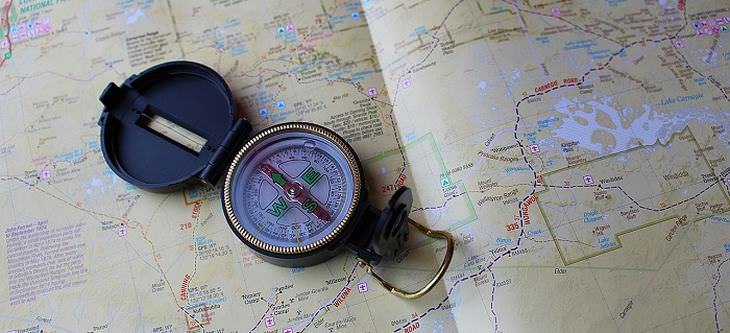
what negativity teaches us
When did I become angry with myself? 
Has this sort of thing happened in the past? 
Were my reactions to this situation different last time? 
If I acted differently, was I more or less frustrated?

Another way of using negative thoughts as a compass is by mapping out your fears or the obstacles in the way of you feeling better. Try asking yourself: 
 
Am I mad at myself because there’s something I could have done differently? 
If so, can I avoid this type of obstacle next time?
Are there other ways to approach this problem? 
What can I do differently next time?

2. Falling into familiar holes doesn’t become less painful 
Imagine walking down the street and suddenly falling into a hole. The first time it happens, you’ll be mad at the city for its negligence. The second time, you’ll be mad because it still hasn't fixed the problem despite the risk. The third time, you’ll be mad at yourself because you didn't remember that there was a hole there. Why did you fall into that hole time after time? Most likely it's because you weren’t looking where you were heading and were too busy blaming others, thus avoiding your own responsibility. 
 
The best way to deal with such “holes” in your life is in stages - by covering the hole if you can, finding a way around the hole while it’s still there, or looking forward to avoid falling into that hole (or others) in the future. Instead of blaming others for your predicament, take responsibility for what you can do differently, and do it.

3. Your best friend is you 
Negativity turns you into your own judge, jury, and executioner. As proof, we still remember certain mistakes we made in the past that others have already forgotten. However, we tend to ignore the most important lesson that each negative thought carries with it - just as we are our own harshest judges, we are also our own best friends. 
 
Instead of running in circles, finding yourself guilty time and time again, try looking at the problem impartially, as if a friend is telling you about their problem and asking you for your opinion. What your advice be? Is it really a problem that cannot be overcome? When you look at an issue from the sideline, you can often find a solution more easily. If you keep practicing this lesson, you’ll find it easier to connect with yourself and stop judging yourself so harshly.

4. No one knows everything  
Many of our negative thoughts originate from the false assumption that they are indisputable facts. We can be sure that there is only one reason for our failings, or that people act a certain way because of one specific reason. These assumptions can be completely wrong, making them into the feet we use to trip ourselves over when dealing with future problems. 
 
If we think that a colleague has no time for us because they don’t like us, we won’t be able to communicate with them positively in the future, even if their reason was that they were busy, or weren’t feeling well when we approached them. Such an incident can lead us to analyze our relationship with others incorrectly, as well as causing us to make the same mistakes time and time again in the future. In quite the same way, being rejected when applying for a job can make us think we’re not talented enough when that position may have been made redundant for a variety of reasons. 
 
Try reminding yourself that in any negative situation, some things that you’re not aware of and are beyond your control may have taken place. Remember that nobody is omniscient, and that’s perfectly fine.

5. If you think you’re drowning in negativity, you’re probably wrong 
Do you think that everything bad that happens to you is the result of personal malice, and that bad things keep happening to you all the time? It may be time to stop for a moment and remind yourself that the worst thing that is happening is what you’re doing to yourself. Every negative thought provides us with two options - to fall into despair, or to learn and grow. Sadly, most of us choose the first option. 
 
In order to help yourself see the situation from a broader perspective, assign every negative thought a couple of new friends - factual proof, and a different interpretation. Factual proof forms the basis of assessing your situation (for example, if a friend is mad at you, what are we basing our understanding of that anger on?), at the same time, even if you’re sure that your interpretation is correct, train yourself to come up with an alternative, logical interpretation of the situation. It might just be the right interpretation after all.

6. Some positive thoughts are disguised as negative ones  
Not all thoughts that begin in a negative tone are necessarily negative themselves. It may surprise you, but if you think about it, you’ll find out that it is indeed the case. You may be imagining the worst possible scenario about something that may happen to someone you hold dear, but this thought is actually a positive thought, originating from a place of love and care for that person. 
 
Try and express as many negative thoughts in a positive way and you may find out that people who originally reacted to these thoughts in a negative way now react to them differently after they understand the source of your fears or anger. what negativity teaches us.

7. To move forward, stop collecting trash  
After you’ve sifted through your negative thoughts and learned as much as you can from them, you can divide them into negative thoughts that can help you, and those that are nothing but “trash”. In other words, don’t let the trashy thoughts take up space in your head – they’ll only slow you down and make you feel unhappy. 
 
 No one likes to live in a house that is filled with trash, and the same goes for you and your mental space. Instead of punishing yourself by preoccupying yourself with these unnecessary thoughts, which exact a heavy toll on your mental state, try disposing of them as soon as you can. If a negative thought pops up, treat it as a memo to clear your mind up and make room for positivity instead.

This is only for your information, kindly take the advice of your doctor for medicines, exercises and so on.   

https://gscrochetdesigns.blogspot.com. one can see my crochet creations  
https://gseasyrecipes.blogspot.com. feel free to view for easy, simple and healthy recipes    
https://kneereplacement-stickclub.blogspot.com. for info on knee replacement

Labels: , , , , , , , ,

Friday, April 17, 2020

Five things coronavirus can teach us about life and death

The COVID-19 pandemic and the wall-to-wall news coverage that has come with it has changed many of our lives seemingly overnight. In the UK, as in many countries, this news coverage includes a daily death toll. For the first time in many people’s lives they are having to face their own mortality and that of their loved ones.

Facing up to this fact can be painful and disabling, but in my work as a professor of death studies I have found it offers an opportunity to rediscover truths about life – both individually and in society.

Below are five positive things death can teach us about life.


1. Your life perspective changes

Shared adversity can foster a sense of community and affinity with others that can be masked in normal times. The challenge is to sustain this after adversity ends. And just as personal encounters with mortality can transform a person’s life, a societal encounter with mortality has the potential to transform the life of society.

Disaster, pandemic and war can destabilise everyday social arrangements and assumptions, and catalyse profound social change. Arguably the Black Death helped end feudalism, the Chernobyl disaster helped hasten the collapse of the Soviet Union, and the experience of community solidarity and state intervention during World War II helped fuel the UK’s desire to set up a welfare state. This pandemic has potential to change society for the better, if we are able to seize this opportunity.


2. It highlights the power of nature

Many like to think they are masters of the physical world, including their own bodies. The deterioration of the body – whether through illness, disability, old age or ultimately death – reveals the limits of this assumption.

On a wider scale, humans are devastating the natural world, causing the extinction of thousands of species at an ever-increasing rate. Now, nature, in the form of a tiny virus that particularly threatens humans, is giving us a taste of our own medicine. The virus – like earthquakes, floods and other natural disasters – is reminding us that humans are also part of the natural world.


3. And the power of connection
New forms of heroism are emerging among frontline health workers, cleaners, delivery drivers, cashiers, refuse collectors and volunteers. From the clapping for carers that neighbourhoods in some countries are doing to the resurgence of neighbourliness and volunteering, the pandemic has created webs of giving and receiving. Distant family members and friends from the past get back in touch. What people do now counts, and can provide a meaning to life sadly absent in many nine-to-five jobs.

Sociologist and thinker Michael Young (Lord Young of Dartington) spent his life documenting and fostering social solidarity in Britain – he helped found the welfare state in the 1940s and then wrote a sociological study of family and kinship in east London. In the 1990s, he wrote in a study of people dying of cancer that death, while sundering relationships, can also bring people together:

Death is the common experience which can make all members of the human race feel their common bonds and their common humanity.
My own research confirms this to be true.

4. This is an opportunity for review
Facing up to mortality prompts us to reevaluate our lives. There are key times in the life course when this is likely to happen. One is the mid-life crisis, another is when entering old age – people look at what they have done so far, and may find themselves content with this, or decide to change, or regret that it seems too late to change.

The pandemic may cause some to review their lives while they still have enough decades left to act on their review. Not only whole societies, but some individuals may decide to live in new ways.


5. Death needs to be talked about

Facing up to mortality also has some simple practical implications. However fit and youthful you are, you should write a will and talk frankly and openly to those closest to you about your thoughts, hopes and fears.
alk about what treatment you would or would not want if you catch COVID-19 and deteriorate. But be aware that with both health services and families stretched, there is no guarantee your wishes will be carried out – though discussing them first certainly helps.

Death’s lesson here, perhaps, is about the limits to our control over our own life.


This is only for your information, kindly take the advice of your doctor for medicines, exercises and so on.     

https://gscrochetdesigns.blogspot.com. one can see my crochet creations  
https://gseasyrecipes.blogspot.com. feel free to view for easy, simple and healthy recipes    
https://kneereplacement-stickclub.blogspot.com. for info on knee replacement

Labels: , , , , , , , , , , , , ,

Monday, April 13, 2020

5 Lessons We Can Learn From the Lockdown

These are unusual times for all of us. I’m deliberately using a neutral word, rather than saying difficult or challenging. Lockdowns, social distancing, and quarantines met each and every one of us at a different point in our lives and brought us different challenges accordingly. There are financial woes, and the need for human contact, each felt in a different volume, shape, and form by different individuals. It is important to remember that even if the days seem to stretch on and on, this situation is not permanent. It's not forever. This too shall pass, and we’ll emerge slightly changed from it, both as a society and as individuals. Some lessons we’ll only be able to fathom in hindsight, and some are already forming before our very eyes. So what conclusions can we draw from the lockdown so far? 

1. A LOT Can Be Done From Home
Until a couple of weeks ago, working from home did not even seem like an option to most people. Until there was no other choice. And then it occurred to us, how almost everything that we did in the office can be done... from our couch. How so many meetings actually could have been emails. Many employers have even initiated Virtual Happy Hours or Virtual Coffee Breaks to maintain a sense of community in the workplace.
Of course, online interaction cannot fill all of the needs face-to-face interaction does. Research has revealed that in creative assignments, for example, work teams perform better face to face. And some jobs are simply impossible to do remotely. So, is it possible and likely that working from home will become the new norm after the pandemic’s end?
Not entirely, but it will certainly become a much more common practice, and many companies will change their policies about it. It can reduce the cost of employers’ real estate and be beneficial for employees who proved that they can do it successfully. Rather than having everybody at the office, or everybody working from home, it will most likely be a hybrid of the two. 


2. Buying Less Is Possible
Lockdown posed a threat to many people’s salaries and work security. But it had one upside - I suddenly realized I just stopped spending money unnecessarily. Obviously, travel costs no longer exist, but there is more to it. As the days turned into weeks, fewer and fewer purchases seemed vital. Lockdown made it easier to tell the difference between the things I want and the things I need.
Cooking at home aids sustainability. Cooking our own meals is healthier, and with so much more time on our hands, we could work out and develop habits of sustainability. I, and many others, I’m sure, have become more aware of what exactly we have at home and how to make the most of it, even getting creative with leftovers. The global financial situation is likely to be shaky for a while, as going back to normal will be a gradual process, so those new spending habits are an asset to preserve. 


3. The Power of Nature
Not only do these changes in buying habits help us cut costs, but they are also environmentally responsible - fewer plastic packages, more seasonal and local food. On the bigger scale - the people of Delhi, the world’s most polluted city, now experience the freshest air in decades. The same is true for other cities like Bangkok, Sao Paulo, and Bogota. Animals noticed the absence of humans, too, and started showing up in spaces that are usually too populated with people.
It's true that all of these wonderful things are happening while we are confined to our homes, and so we can’t necessarily enjoy them. Those lucky enough to have a garden or live in rural areas, and certainly those that don’t have these privileges - we all understand how important nature is, not only as a resource but to our mental health. Hopefully, this understanding will prompt humanity to treat planet Earth with more care. 


4. Be Critical of Our News Consumption
The new situation has made many of us obsessed with the news. But I soon found out that less news intake is a whole lot more. There is a reason many mental health experts have advised limiting our news intake to once or twice a day. Staying up to date is important and can ease anxiety, but getting too caught up in media reports can be a trap.
There is an influx of opinions, assumptions and calculated guesses which can be misrepresented as facts - and while interesting, too much of it may actually increase anxiety. Lockdown has been helpful in developing this awareness - which media channels are trustworthy, right for me, and how much news consumption is healthy for me. 


5. The Appreciation of Freedom
When news about the lockdown in Wuhan started circulating in January, the measures taken by the Chinese government seemed draconian. It seemed impossible that these rules would soon apply to all of us. As cliche as it may sound, this unprecedented state has made us appreciate all of the little things that made up our lives before all this started - which can all be put under the umbrella of freedom.
We were free to get a haircut. We were free to buy coffee made by a stranger. We were free to visit our family and see our friends whenever we pleased. If anything, the lockdown has taught me how valuable and indispensable this personal autonomy is. 


This is only for your information, kindly take the advice of your doctor for medicines, exercises and so on.     

https://gscrochetdesigns.blogspot.com. one can see my crochet creations  
https://gseasyrecipes.blogspot.com. feel free to view for easy, simple and healthy recipes    
https://kneereplacement-stickclub.blogspot.com. for info on knee replacement

Labels: , , , , , , ,