Thursday, November 06, 2025

Huge Study Links 99% of Heart Attacks And Strokes With Four Risk Factors

 Heart attacks and strokes rarely occur without warning.

According to health data from more than 9 million adults in South Korea and the US, nearly everyone who develops heart disease and suffers a major cardiovascular event has one of four major risk factors in the lead-up.

These factors include high blood pressure, high cholesterol, high blood sugar levels, and tobacco smoking (past or current).

Combined as a group, they preceded 99 percent of all cardiovascular events during the long-term study.

Even in women under 60 – the demographic with the lowest risk of cardiovascular events – more than 95 percent of heart attacks or strokes were linked to one of these existing risk factors.

High blood pressure was the factor most commonly tied to cardiovascular events. In both the US and South Korea, more than 93 percent of individuals who experienced a heart attack, stroke, or heart failure had hypertension beforehand.

Managing this risk factor could, therefore, be key to preventing serious cardiovascular disease down the road.
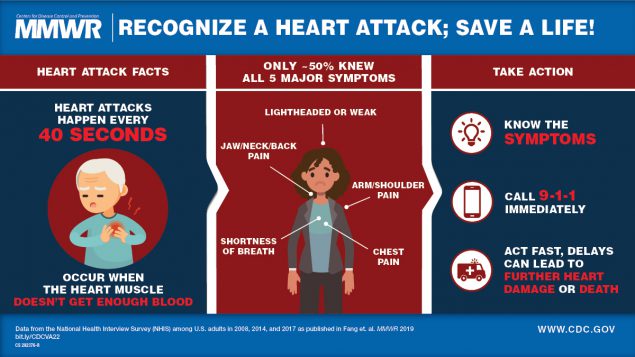
CDC Heart Attack  

 "We think the study shows very convincingly that exposure to one or more nonoptimal risk factors before these cardiovascular outcomes is nearly 100 percent," says cardiologist Philip Greenland from Northwestern University.

"The goal now is to work harder on finding ways to control these modifiable risk factors rather than to get off track in pursuing other factors that are not easily treatable and not causal."

The authors note that their results challenge recent claims that insidious cardiovascular events occurring in the absence of risk factors are increasing, suggesting that previous studies may have missed diagnoses or overlooked risk factor levels that were below the clinical diagnostic threshold.

In an accompanying editorial, Duke University cardiologist Neha Pagidipati (who was not involved in the study) argues that the results show just how important it is to manage health risks before they lead to serious, potentially fatal, outcomes.

"We can – and must – do better," she writes.

The study was published in the Journal of the American College of Cardiology.


This is only for your information, kindly take the advice of your doctor for medicines, exercises and so on.   


Labels: , , , , ,

Tuesday, February 01, 2022

Diabetes: Beware of this sign of high blood sugar in your hands and fingers

Diabetic neuropathy is a form of nerve damage that usually affects the legs and feet; and as per the Mayo Clinic, it is seen in as many as 50 per cent diabetes patients. It is of four types, and although the symptoms are mostly mild, there is one type of diabetic neuropathy that comes with severe symptoms – it is mononeuropathy.

Key Highlights

  • Across its many forms, type-1, type-2, and gestational – diabetes can be detrimental if blood sugar levels are not brought under control timely.
  • Amidst a plethora of symptoms, mononeuropathy can cause tingling and numbing sensations in the hands.
  • While type-1 diabetes is a state wherein the body produces no insulin at all, gestational diabetes occurs during pregnancy when blood sugar levels go for a toss.

Be it the pre-COVID world or the post-pandemic scenario, diabetes continues to be a major cause of concern. Across its many forms, type-1, type-2, and gestational – diabetes can be detrimental if blood sugar levels are not brought under control timely. What’s worse, this state characterised by insulin resistance, and the shortage is expected to be a major health complication after COVID-19 subsides. Therefore, in order to walk the road of better management, it is essential to know the signs; and the good news about diabetes is that its symptoms are quite prominent, and a major one may appear on your hand and fingers – it is diabetic neuropathy.

What is diabetic neuropathy?

Diabetic neuropathy is a form of nerve damage that usually affects the legs and feet; and as per the Mayo Clinic, it is seen in as many as 50 per cent diabetes patients. It is of four types, and although the symptoms are mostly mild, there is one type of diabetic neuropathy that comes with severe symptoms – it is mononeuropathy.

Amidst a plethora of symptoms, mononeuropathy can cause tingling and numbing sensations in the hands. It can also affect all of the fingers except for the little one. Besides numbing of hands, other symptoms of this condition include:

  1. Weakness in hands
  2. Paralysis on a side of the face
  3. Pain behind one eye
  4. Double vision
  5. Focus problems

Which of the symptoms are causes of concern for diabetes patients?

According to the National Health Service of England, some symptoms of diabetes must not be given a miss. Upon noticing these, getting diagnosed holds precedence:

  1. Unexplained weight loss
  2. Excessive thirst
  3. Wounds that do not heal easily
  4. Blurred vision
  5. Itchy around genitalia
  6. Moss of muscle mass
  7. Fatigue
  8. Frequent urination at night

Diabetes: The most common form

While type-1 diabetes is a state wherein the body produces no insulin at all, gestational diabetes occurs during pregnancy when blood sugar levels go for a toss. However, type-2 diabetes is a lifestyle-oriented condition wherein the body becomes resistant to insulin over time due to excessive intake of sugary foods.

Once diagnosed with type-2 diabetes, a patient may have to take medication for life. However, adopting some dietary and lifestyle changes can prove helpful, for instance:

  1. Complete abstinence from sugar intake in almost every form
  2. Limiting intake of fruits to manage fructose consumption
  3. Getting moderate levels of workout
  4. Sticking to a low-carbohydrate diet
  5. Trying to lose weight

These tips can help with better management of blood sugar levels over time. If not controlled timely, it can result in a diabetic coma with symptoms like:

  1. Heart diseases
  2. Obesity
  3. Limb amputation
  4. Dry mouth
  5. Headaches
  6. Nausea
  7. Shortness of breath
  8. Weakness
  9. Concentration problems
  10.  

 This is only for your information, kindly take the advice of your doctor for medicines, exercises and so on.   

https://gscrochetdesigns.blogspot.com. one can see my crochet creations  
https://gseasyrecipes.blogspot.com. feel free to view for easy, simple and healthy recipes    
https://kneereplacement-stickclub.blogspot.com. for info on knee replacement

Labels: , , , , , , , , ,

Wednesday, July 14, 2021

10 signs that your blood sugar levels are too high

It is dangerous to walk around with high blood sugar for too long

Your blood sugar level starts to rise when your body produces less or no insulin. Normally, your body produces insulin automatically, for example, when you’ve had a meal with a lot of carbs. The amount of carbs makes your blood sugar levels go up, but insulin makes those levels go down again. You can imagine that this process does not work the way it should when your body does not produce enough insulin. Blood sugar levels that are too high are dangerous, which is why we present you with ten signs to help your recognise it.

Do you often have complaints like these?

Consequences

High blood sugar is not life-threatening at first, but you can’t wait too long to do something about it. Your organs and brain can get damaged when your blood sugar is too high for too long. Apart from that, you also have an increased risk of infections and a high blood sugar level can eventually put you in a coma. This is why it is wise to learn the signs of a high blood sugar level so you can spot it in time.

The signs

  • Fatigue or listlessness
  • Irritability
  • Having to pee a lot
  • Being very thirsty
  • Double or blurred vision
  • Losing weight even though your eating pattern hasn’t changed
  • Itching (especially around the genital area)
  • Vomiting
  • Having difficulty breathing
  • Having infections often or having quickly recurring infections such as a urinary infection

Paying extra attention

When you experience the symptoms mentioned above, it is likely that you have a high blood sugar level. This high blood sugar level is also called type 2 diabetes. Do you want to spot it even earlier? Look for other signs, such as a belly that is too big or whether type 2 diabetes runs in the family. Are you in doubt? Consult your GP. Make sure to spot it in time so you can quickly take action.

This is only for your information, kindly take the advice of your doctor for medicines, exercises and so on.   

https://gscrochetdesigns.blogspot.com. one can see my crochet creations  
https://gseasyrecipes.blogspot.com. feel free to view for easy, simple and healthy recipes    
https://kneereplacement-stickclub.blogspot.com. for info on knee replacement

Labels: , , , , , , , , , , ,