Monday, August 01, 2022

The BEST Tinnitus Remedies and Treatments

Tinnitus refers to hearing ringing, buzzing, or any other persistent sounds in your ears. Even though most have experienced brief tinnitus at some point, 10% of all Americans have persistent tinnitus. These annoying buzzing sounds can affect either one or both ears, they vary in volume, and can either be constant or reappear from time to time. For those with severe tinnitus, the ringing in the ears can interfere with daily activities, may reduce hearing, makes it difficult to fall asleep, or can even wake you up at night. 
 
What causes tinnitus?

Tinnitus ear pain

Finding out the root cause of your tinnitus is the first step in treating the condition. You’d be surprised by how many conditions can make the buzzing sounds appear in your ears. Anything from a temporary blockage to more alarming conditions is a possible explanation. In many cases, tinnitus just shows up for no identifiable reason, a condition known as “idiopathic tinnitus.”

There are two types of tinnitus - subjective tinnitus and objective tinnitus: 
 
Subjective Tinnitus  
Subjective tinnitus is more common, and it’s actually not a problem with your ear. Instead, the condition occurs due to abnormal nerve activity in the brain's auditory cortex. This can be due to a variety of reasons, such as: 
 
Chronic exposure to loud noises at work or any other circumstances 
 
Ototoxic medications - chemotherapy, some antibiotics, and anti-inflammatory meds 
 
Presbycusis (age-related hearing loss) or other types of hearing loss, such as fluid build-up in the ears, blockages, and eustachian tube dysfunctions 
 
Ménière’s disease 
 
Head and neck problems and injuries 
 
Sinus pressure and trauma caused by pressure changes 
 
Traumatic brain injury and neurological disorders. 
 
 Objective Tinnitus

Tinnitus pain falling asleep
Less commonly, a person experiences ringing in the ears as a result of a physiological problem in or near the middle ear. This condition is called objective tinnitus, probably because this type of noise can occasionally be heard by the doctor examining the patient's ear. Patients suffering from objective tinnitus often describe the noise as a pulsing sound. 
 
Objective tinnitus can be caused by: 
 
A muscle spasm in the ear area 
 
Loud noises 
 
An infection of the ear or the sinuses 
 
Atherosclerosis and other problems with blood vessels 
 
Brain tumors 
 
Hormonal issues. 
 
How is tinnitus diagnosed? 
 
If your tinnitus persists for more than a few seconds or interferes with your daily life, see your primary care doctor (they will also help rule out any serious conditions that could be causing tinnitus). During the meeting, the doctor will examine your ears, head, and neck, ask you to describe the sounds, and inquire if any injuries or occupational trauma may have contributed to your symptom.  
 
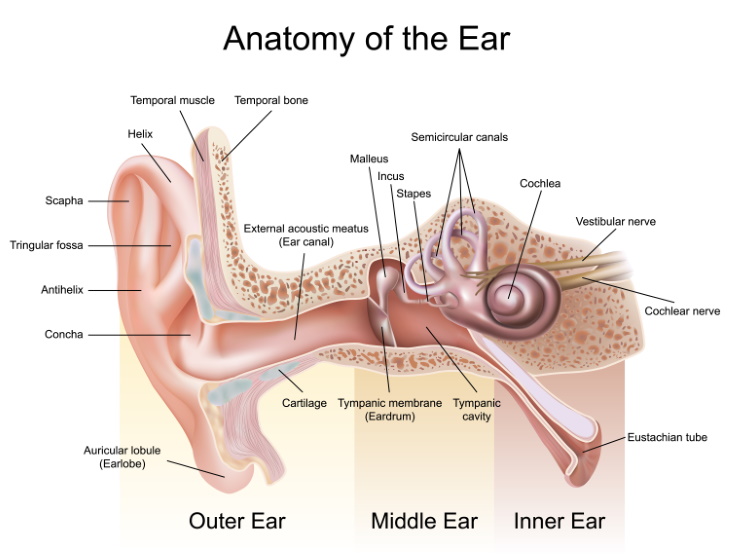
  Tinnitus ear anatomy

Not all doctors will conduct a hearing or movement test. Usually, a patient is referred to a trained audiologist. The specialist may use speech recognition tests, auditory tests, and other medical tests, such as CT or MRI imaging or blood work to diagnose the cause of your tinnitus properly. 
 
Although tinnitus is rarely a symptom of a medical emergency, see your doctor if you experience any of the following symptoms: 
 
Sudden hearing loss 
 
Facial paralysis 
 
Discharge and odors from your ear 
 
A pulsing sound that matches your heartbeat. 
 
How to find relief from tinnitus  
The good news is that tinnitus can often be either fully or largely resolved through treatment and lifestyle changes. We list the most effective treatments and remedies for tinnitus in this section. Please be aware that it will take some time for the symptom to go away, so hang in there! 
 
Sound-masking 
Sound masking is widely regarded as one of the most effective devices for tinnitus patients. These are devices that create a background noise that, although temporarily, cancels out the ringing in the ears. Sound masking devices are particularly effective for those whose tinnitus prevents them from falling asleep or concentrating on work.

So what devices work for sound masking? Different approaches and sounds seem to be best for different people, but anything from white noise machines to ordinary fans, a television, sound machines, headphones, and in-ear masking devices can work. Even your own laptop or phone can become a sound-masking device, so we recommend that you start there because it’s free. We link two excellent smartphone apps for sound masking below: 
 
myNoise (Android and iOS) 
 
NatureSpace (Android and iOS). 
 
Note that some people find that listening to music, audiobooks, and podcasts may be more beneficial for masking because they both muffle the sound and distract you by holding your attention. Others conclude that white noise helps them more, and a 2017 study also found that white noise is more helpful than nature sounds. The volume of the sound is up to you. 
 
Hearing aids

For many people, tinnitus can be an early sign of hearing loss. That is because hearing loss usually comes with changes in your brain that have to do with recognizing sounds. For patients with hearing loss and tinnitus, a hearing aid can make a world of difference. These are small in-ear devices that increase the volume of what you hear.
 
But even those who don’t experience noticeable hearing loss can benefit from a hearing aid. The better you hear, the less attention you pay to your tinnitus. And once the tinnitus is gone, you can stop using the hearing aid altogether. A survey found that 60% of tinnitus patients find some relief with a hearing aid and 22% report significant improvement.

Treat the underlying cause
Tinnitus ear test
The American Tinnitus Association reports that most tinnitus cases are the result of hearing loss. However, if your tinnitus is caused by something like a blockage, infection, or a condition like temporomandibular joint (TMJ) disorder, then addressing the condition will almost certainly make your tinnitus go away as well. 
 
Simply dissolving the excess earwax may be enough to fully resolve a mild case of tinnitus. That’s another reason why you shouldn’t rely on your own intuition as to the cause of tinnitus. Your physician, an audiologist, or an ENT specialist can match you up with the best treatment. 
 
Habituation
If you have chronic or recurrent tinnitus, habituating is one of the key skills to learn. Habituating, or ignoring tinnitus, is one of the best ways to find relief for good. This is done by breaking the stress cycle and essentially distracting your brain from noticing the tinnitus. 
 
This can be done by engaging in mindfulness meditation, yoga, or any other activity that helps shift your focus off the noise in your ears. There are even mindfulness-based stress reduction courses that aim to give people skills to control and shift their attention away from tinnitus. 
 
Relaxation is important in treating tinnitus for two reasons. Firstly, it helps prevent ringing in the ears, as stress is a common trigger of tinnitus. And secondly, knowing how to calm your mind is a key tool to preventing tinnitus from affecting your daily life. 
 
Be mindful of your diet
Some tinnitus sufferers find relief from adjusting their diet. Particularly, Meniere's disease sufferers - a condition that causes hearing loss, tinnitus, and dizziness - find that reducing salt intake in their diet is helpful. Consuming more foods rich in zinc (e.g., poultry, fish, pumpkin seeds, beans, and peanuts) and vitamin B12 (e.g., meat, milk, cheese, eggs) may also be beneficial. 
 
Reducing caffeine, tobacco, and alcohol consumption may also be helpful for some tinnitus sufferers. And last but not least, anecdotal reports suggest that the herb supplement Ginkgo Biloba reduces tinnitus in some people. 
 
Don’t forget about hearing protection
If your work involves spending hours upon hours in noisy city spaces, around loud machinery, or next to speakers, you may be hopeless about getting rid of tinnitus. To manage the condition, such people must wear foam earplugs, earmuffs, or both. Remember that noise exposure can both trigger and worsen tinnitus, and it also damages your hearing. 
 
High-fidelity earplugs, also called musician’s earplugs, are the best for most people. The advantage of these earplugs is that instead of simply blocking all sounds, they reduce the decibel level of outside noises. This allows you to have conversations and go on with your daily life while you’re wearing earplugs. Such earplugs can be purchased at pharmacies or custom-ordered by your audiologist. 
 
Instant relief 
There's a variety of massages and moves that can help temporarily relieve tinnitus. The move in the video below can reduce or make tinnitus completely go away for several hours.


This is only for your information, kindly take the advice of your doctor for medicines, exercises and so on.   

https://gscrochetdesigns.blogspot.com. one can see my crochet creations  
https://gseasyrecipes.blogspot.com. feel free to view for easy, simple and healthy recipes    
https://kneereplacement-stickclub.blogspot.com. for info on knee replacement

Labels: , , , , , , , , , ,

Thursday, January 20, 2022

6 Recent Groundbreaking Health & Medicine Advancements

2021 was a groundbreaking year for health and medical breakthroughs. While a lot of effort and time went into understanding more about the evolution of COVID-19 and developing vaccines and medications to fight it, our researchers and scientists also took significant steps in several other medical areas even as the most deadly pandemic of our time raged on. 
 
From developing milestone medicines for Alzheimer’s disease to getting the first-ever knee replacement with a smart implant, here are some of the most significant medical breakthroughs — both large and small — from the past year. 
 
1. A Blood Test to Detect Early Cancer
Medical Breakthroughs of 2021,  Detect Early Cancer
A recently developed blood test can help detect cancer early. As you might be aware, early detection is the key to surviving cancer. However, only a few tests such as Pap smears, mammograms, lung screenings, and colonoscopies exist currently that can help detect the disease at its most curable stages. The Galleri test can change the game. The new blood test uses genetic sequencing technology and artificial intelligence to alert a doctor if you have a signal for the disease and points out which organ it comes from. The test has the potential to detect more than 50 types of cancer. 
 
In a study published in Annals of Oncology, researchers analyzed 4,077 participants (2,823 of whom had cancer) to test the Galleri test’s efficacy. They found that the overall sensitivity for cancer detection was 51.5%, which increased with the tumor stage. More importantly, the test managed to successfully predict the location of the tumor about 89% of the time. A much larger trial involving 140,000 people aged 50 to 77 years will follow soon where all the participants will have their blood analyzed over a period of 2 years.

2. First Injectable HIV Prevention Drug
Medical Breakthroughs of 2021, Injectable HIV Prevention Drug 
The Food and Drug Administration (FDA) has recently approved the first long-acting injectable medication for use as pre-exposure prevention against HIV. The new drug, named Apretude, is an injectable that will be given every two months as an alternative to HIV prevention pills. Two FDA trials to analyze the safety and efficacy of the novel drug have been undertaken so far. The results showed that the participants who took Apretude had significantly reduced chances of contracting HIV when compared to people taking daily oral medications - by 90 percent for cisgender women and by nearly 70 percent for cisgender men and transgender women who have sex with men. 
 
This could be a milestone in HIV prevention and can prove to be critical to addressing the HIV epidemic in the U.S., says the FDA. While the use of PrEP (pre-exposure prophylaxis) – a medicine taken to prevent getting HIV – has helped, the Centers for Disease Control and Prevention data shows that about only 25% of the 1.2 million people for whom PrEP is recommended were prescribed the treatment last year. This new long-acting injectable can make adherence easier because it’s a medication that one can take only once every 2 months at a doctor’s office. Experts say that since people tend to attend a doctor’s appointment while often forgetting to take medications at home, Apretude can help increase PrEP usage and bring down the HIV rate worldwide.
 
3. Low-Cost Over-The-Counter Hearing Aids
Medical Breakthroughs of 2021,  Over-The-Counter Hearing Aids
When you can’t understand what your grandkid is saying over the phone, a hearing aid can help make things easier. However, these devices are quite costly. Once you include the fee of a hearing-health professional to them, who you have to see, hearing aids can easily touch thousands of dollars for a pair. Thankfully, the FDA has recently proposed the creation of a new category of over-the-counter (OTC) hearing aids that will be sold directly to the millions of people in need of them. The proposed rule aims to promote the wide availability of low-cost hearing aids to the average person. An estimated 38 million American adults suffer from mild to moderate hearing loss. Having more affordable hearing aid options will certainly make life easier for them.

4. First-Ever Knee Replacement with "Smart" Implant
The first-ever knee replacement using a smart implant was successfully completed in October last year. The implant, called the Persona IQ, provides remote, automatic internal medical data through a small “smart” stem extension attached to the bottom portion of the implant. This stem contains sensors that measure data points such as the number of steps taken, walking speed, range of motion, stride length, etc., and sends the information back to the orthopedic surgeon to track recovery. 
 
Persona IQ received FDA approval in August 2021 and industry experts believe that this could trigger the beginning of a smart implant revolution. They could improve health outcomes and provide patients with detailed information about their bodies. These devices could also help result in the personalization of physical therapy plans.
 
5. The Most Affordable Insulin Ever
Medical Breakthroughs of 2021, Affordable Insulin
Approximately 537 million adults are living with diabetes currently, according to the International Diabetes Federation. For a lot of them, insulin – an essential hormone produced by the pancreas that helps process glucose – is important for survival. But the cost of the man-made version of human insulin unfortunately is absurdly high today. There's some good news on that end. 
 
The FDA has recently approved Biocon Biologic's Semglee insulin glargine (a long-acting human insulin analog to enhance glycemic control) as a new and affordable basal insulin for adults and children with type 1 diabetes and adults with type 2 diabetes. It has been designated as “interchangeable biosimilar” insulin. A biosimilar is a biological therapy having highly similar safety and efficacy to the brands that are already FDA-approved and on the market but has "no clinically meaningful differences." It’s basically a generic medication that pharmacists are allowed to substitute for a name-brand drug, but it doesn’t need prior approval from a doctor to make the swap. 
 
Semglee costs $148 for five pre-filled insulin pens (3 mL each) and is administered subcutaneously (under the skin) once daily. For people who are uninsured or underinsured, or don’t qualify for patient assistance programs, Semglee can become an affordable option.
 
6. A Milestone for New Medicines for Alzheimer’s Disease 
 
In what is a significant landmark for new medicines for Alzheimer’s disease, Biogen's Aduhelm has become the first new Alzheimer's drug approved by the FDA in nearly 20 years. It’s also the first drug cleared in the U.S. to slow cognitive decline in people with Alzheimer's. 
 
“It is a new day,” Harry Johns, CEO of the Alzheimer’s Association, said in a statement. “This approval allows people living with Alzheimer’s more time to live better. For families, it means being able to hold on to their loved ones longer. It is about reinvigorating scientists and companies in the fight against this scourge of a disease. It is about hope.”

Aduhelm’s efficacy was evaluated in three separate studies that included a total of 3,482 patients with Alzheimer’s disease. Researchers found that the treatment significantly reduced dose-and time-dependent amyloid-beta plaque in the brain—a hallmark of Alzheimer’s disease. Meanwhile, patients in the control arm of the studies showed no reduction of amyloid-beta plaque. 
 
Previously, there were no drugs cleared by the FDA that can slow the mental decline from Alzheimer’s. Almost 44 million worldwide are estimated to be living with Alzheimer’s disease, the most common cause of dementia. Aduhelm could be a game-changing moment for them.

This is only for your information, kindly take the advice of your doctor for medicines, exercises and so on.   

https://gscrochetdesigns.blogspot.com. one can see my crochet creations  
https://gseasyrecipes.blogspot.com. feel free to view for easy, simple and healthy recipes    
https://kneereplacement-stickclub.blogspot.com. for info on knee replacement


Labels: , , , , , , , ,