Reiki: Origins, Benefits, Practice, and the Science Behind it
Our approach to health is both
science-based and holistic. This means that, first and foremost, we
believe in Western medicine, but we also think that alternative and
complementary healing practices have the power to accelerate healing and
act as an amplifier to Western medicine. The link between mental and
physical well-being is undeniable, and our mission is to equip you with
knowledge.
In this article, we will be discussing a
complementary healing therapy known as Reiki. We will explain what it
is, the theoretical science behind it, and how it can benefit you.
The Origins of Reiki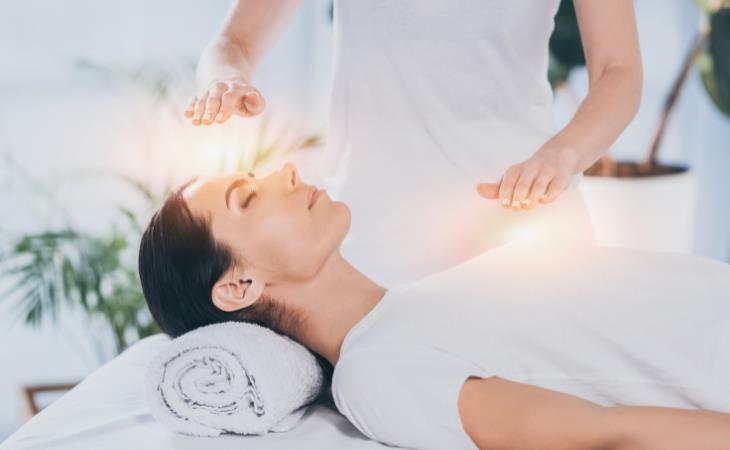
Reiki originated in mid-11th century Japan.
It is based on ancient Tibetan Buddhist teachings. According to Reiki,
physical or emotional impairment is linked to an abnormality in the
energy bio-field. To solve this, a renewed flow of energy is needed.
The word Reiki is composed of two Japanese words: Rei, which means
"God‘s wisdom", and ki, which means "life force energy" and is sometimes
pronounced as chi. You may know this word from "tai chi." This is the
energy that heals.
A Reiki healer acts as a channel for this energy. They are not the
origin nor the source of this energy. Instead, they function as a
mediator between the energy that flows in the world and the patient.
Using their hands, Reiki healers transfer energy back into the body,
similarly to the way acupuncture promotes the flow of energy.
Reiki in practice
In practice, a Reiki session takes up to 90
minutes. The therapist will place their hands either directly on parts
of the body, or just hovering above. The treatment usually (but not
always) focuses on the upper body, mostly the head, neck, and shoulders.
Each pose will last 3 to 10 minutes, according to the way the therapist
feels the patient’s needs. There is usually very little talking.
During the session, the Reiki healer may feel a sensation of warmth or
tingle in the palm of their hands as the energy flows. The recipients
may feel warmth, tingling sensations, and deep relaxation. Reiki healers
explain that the energy stops flowing on its own – they do not decide
how long each pose will last. Once it reaches the patient’s body, it
goes where it is needed on its own.
Benefits of Reiki
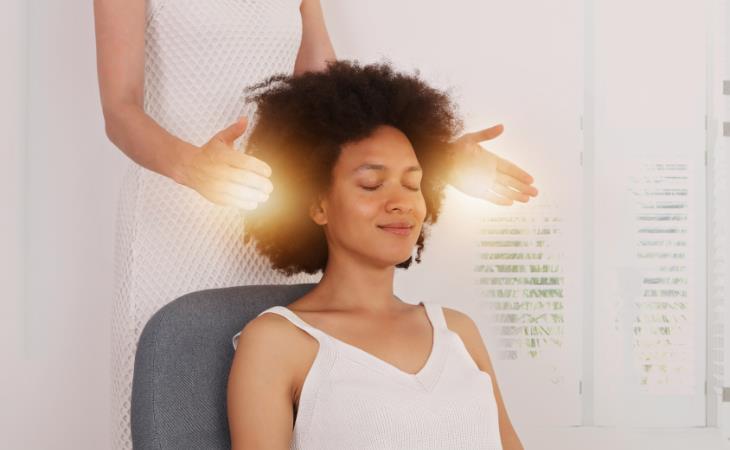
In order to become a Reiki healer, one must
go through a special initiation ceremony that will open their energetic
channels. Once open, they will remain accessible for life. It is
important to note that, while it is considered spiritual, as meditation
is, Reiki is purely secular. You don’t have to subscribe to any belief
system to reap the benefits of Reiki healing.
Reiki healing can tremendously help with mental distress and physical
dysfunctions caused by it. It encourages relaxation, better sleep,
improved mood, and even pain relief according to Everyday Health. It
will also help accelerate healing after an operation, in conjunction
with physical therapy and medication if needed.
Its purpose is to promote a healthy flow of energy throughout the body
and to promote and kickstart the patient’s self-healing abilities.
Possible scientific explanations

Our body is constantly moving between being
controlled by the sympathetic nervous system and the parasympathetic
nervous system. The sympathetic nervous system activates our fight or
flight response, and is in charge in a state of stress, even when we’re
not being threatened. This means that the body cannot spare resources
for healing and regeneration.
Once the body is back in a state of deep true relaxation, the
parasympathetic nervous system takes over, allowing for rest, digestion,
and regeneration – all the things you need for sound healing.
Reiki aims to restore the body to that state, in which not only the mood
and sleep are improved, but daily anxiety is lessened, and blood
pressure lowers.
There is a small body of research on Reiki, but studies that were
conducted in the past don’t add up to create solid scientific evidence.
As with every alternative therapeutic method, it depends on who you ask.
There are, however, several interesting theories on how exactly Reiki
heals the body and mind. We will share two of them here.
One theory relies on the electric charges in the body. Every object that
runs on electricity, such as the brain and heart, has a magnetic field.
According to this theory, the proximity of the healer's open energetic
magnetic field to the patient’s so-called “jammed“ magnetic field has
the power to fix the flow of energy, much like one car‘s engine can help
jump- start another's with cables.
Another theory suggests that there’s a basis in quantum physics. This is
the study of the tiniest particles of the universe, the ones that make
up atoms and visible light. They include electrons, nucleons, and
photons. Photons are the particles that compose light, and just like
every particle of this kind, they can be in several places at once –
they can be both a wave and a particle at the same time, depending on
how you measure and examine them.
Some studies suggest that these particles can be influenced by thought
or intention, which is what the Reiki healer does, according to the
theory. Reiki healers simply gather and re-organize energetic quantum
particles in the recipient's body.
The bottom line
here is a whole history and symbolism to explore in the world of Reiki,
far too much to contain in one article. But to conclude, we will share
the five Reiki principles, as practical mantras you can take with you on
your daily healing journey.
1. Just for today, do not worry.
2. Just for today, do not anger.
3. Just for today, be humble.
4. Just for a day, be honest.
5. Just for today, be compassionate toward yourself and others.
This wording promotes a slow and steady movement throughout life. Taking
it day by day, and honoring the present.
Other than this, why REIKI works is, it is purely based on science- scientist knows there is energy everywhere, within us and outside us also. What a REKI channel does is takes the energy from the universe- this happens once the chakras are opened, and the energy is passed on the recipient. REIKI channels are only healers, we don't use the word cure. To experience REIKI- how is works, one should have an open mind, then only you'll be able to receive the energy and experience how it relaxes both your body and mind totally.
Other than this, why REIKI works is, it is purely based on science- scientist knows there is energy everywhere, within us and outside us also. What a REKI channel does is takes the energy from the universe- this happens once the chakras are opened, and the energy is passed on the recipient. REIKI channels are only healers, we don't use the word cure. To experience REIKI- how is works, one should have an open mind, then only you'll be able to receive the energy and experience how it relaxes both your body and mind totally.