Tuesday, December 21, 2021

4 Simple Hand Exercises to Alleviate Arthritis Symptoms

Arthritis wears away at the cartilage that cushions our joints and keeps them healthy and pain-free. Over time, this process of gradual but steady damage to the joints becomes more noticeable and painful. With more damage comes more inflammation, stiffness, weakness, and pain, especially after repetitive tasks like typing on the keyboard or using kitchen utensils. Medications and dietary changes can help reduce these worrisome symptoms in the long run, but if you’re looking for instant arthritis relief, exercises are probably the best option. 
 
Hand exercises for arthritis strengthen the muscles that support the joints. They also increase the production of synovial fluid that lubricates the joints. As a result, you will experience pain relief and improved range of motion of your hands and wrists right away. With consistent practice, you will also notice more flexibility and a better grip, so these exercises are definitely worth trying. Exercise
 
1. Stretch your wrists to relieve stiffness and pain
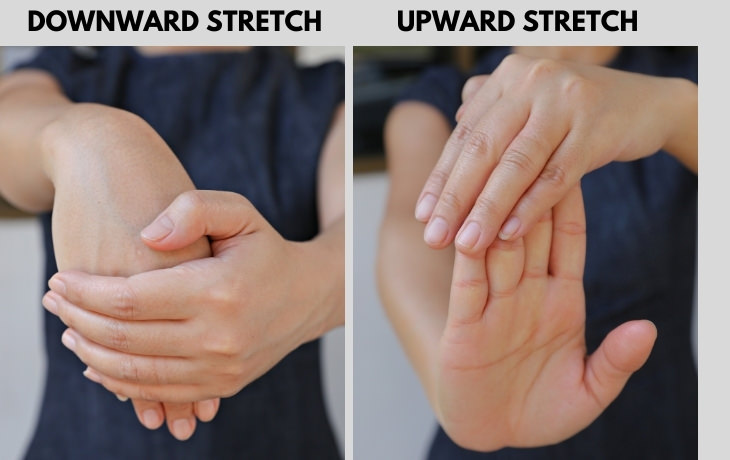
Hand Exercises for Arthritis wrist stretches
Start by giving your hands and wrists a general warmup. This will lubricate the joints, preparing them for the exercises to follow. Wrists can also get stiff from arthritis, and these exercises help improve their flexibility. 
 
Follow these steps to perform the stretch:
 
Downward Stretch 
1. Hold your arms out straight in front of you, with one palm facing down. 
 
2. Use the other hand to press down on the hand that’s facing down. Be gentle, you should feel a stretch on the tops of the palm, wrist, and arm, but no sharp pain. 
 
3. Hold this position for 5 seconds, then release. Repeat 5-10 times, and then do the same on the opposite side.  
 
Upward Stretch 
 
1. Hold your arms out straight in front of you, with one palm facing up. 
 
2. Use the other hand to press on the base of the palm that’s facing up until you sense a pleasant stretch in the inner part of the wrist and arm. 
 
3. Hold this position for 5 seconds, then release. Repeat 5-10 times, and then follow the same steps on the opposite side.
 
2. Strengthen hand muscles with sequential finger bends
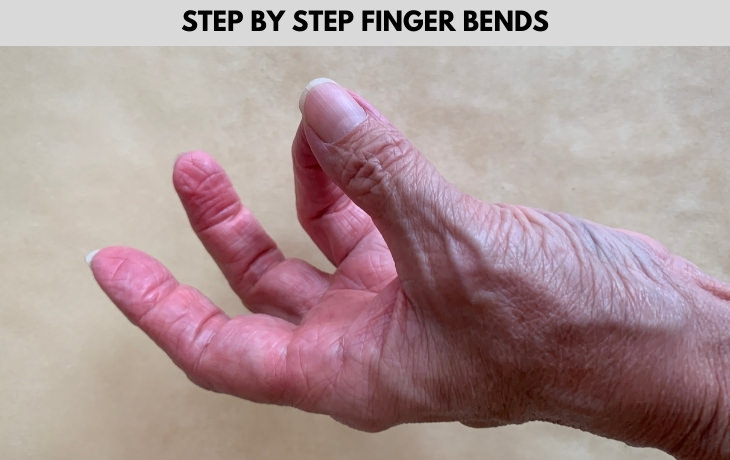
Hand Exercises for Arthritis sequential finger bends
This exercise is like a pushup for your fingers and the base of the palm. It helps strengthen the hand muscles and will improve your grip and flexibility. In this exercise, you will need to bend each finger one after the other. 
 
There are two ways you can do this exercise. If your fingers are relatively flexible, you can bend the finger completely until the fingertip rests where the base of the finger meets the palm. Alternatively, you can bend the finger to meet your thumb, as shown in the image above - this is an easier version of this exercise. The exercise itself is pretty straightforward. 
 
Here are the steps:  
1. Start in the same position, but with only one of your hands held up straight. 
 
2. Bend your pinkie down toward your palm (or the thumb). Hold this position for 5 seconds. 
 
3. Straighten the pinkie, and then bend the ring finger for 5 seconds. Release, straighten, and move on to the middle finger, and so. 
 
4. When you get to the thumb, simply bend it towards the palm and hold for 5 seconds. 
 
5. Repeat the same exercise on the other hand. You can do this exercise several times throughout the day.

Exercise 3. Do the “O” or “C” finger bend whenever your hand is feeling stiff
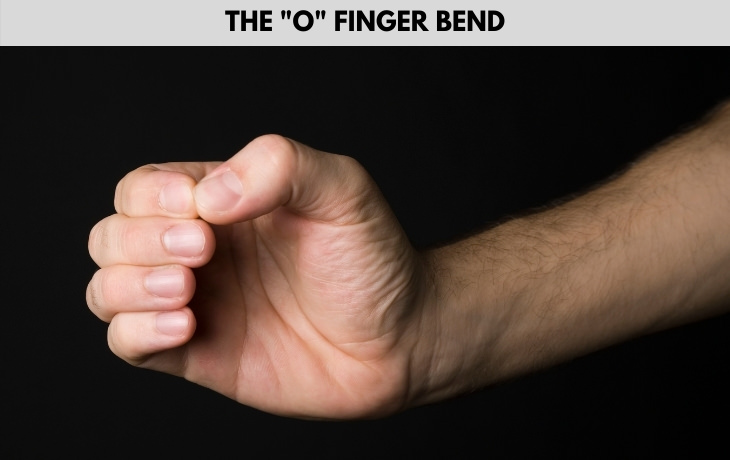
Hand Exercises for Arthritis O finger bend
Unlike the previous task, where we exercised each finger separately, this finger bend activates all the muscles together, which brings relief to hands that feel stiff and weak. Just like the previous exercise, there are two methods of doing this finger bend. The “O” stretch is more advanced and challenging, whereas the “C” stretch is the easier one. 
 
Here are the steps: 
 
1. As the name suggests, this exercise requires you to curve all of your fingers in until they form a shape similar to the letter “C” or “O”. 
 
2. Hold for 5 seconds, then release and straighten the fingers. 
 
3. Repeat 5-10 times on each hand.  
 
Exercise 4. Improve strength and relieve stiffness with these variations of a fist
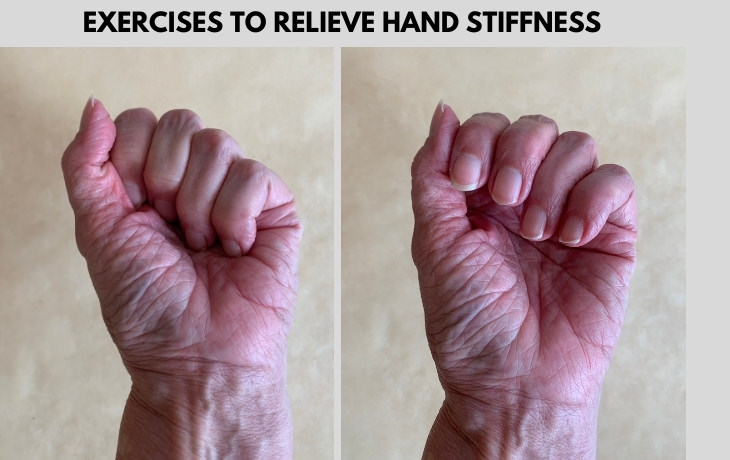
Hand Exercises for Arthritis
This is probably the easiest and most straightforward exercise we will show you. It’s also the last one. You can do it anywhere and anytime, which makes it a great option for instant stiffness relief. 
 
As before, we will walk you through 2 versions of this exercise. The easier one only requires bending your fingers halfway, whereas the more advanced variation requires you to make a full fist. Follow these steps: 
 
1. Hold your arms out straight in front of you, with all the fingers straight. 
 
2. Slowly bend your hand into a fist halfway, as shown in the image on the right. Your thumb should be on the outside of the hand. 
 
3. You can stop here and hold this position for 5 seconds. Alternatively, you can bend your fingers inward completely, as shown in the image on the left, and hold. 
 
4. Open the hand and straighten the fingers. Repeat the exercise 10 times on each hand.

This is only for your information, kindly take the advice of your doctor for medicines, exercises and so on.   

https://gscrochetdesigns.blogspot.com. one can see my crochet creations  
https://gseasyrecipes.blogspot.com. feel free to view for easy, simple and healthy recipes    
https://kneereplacement-stickclub.blogspot.com. for info on knee replacement


Labels: , , , , , , ,

Thursday, February 06, 2020

7 Benefits Of Turmeric Tea

Turmeric is a bright yellow-orange spice commonly used in curries and sauces. It comes from the turmeric root. The spice has been used for its medicinal, antioxidant, and anti-inflammatory properties for thousands of years.

Turmeric tea is one popular form of consuming turmeric. It has a unique but subtle flavor. The tea is also great way to reap the following health benefits of turmeric.


1. Eases arthritis symptoms

Turmeric tea’s strong anti-inflammatory properties can help ease inflammation and swelling in people with arthritis. This reduces painful symptoms. One studyTrusted Source found that an active compound in turmeric, called curcumin, was effective in reducing pain in patients with osteoarthritis.
 

2. Helps prevent Alzheimer’s disease
While research is still searching for what exactly causes Alzheimer’s disease, it seems as though the curcumin found in turmeric may help prevent it. Turmeric’s antioxidants prevent damage that can lead to Alzheimer’s. Even more importantly, some research shows that turmeric can reduce the synaptic marker loss and the accumulation of amyloids linked to Alzheimer’s development.
 

3. Helps prevent cancer
Turmeric tea’s many medicinal properties, including antioxidant and anti-inflammatory properties, could contribute to cancer prevention. The National Cancer Institute has recognized curcumin as an effective anticarcinogen, or substance that helps prevent cancer.
 

4. Maintains ulcerative colitis remission
Ulcerative colitis (UC) is a chronic condition that causes ulcers in the lower end of the gastrointestinal tract. Turmeric could help maintain remission from symptoms. According to the University of Maryland Medical Center, a study found that UC patients in remission had significantly lower relapse rates if they consumed turmeric.
 

5. Boosts the immune system
The medicinal properties in turmeric may be able to boost the immune system, even in people with immune disorders. One studyTrusted Source theorized that turmeric can moderate the immune system.
 

6. Lowers cholesterol
Lowering LDL (or “bad”) cholesterol can help reduce your risk of developing some serious conditions, including heart disease and stroke. There is evidence that turmeric is effective at doing just that. For example, a 2008 studyTrusted Source that found that a low dose of curcumin was associated with reduced LDL and total cholesterol levels.


7. Can help treat uveitis
Uveitis is an inflammation of the iris. Some early research has indicated that curcumin found in turmeric may actually be as effective of a treatment as corticosteroids, but without the side effects.
 

How to make turmeric tea

To make turmeric tea at home, follow these steps:

    Boil 3 to 4 cups of water on the stove.
    Add 2 teaspoons of turmeric and stir.
    Simmer for about 5 to 10 minutes.
    Strain the tea into another container.
    Add in honey, fresh squeezed lemon or orange juice, and milk to taste.

Potential risks and complications

Turmeric is generally safe as long as you consume it in moderation. You should check with your doctor about drinking turmeric tea if you have had:

    inflammation of the gallbladder or gallbladder stones
    obstruction of bile passages
    stomach ulcers
    diabetes (turmeric supplements may lower blood sugar)

Taking too much turmeric may cause side effects, however. These include:

    increased stomach acidity, which can cause ulcers
    a blood-thinning effect

Because turmeric may thin your blood, you should stop drinking turmeric tea two weeks before surgery. Do not take turmeric tea if you are on blood thinners, either.


Who should drink turmeric tea?
Turmeric tea is considered safe for most people to drink. It can relieve pain and inflammation without the side effects that even over-the-counter medications like NSAIDs can cause, such as internal bleeding, ulcers, and reduced white blood cell count.

Almost anyone can benefit from drinking turmeric tea, especially because it can boost the immune system and act as an anticancer agent. People with pain caused by inflammation can perhaps benefit the most. People who have diabetes or who take blood thinners should talk to their doctors before trying any turmeric supplement, however.


This is only for your information, kindly take the advice of your doctor for medicines, exercises and so on.     
https://gscrochetdesigns.blogspot.com. one can see my crochet creations  
https://gseasyrecipes.blogspot.com. feel free to view for easy, simple and healthy recipes    
https://kneereplacement-stickclub.blogspot.com. for info on knee replacement
 

source-healthline

Labels: , , , , , , , , , , ,