Tuesday, March 31, 2026

Unexpected Drug Combo May Supercharge Weight Loss in Older Women

Scientists have uncovered a potential drug combo that may supercharge popular weight-loss treatments for older women.

In a small retrospective study of women taking varying doses of tirzepatide for weight loss, after 15 months of treatment, participants who were also using menopausal hormone therapy experienced 35 percent more total bodyweight loss than those not using hormone therapy.

For the research, scientists at the Mayo Clinic and Wayne State University in the US gathered health data from 120 women, the majority of whom were White, and in their 50s.

Eighty of the participants only used tirzepatide for weight loss, and 40 used tirzepatide as well as any type of menopausal hormone therapy, with data tracking their health for an average of 18 months.

On average, women on both tirzepatide (a GLP-1-based drug sold under the brand names Zepbound or Mounjaro) and hormone therapy lost 19.2 percent of their starting body weight, while those taking only tirzepatide lost an average of 14 percent. That 5.2 percentage‑point difference is statistically significant.

 A higher proportion of those taking hormone therapy achieved 30 percent or more total bodyweight loss.
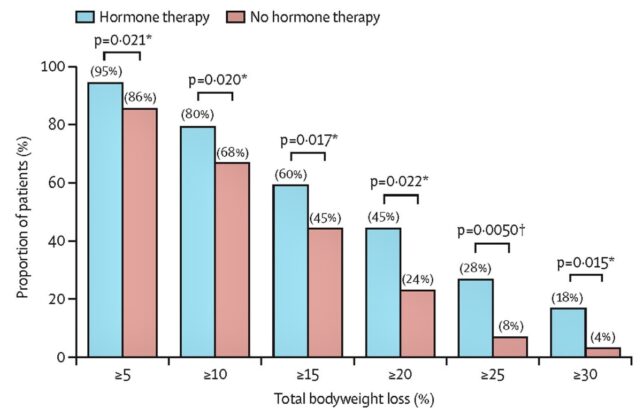
 A bar chart comparing two groups


The authors of the study now hope to conduct controlled, randomized studies on the combo to see if this apparent drug synergy stands up under scrutiny and really is causing greater weight loss.

These preliminary findings on tirzepatide join a 2024 study, authored by some of the same Mayo Clinic researchers, which found that after 12 months, a greater proportion of postmenopausal women using semaglutide and hormone therapy achieved 10 percent or more total body weight loss than those taking just the GLP-1 drug.

"The magnitude of this difference warrants future studies that could help clarify how GLP-1-based obesity medications and menopausal hormone therapy may interact," says lead author and women's health researcher Regina Castaneda at the Mayo Clinic Center.

Menopause occurs when menstruation ceases, and it is a monumental transition that brings widespread changes and sweeping hormonal shifts to the body and brain. The transition and the after effects can lead to a whole host of unpleasant physical symptoms, including fatigue, hot flashes, night sweats, poor sleep, and low libido.

Menopause hormone therapy can be used to manage these challenges, and it may offer some protection from menopause-associated illnesses, such as osteoporosis and possibly heart disease. The medicine usually comes in pill, patch, or topical form, and it aims to replace some of the body's lost hormones, such as estrogen or progesterone.

 While some studies suggest that menopause replacement therapy may help prevent weight gain in later life, it's unclear if or how they may promote weight loss.

Menopause as a whole is historically underfunded and under-researched. Plus, GLP-1 drugs are a relatively new drug class that scientists are still trying to understand.

What we do know is that weight gain is common for pre- and post-menopausal women, and it is also common for those with reproductive issues impacting their ovaries and uterus.

Patients with polycystic ovary syndrome, for instance, are more likely to experience insulin issues, which can increase the risk of type 2 diabetes and lead to weight gain.

The current research did not distinguish between the type or dose of hormone therapy, analyzing them as a single group.

 In October 2025, Castaneda spoke at the Menopause Society Annual Meeting about her team's recent results and how much more we have to learn.

"Millions of women struggle with weight gain during midlife, and the reality is that we don't know what the answer is," she said.

"We don't know why we're observing these superior weight loss outcomes in women using tirzepatide in addition to hormone therapy."

Castaneda points to initial studies in rodents, which have found that estrogen treatments can enhance the body's natural GLP-1 signaling system. But results are inconsistent, and there are other possible explanations, as endocrinologist and senior author Maria Daniela Hurtado Andrade explains.

"It is possible that women using hormone therapy were already engaged in healthier behaviors," Hurtado Andrade says, "or that menopause symptom relief improved sleep and quality of life, making it easier to stay engaged with dietary and physical activity changes."

The only way to know for sure is to conduct rigorous clinical experiments on the drug combo.

In the future, Hurtado Andrade says she and her team are going to carry out a randomized controlled trial to see if the benefits of menopause hormone therapy "extend beyond weight loss specifically, whether hormone therapy also enhances the effects of these medications on cardiometabolic measures."

"If confirmed," she argues, "this work could speed the development and adoption of new, evidence-based strategies to reduce this risk for millions of postmenopausal women navigating this life stage."

The study was published in The Lancet Obstetrics, Gynaecology, & Women's Health.


This is only for your information, kindly take the advice of your doctor for medicines, exercises and so on.   


Labels: , , , , , ,

Thursday, March 03, 2022

Menstrual pain could be endometriosis; affects 1 in 10 females in child-bearing years in S'pore

For around a decade during her teenage years, Member of Parliament Carrie Tan suffered severe menstrual cramps every month, where the pain was so intense that she had to lie down to wait for it to subside.

The agony was so bad that when she was in her late 20s, there were two consecutive months she blacked out when her period came. On the second occasion, she broke out in cold sweat, blacked out, woke up feeling afraid and made a trip to the emergency department of a hospital.

"I was put on drips, given painkillers and again sent home. No one told me why I was having so much pain," the 39-year-old MP for Nee Soon GRC said in a virtual media briefing on Wednesday (March 2), a day before the start of Endometriosis Awareness Week.

She later discovered that she suffered from endometriosis, a chronic condition where tissues resembling the lining of the womb grow in other organs such as the ovaries, bowels and even the lungs and nose.

This may result in pain in various parts of the body, including while urinating and during sex, and increased menstrual discomfort.

Ms Tan's condition is common here, where about one in 10 females in child-bearing years suffer from it. Endometriosis is a disorder that is dependent on the female hormone estrogen, hence, the condition tends to regress after menopause. Estrogen levels decline during menopause.

Dr Ma Li, a consultant in the department of obstetrics and gynaecology at the National University Hospital (NUH), said: “Endometriosis is a systematic disease  that can affect the whole body and other organs including uterus, ovaries, vagina and rectum. Early treatment will help these women with their overall and reproductive health.”

Some 30 per cent to 50 per cent of women with endometriosis encounter challenges conceiving, said Dr Celene Hui, a consultant in the minimally invasive surgery unit, division of obstetrics and gynaecology at KK Women's and Children's Hospital.

Endometriosis can result in inflammation and scarring, damaged fallopian tubes, impaired embryo implantation, poorer egg quality and decreased egg supply or ovarian reserve, she added.

These painful periods can also result in emotional distress, affecting work and quality of life.

"Most of the time, women of the reproductive age group attend our clinics because they are trying to start a family. The child-bearing potential declines significantly with increasing age. I urge women with symptoms of endometriosis to come forward earlier, so that their pain can be better managed and their fertility may be preserved and protected," Dr Hui said.

There is currently no non-invasive, reliable method for diagnosing endometriosis, so the condition's true prevalence is unknown. Although surgery still remains the gold standard for definitive diagnosis, there is a shift towards diagnosing endometriosis based on symptoms and investigations, allowing doctors to start treatment earlier rather than later. 

Dr Hui added that there is a 6.7 year delay between symptom onset and diagnosis, as the lack of awareness of this condition, stigma around menstruation and lack of specific symptoms increase the difficulty of diagnosis.

This condition is more common among Asians compared with Caucasians, and more prevalent among women with a lower body mass index. Those with a short menstrual cycle length or experience obstruction of menstrual flow are also likely to experience higher risk.

To help women diagnose this condition, an online questionnaire that is available in four languages can be done.

"The higher the score, the more they should see a doctor to seek advice. We are still in a society where everybody thinks it is normal to have some menstrual pain. But when the pain becomes so severe that it's affecting your job, your quality of life, it can't be normal any more," Dr Anthony Siow, medical director at ASC Clinic for Women in Gleneagles Medical Centre, said.

Based on the endometriosis questionnaire carried out from March 2021 to February 2022 involving 2,522 women in Singapore, it was found that 55 per cent suffer from symptoms that may suggest possible endometriosis or other gynaecological conditions that warrant a visit to a gynaecologist.

The questionnaire – created by doctors from NUH, Singapore General Hospital and KKH – also found that more than half of the participants are on regular medicines or supplements to control their pain.

Medical therapy can provide effective pain relief in 60 per cent of women here. This can be in the form of hormonal therapy with the progestin-only pills or the combined hormonal contraceptive pill, the hormonal intrauterine device or medications to induce a menopausal state.

Surgery can also be performed through keyhole incisions.

For Ms Tan, she changed her diet, consuming more “warming foods” such as ginger tea a few days before her period and cutting cold drinks out as much as possible. 

She still suffers from period pain, but it does not happen every month and is manageable now.

On how to raise awareness and reduce the stigma around periods, she stressed that it is important to encourage conversations.

There are ground-up initiatives, such as a campaign called E for Endometriosis that is actively going around spreading awareness of the condition, Ms Tan said. 

The campaign was started by Ms Namira Mohamad, who began experiencing painful menstrual cramps right from her first period at age 11. She is a stage four endometriosis patient.

“If we can make conversations around periods and menstrual pains more commonplace and easier to talk about, then it is easier for women to share their pain and experience... then those who have more awareness can share the knowledge and encourage others to step forward to see their GPs,” Ms Tan added.

On advocacy to employers, efforts such as opening up conversations at the workplace, holding health talks and educating human resource departments about this condition will be useful.

"So that women don't feel shy to talk about it and to seek help," Ms Tan said.


This is only for your information, kindly take the advice of your doctor for medicines, exercises and so on.   

https://gscrochetdesigns.blogspot.com. one can see my crochet creations  
https://gseasyrecipes.blogspot.com. feel free to view for easy, simple and healthy recipes    
https://kneereplacement-stickclub.blogspot.com. for info on knee replacement


Labels: , , , , , , , , , , , , , ,