Friday, July 17, 2026

8 Deceitful Methods Companies Use To Hide Sugar In Foods

 It’s no secret that eating too much added sugar can harm your health in a variety of ways, with excess sugar consumption being linked to a variety of conditions like diabetes, heart disease, and cancer. But even if you use little to no added sugar in your cooking, you might be consuming way more of it than the recommended daily amount. How is that possible? One major reason why that might be happening is that companies add a lot of sugar to their products, but they try to conceal it in a variety of ways to be able to pass them off as healthy foods.

And while the maximum daily amount of added sugar for men should be no more than 37.5 grams (9 teaspoons) and for women it should not exceed 25 grams (6 teaspoons), 1 protein bar can contain as much as 30 grams (7.5 teaspoons) of added sugars, which is over the daily recommended allowance for women. Let’s investigate how it is possible for companies to sell you junk food under the premise of healthy food, and how you can use food labels to make smart purchasing decisions that would promote and not harm your health.

1, They use a different word for sugar

When you want to find out how much sugar a product contains, let’s say, a box of cereal, you usually look at the back of a cereal box and scan the ingredients list for keywords like sugar, sucrose, glucose, and fructose. If you don’t find those, or find them in the middle or at the end of the ingredients list, which means that there isn’t a lot of it in the product, you make the conclusion that it’s a healthy choice, right?

Well, not entirely, as many companies nowadays use many “alternative” names for sugar in an attempt to deceive a consumer that is used to scan the ingredients list before purchasing a certain product. Here is a list of such alternative names that you should watch out for when it comes to powdered added sugar.
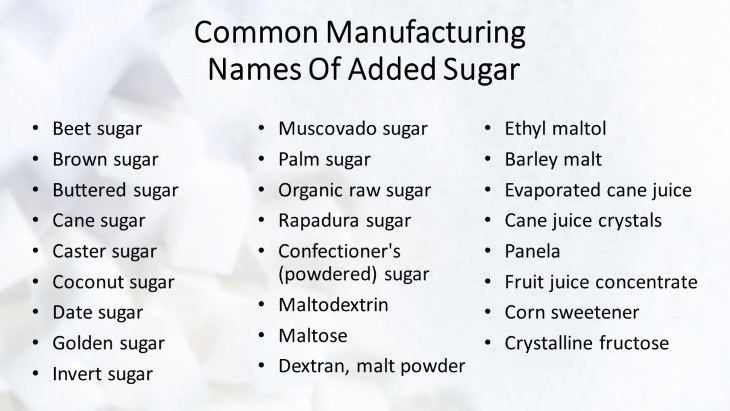
sugar marketing They Use a Different Word For Sugar

Added sugar is also often used in syrup form rather than powdered form, in which case they commonly appear as the following ingredients on nutrition labels.
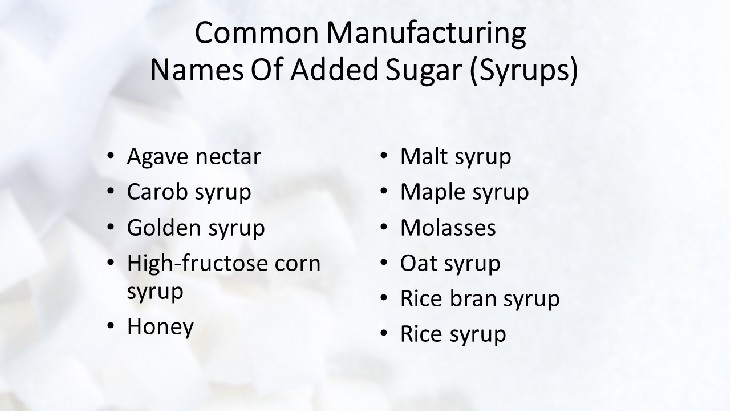

sugar marketing syrups
2. Adding sugar to things that aren't sweet

You would expect to see added sugar appearing as an ingredient on a box of cookies, but not so much on a can of tomato sauce, salad dressings, and soups. The truth is that humans simply love sweet food because our brains run on sugar and it’s addictive, and for companies, it’s a cheap way of making a product tastier for consumers.

Unfortunately, all of the foods we mentioned above can actually contain a lot of sugar, which adds up and can be the culprit behind excess sugar consumption. For example, 100 grams of some ketchups can contain as much as 38 grams of sugar, which is higher than the daily allowance for men. That’s why it is always important to always check the sugar content of a product, be it sweet or savory.

3. Adding health-related claims on product packaging
You’re better off completely ignoring claims like natural, zero, healthy, low-fat, diet, and light that often appear on the packaging of products. Instead, look directly at the label and analyze the ingredient list. These products are often lower in fat, calories, and sugar, but they’re often way too abundant in sugars.

4. Using so-called " Healthy Sugars"

 Certain products use labels like refined sugar-free or contains no refined sugar. What these labels mean, however, is that a product doesn't contain white sugar. While it may be true that these so-called “healthy” sugars have a slightly lower glycemic index (GI), they still have little to no additional nutrients compared to whole foods and, at the end of the day, they are still added sugars. A list of popular sugars marketed as healthier can be found in the picture below.
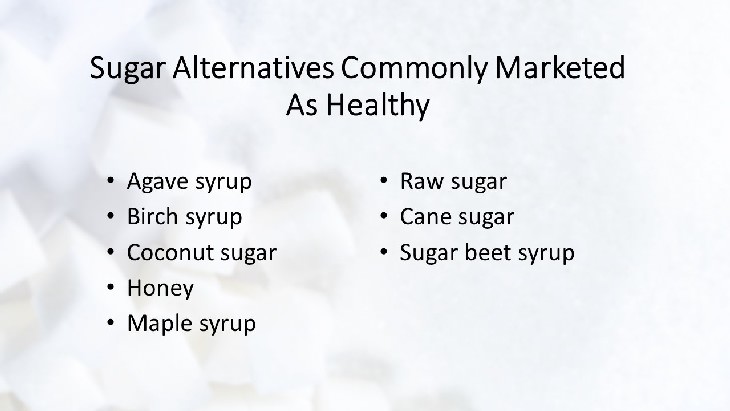
sugar marketing healthy
The bottom line is that like white sugar, fructose or corn syrup, these sugars should not exceed the overall amount of 37.5 g for men and 25 g for women. So, it doesn’t matter if you consume 25 g of white sugar, or 10 g of coconut sugar, 10 g of agave syrup and 5 g of honey as a woman, both equal your daily recommended amount. That doesn’t mean that you cannot choose these alternatives, but remember that they are just as damaging to your health as any other sugar.

5. Using a few "types of sugar"

As we mentioned previously, ingredients appear in any ingredients list according to their amounts in a product, so the first ingredient is usually the most abundant one, whereas there will be very little of the last ingredient on the list. Companies learned to take advantage of this regulation and often use several types of sugar in smaller amounts, which makes them appear lower on the ingredients list.

This can trick a consumer into believing that there is very little sugar in the product. So, if you see a few different types of sugar in the middle or at the end of the list, know that the added amount of all these sugars may be way higher than you expect. For example, if you look at the picture below, you will see that this cereal uses a variety of sweeteners, such as sugar, honey, and brown sugar syrup that appear in different places on the list.

6. Not Distinguishing Between Naturally-Occurring and Added Sugars
There is a difference between eating an orange and drinking a glass of soda, even if both of these products contain a lot of sugar. While products containing added sugars, like a glass of soda, do not contain anything apart from whatever is listed on the packaging, whole foods are packed full with fiber, vitamins, antioxidants and essential nutrients that not only mitigate the damage caused by the sugar they contain, but improve your health. Ingredient labels don’t distinguish between the added and naturally-occurring sugars, but you should keep in mind that choosing whole, unprocessed foods is always better.

7. Changing the Nutritional Facts With Time
If you know that a specific brand makes a great low-sugar product, don’t assume it applies to comparable products by the same brand. It is often the case that a similar product, but with a different flavor or simply one that is sold in a different country will not have the same nutritional content the original did.

It is also often the case that brands change the content of their products when they update the packaging, so always be critical of any changes or variations in the product you know is good, as it may actually turn out to be not so low in sugar. 

8. Check the Serving Size
The last, but definitely crucial line in the nutrition facts portion of a product is the serving size. Food companies often manipulate the serving size of a product, making it too small to be realistic, but this makes the product look like it’s not that high in sugar. So, for example, 1 small can of soda that even a child can gulp down in a matter of seconds often contains multiple servings, which means that by drinking the whole thing you’re actually consuming double or triple the amount of sugar mentioned on the packaging. Be careful and make smart food purchases.


This is only for your information, kindly take the advice of your doctor for food, medicines, exercises and so on.   


Labels: , , , , , ,

Monday, December 16, 2024

Which Form of Sugar Is The Most Harmful?

 Glucose, fructose, and sucrose are three types of sugar that contain an identical number of calories gram for gram. However, their chemical structures greatly differ, as does the way in which your body digests and metabolizes them. Keep reading to find out exactly what makes these three sugars so different, and why these differences actually matter. 

What Is Glucose?

Glucose is a simple sugar, also known as a monosaccharide, and is your body’s favorite carbohydrate-based source of energy. Monosaccharides are composed of a single unit of sugar and that's why they absolutely cannot be broken down into smaller compounds. 

When it comes to food, glucose is most commonly bound to another monosaccharide to form either disaccharides or polysaccharide starches. Glucose is frequently added to processed foods in the form of dextrose, which is actually extracted from cornstarch. When compared to fructose and sucrose, glucose tastes the least sweet.

What is fructose?
Like glucose, fructose is a monosaccharide, too. It’s naturally present in fruit, honey, agave and many kinds of root vegetables. What's more, it’s also frequently added to processed foods in the form of high-fructose corn syrup. 
 
Fructose can be obtained from sugar cane, sugar beets or corn. High-fructose corn syrup is made from cornstarch and contains a great deal more fructose than glucose, in comparison with regular corn syrup. Of the three sugars, fructose has the sweetest taste but the least impact on your blood sugar. 
 
What Is Sucrose?
Sucrose is the scientific name for common table sugar and is a disaccharide that is made up of 50% glucose and 50% fructose. It naturally occurs in many grains, fruits, and vegetables, and is often added to certain processed foods too, such as ice cream, candy, canned food, and breakfast cereals. 
 
Table sugar and the sucrose found inside processed foods are often extracted from sugar beets or sugar cane. Sucrose tastes sweeter than glucose but is not as sweet as fructose.


Glucose absorption and use
 sugar
Glucose is directly absorbed through your small intestine's lining and into your bloodstream. It raises blood sugar far more rapidly than other sugars, which stimulates the release of insulin, a substance that is required for glucose to enter your cells. 
 
Once inside your cells, glucose is either changed into glycogen to be stored or is used up immediately to create energy. Your body tightly regulates your blood sugar levels. When they are too low, glycogen is turned back into glucose and is released into your bloodstream. If glucose is unavailable, your liver can make this type of sugar from other sources. 
 
Fructose Absorption and Use
sugar 
Like glucose, fructose is absorbed directly into your blood via the small intestine. It increases blood sugar levels more gradually than glucose and does not seem to have an immediate impact on insulin levels, however, it could have more long-term negative effects. 
 
Your liver needs to convert fructose into glucose before your body uses it as a source of energy. If you consume more fructose than your liver is able to safely handle, any excess is turned into cholesterol and triglycerides, which could end up causing certain negative health effects such as obesity, fatty liver disease, and high cholesterol levels.

Sucrose absorption and use
 sugar
Since sucrose is a disaccharide, your body needs to break it down before it can be used. Enzymes in your mouth start breaking down sucrose into glucose and fructose before your stomach acid carries on this task. However, the majority of sugar digestion happens in your small intestine. 
 
The enzyme sucrase divides sucrose into glucose and fructose before they get absorbed by your bloodstream. When glucose is present, your body ends up releasing more insulin and absorbs a higher degree of fructose, causing more fat to be created. This is why both fructose and glucose should ideally be eaten separately. 
 
Which Is the Worst for Your Health?
Of the 3 sugars discussed above, fructose appears to be the most harmful by a long shot for a number of reasons. For starters, the effects of consuming too much fructose include type 2 diabetes, obesity, fatty liver disease, metabolic syndrome, and insulin resistance. 
 
One study found that from all known sugars, fructose is the one that can put you at the highest risk for developing type 2 diabetes or obesity. Another study found that people who drink fructose-sweetened beverages put on belly fat almost twice as fast as those who drink glucose-sweetened drinks instead. 
 
What’s more, fructose also increases the hunger hormone ghrelin, which could make you feel less full after eating. Since fructose is metabolized in your liver like alcohol, research suggests that it could be similarly addictive. A certain study found that it also activates your brain's reward pathway, which could lead to increased sugar cravings, and all of the negative effects that tend to follow them.


This is only for your information, kindly take the advice of your doctor for medicines, exercises and so on.   

https://gscrochetdesigns.blogspot.com. one can see my crochet creations  
https://gseasyrecipes.blogspot.com. feel free to view for easy, simple and healthy recipes    
https://kneereplacement-stickclub.blogspot.com. for info on knee replacement
https://cancersupportindia.blogspot.com  for infor on cancer and health related topics
https://GSiyers home remedies.blogspot.com   is the latest addition to my blogs. I'm going to add posts there, do give me your valuable feed back on my blogs. Thanks a lot, take care, be healthy and be happy.


Labels: , ,

Thursday, March 03, 2022

Sugar alternatives for people with Type 2 diabetes

Sugar alternatives for people with Type 2 diabetes

What causes diabetes

Although diabetes is a disease associated with high blood levels, eating sugar is not the only thing that increases your risk. From your diet to exercise routine, many factors impact your risk of developing diabetes.

Why diabetics should limit sugar-intake

With Type 2 diabetes, people become insulin resistant, which reduces the ability of the cells to absorb and use blood sugar for energy. Eating excess sugar can further lead to spike in blood sugar levels, which could be quite dangerous for people with diabetes.

Health substitutes for sugar

Here are some of the healthy sugar substitutes for people with Type 2 diabetes.

Stevia

Stevia is a widely known nonnutritive sweetener or sugar substitute, native to Central and South America, which is said to be safe, as per the U.S. Food and Drug Administration.

Sucralose

Sucralose or splenda is a beneficial sugar substitute for people suffering from type 2 diabetes. Experts believe sucralose is much sweeter than sugar but has no impact on blood sugar levels.

Tagatose

Tagatose is a popular artificial sweetener that researchers believe can lower blood sugar and insulin response.

Monk fruit extract

Also known as Luo Han Guo fruit, monk fruit contains natural sugars, mainly fructose and glucose.

Coconut palm sugar

Coconut palm sugar is a natural sugar made from coconut palm sap, which is said to be a healthy alternative for refined sugars.

Date sugar

Another excellent sugar alternative is date sugar, extracted from whole dates. When eaten in moderation, it is said to be safe for consumption for people with diabetes.

This is only for your information, kindly take the advice of your doctor for medicines, exercises and so on.   

https://gscrochetdesigns.blogspot.com. one can see my crochet creations  
https://gseasyrecipes.blogspot.com. feel free to view for easy, simple and healthy recipes    
https://kneereplacement-stickclub.blogspot.com. for info on knee replacement


Labels: , , , , , , , , , , ,