Saturday, April 19, 2025

4 Simple Hand Exercises to Alleviate Arthritis Pain

Arthritis wears away at the cartilage that cushions our joints and keeps them healthy and pain-free. Over time, this process of gradual but steady damage to the joints becomes more noticeable and painful. With more damage comes more inflammation, stiffness, weakness, and pain, especially after repetitive tasks like typing on the keyboard or using kitchen utensils. Medications and dietary changes can help reduce these worrisome symptoms in the long run, but if you’re looking for instant arthritis relief, exercises are probably the best option.

Hand exercises for arthritis strengthen the muscles that support the joints. They also increase the production of synovial fluid that lubricates the joints. As a result, you will experience pain relief and improved range of motion of your hands and wrists right away. With consistent practice, you will also notice more flexibility and a better grip, so these exercises are definitely worth trying.
Exercise 1. Stretch your wrists to relieve stiffness and pain
 
Hand Exercises for Arthritis wrist stretches
Start by giving your hands and wrists a general warmup. This will lubricate the joints, preparing them for the exercises to follow. Wrists can also get stiff from arthritis, and these exercises help improve their flexibility.

Follow these steps to perform the stretch: 
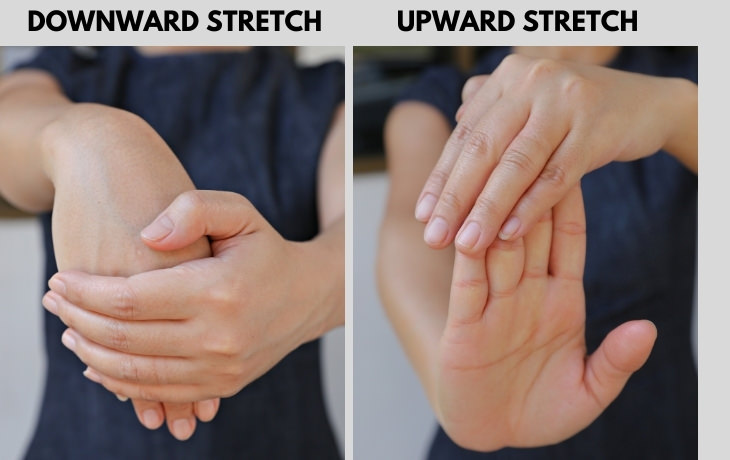
Downward Stretch 
1. Hold your arms out straight in front of you, with one palm facing down. 
2. Use the other hand to press down on the hand that’s facing down. Be gentle, you should feel a stretch on the tops of the palm, wrist, and arm, but no sharp pain. 
3. Hold this position for 5 seconds, then release. Repeat 5-10 times, and then do the same on the opposite side. 
 
Upward Stretch  
1. Hold your arms out straight in front of you, with one palm facing up. 
2. Use the other hand to press on the base of the palm that’s facing up until you sense a pleasant stretch in the inner part of the wrist and arm. 
3. Hold this position for 5 seconds, then release. Repeat 5-10 times, and then follow the same steps on the opposite side.

 
Exercise 2. Strengthen hand muscles with sequential finger bends
 
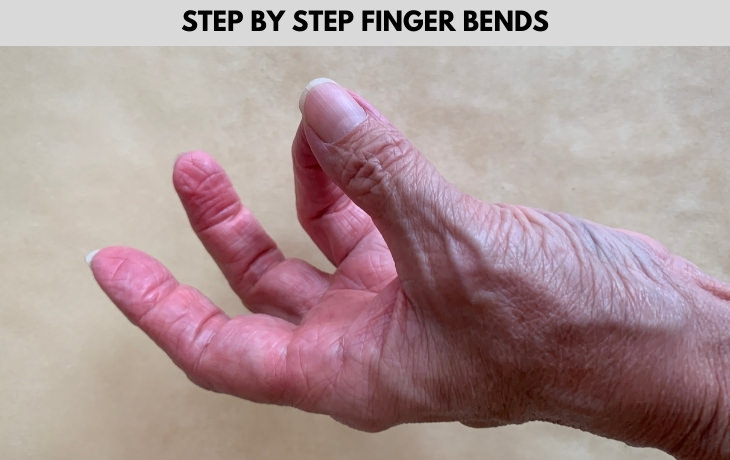
Hand Exercises for Arthritis sequential finger bends

This exercise is like a pushup for your fingers and the base of the palm. It helps strengthen the hand muscles and will improve your grip and flexibility. In this exercise, you will need to bend each finger one after the other. 
 
There are two ways you can do this exercise. If your fingers are relatively flexible, you can bend the finger completely until the fingertip rests where the base of the finger meets the palm. Alternatively, you can bend the finger to meet your thumb, as shown in the image above - this is an easier version of this exercise. 
 
The exercise itself is pretty straightforward. Here are the steps: 
1. Start in the same position, but with only one of your hands held up straight. 
2. Bend your pinkie down toward your palm (or the thumb). Hold this position for 5 seconds. 
3. Straighten the pinkie, and then bend the ring finger for 5 seconds. 
Release, straighten, and move on to the middle finger, and so. 
4. When you get to the thumb, simply bend it towards the palm and hold for 5 seconds. 
5. Repeat the same exercise on the other hand. You can do this exercise several times throughout the day.

 
Exercise 3. Do the “O” or “C” finger bend whenever your hand is feeling stiff

Hand Exercises for Arthritis O finger bend
Unlike the previous task, where we exercised each finger separately, this finger bend activates all the muscles together, which brings relief to hands that feel stiff and weak. Just like the previous exercise, there are two methods of doing this finger bend. The “O” stretch is more advanced and challenging, whereas the “C” stretch is the easier one. 
 
Here are the steps: 
1. As the name suggests, this exercise requires you to curve all of your fingers in until they form a shape similar to the letter “C” or “O”. 
2. Hold for 5 seconds, then release and straighten the fingers. 
3. Repeat 5-10 times on each hand. 
 
 
Exercise 4. Improve strength and relieve stiffness with these variations of a fist
 
Hand Exercises for Arthritis
This is probably the easiest and most straightforward exercise we will show you. It’s also the last one. You can do it anywhere and anytime, which makes it a great option for instant stiffness relief. 
 
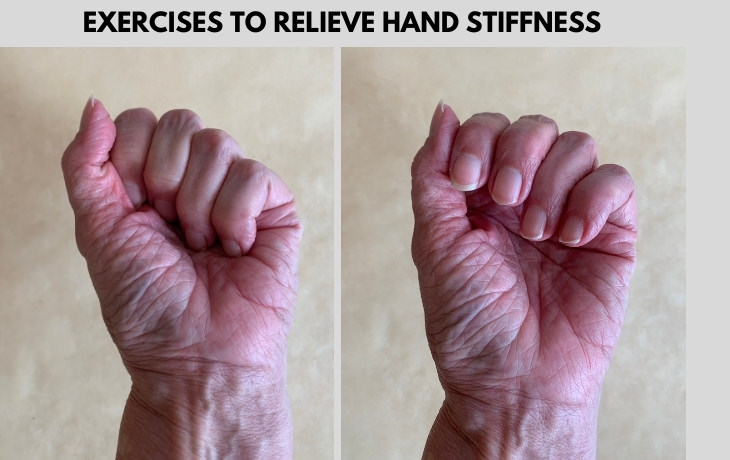
As before, we will walk you through 2 versions of this exercise. The easier one only requires bending your fingers halfway, whereas the more advanced variation requires you to make a full fist. Follow these steps: 
 
1. Hold your arms out straight in front of you, with all the fingers straight. 
2. Slowly bend your hand into a fist halfway, as shown in the image on the right. Your thumb should be on the outside of the hand. 
3. You can stop here and hold this position for 5 seconds. Alternatively, you can bend your fingers inward completely, as shown in the image on the left, and hold. 
4. Open the hand and straighten the fingers. Repeat the exercise 10 times on each hand.


This is only for your information, kindly take the advice of your doctor for medicines, exercises and so on.   


Labels: , , , , ,

Sunday, December 08, 2019

Understanding and Managing Colic Effectively

You have just brought your new born baby home and you can’t stop admiring the tiny human being that you have given birth to. But just then your baby lets out a shrill ear shattering wail and whatever you do just does not seem to comfort your little one. His clenched fists and red face makes you wonder what you did wrong. Your baby may just be showing the signs of a condition called colic.

Colic in babies basically refers to an otherwise healthy baby crying inconsolably for long stretches of time. Symptoms of colic may include frequent spitting up, poor eating and irritability during and after feeds.

While the exact cause of colic is still unknown, some theories include:

The immature digestive system of an infant makes it more susceptible to some of the substances in breast or formula milk.


In the case of breastfed babies, colic may be a reaction to specific foods in the mother’s diet.
    Excessive air in the baby’s gastrointestinal tract

Some studies also indicate a imbalance in the gut micro-organisms to be a probable cause of colic. It has been seen that babies with colic had lower counts of good bacteria such as Bifidobacterium and Lactobacilli as compared to healthy babies.

Addressing colic in infants is not only important for the babies overall health in both short and long term but also to reduce its adverse effects on maternal mental health and the family quality of life.


Tips to Improve Digestion in Infants


A baby is born with an immature gut which may lead to digestive discomfort in otherwise healthy infants. The initial days of an infant are crucial for the development of a healthy and well-functioning digestive tract. A healthy gut microbiota contains a balance of many classes of bacteria that have health promoting functions. An imbalance in gut flora has been found to be associated with asthma and allergy, infantile colic and gastrointestinal disorders, infections, inflammatory bowel disorders and obesity.

Studies indicate that external stimuli such as nutrition and environment play an important role in the development of the infants gastrointestinal (GI) system. As colic is a problem associated with the baby’s gut and that a low amount of good bacteria could be a probable cause for development of colic in the baby, it would be beneficial if ways to increase the count of these beneficial micro-organisms are looked at. As is widely known, human breast milk is the best form of nutrition for infants. It contains two important factors that helps shape the baby’s gut micro-organism in terms of diversity and stability. It acts as an important source of beneficial bacteria and contributes to the establishment of a well-balanced gut flora in a baby. With this, it is also a rich source of oligosaccharides, the third largest component of breast milk after carbohydrates and fat .These oligosaccharides have a prebiotic effect on infant gut health, promoting the growth of beneficial bacteria like bifidobacteria and lactobacilli which may help in reduction of colic in babies.

Prebiotics are basically non digestible carbohydrates that travel to the colon intact and have the ability to selectively stimulate the growth and activity of beneficial bacteria in the colon.


Some other Benefits of Prebiotics are:

    Decreases incidence of falling sick.
    Promotes softer stools.
    Reduces incidence of allergic symptoms like skin allergies.

With little or no role of medication for colic, studies indicate that use of certain probiotic strains, prebiotic oligosaccharides in babies along with a low allergen diet (no consumption of milk and dairy products, etc.) by the mothers in case she is breast feeding may bring relief from colic for the baby. Calming measures like soothing motions, more frequent burping during feeds, offering pacifiers, swaddling, limiting stimulation, carrying baby around in a carrier, massaging the baby’s back or belly, cuddling or holding the baby close and playing music can help soothe the baby.

It is always advisable to check with your health care professional regarding the requirement of any dietary changes for a breastfeeding mother and also rule out any underlying medical condition that is triggering the crying. Also, in cases where breast feeding is not possible, check with your doctor to know alternate ways to manage colic in babies.


this is only for your information, kindly take the advice of your doctor for medicines, exercises and so on.     
https://gscrochetdesigns.blogspot.com. one can see my crochet creations  
https://gseasyrecipes.blogspot.com. feel free to view for easy, simple and healthy recipes    
https://kneereplacement-stickclub.blogspot.com. for info on knee replacement


Labels: , , , , , , , , , , , ,