New Breakthrough Can Save Lives of Cancer Patients
There may be a breakthrough in the fight
against rhabdomyosarcoma, a particularly aggressive type of childhood
cancer that begins in muscle tissue. Scientists have achieved a
remarkable feat by transforming these cancer cells into healthy muscle
cells. This achievement could be a major milestone in the development of
new treatments for this disease, as well as providing valuable
information for treating other human cancers.
"The cells literally turn into muscle," says molecular biologist
Christopher Vakoc of Cold Spring Harbor Laboratory.
"The tumor loses all cancer attributes. They're switching from a cell
that just wants to make more of itself to cells devoted to contraction.
Because all its energy and resources are now devoted to contraction, it
can't go back to this multiplying state."
There may be a breakthrough in the fight against rhabdomyosarcoma, a
particularly aggressive type of childhood cancer that begins in muscle
tissue. Scientists have achieved a remarkable feat by transforming these
cancer cells into healthy muscle cells. This achievement could be a
major milestone in the development of new treatments for this disease,
as well as providing valuable information for treating other human
cancers.
"The cells literally turn into muscle," says molecular biologist
Christopher Vakoc of Cold Spring Harbor Laboratory.
"The tumor loses all cancer attributes. They're switching from a cell
that just wants to make more of itself to cells devoted to contraction.
Because all its energy and resources are now devoted to contraction, it
can't go back to this multiplying state."
Understanding cancer can be a little complicated. Cancer varies
depending on the cell it originates from, unlike the image of a
singular, monolithic entity.
There is a high mortality rate for people with rhabdomyosarcoma; the
survival rate is 50-70% for people at intermediate risk. Differentiation
therapy is one remedy that has proven promise. It came about when
researchers discovered that leukemia cells are immature, much like
undifferentiated stem cells that haven't fully matured into a particular
cell type. These cells are coerced by differentiation therapy to carry
on with their development and differentiate into particular mature cell
types.
Earlier, Vakoc and his team of researchers accomplished an incredible
feat. They managed to undo the cancerous mutation present in cells
linked to Ewing sarcoma, a severe childhood cancer primarily affecting
bones. Their audacious objective was to replicate this accomplishment
for rhabdomyosarcoma, even though experts believed that using
differentiation therapy for this cancer type might take decades to
become feasible.
The research team used advanced genetic screening methodology to achieve
this goal. They wanted to find genes that could turn rhabdomyosarcoma
cells into full-fledged muscle cells. Their solution was encoded in a
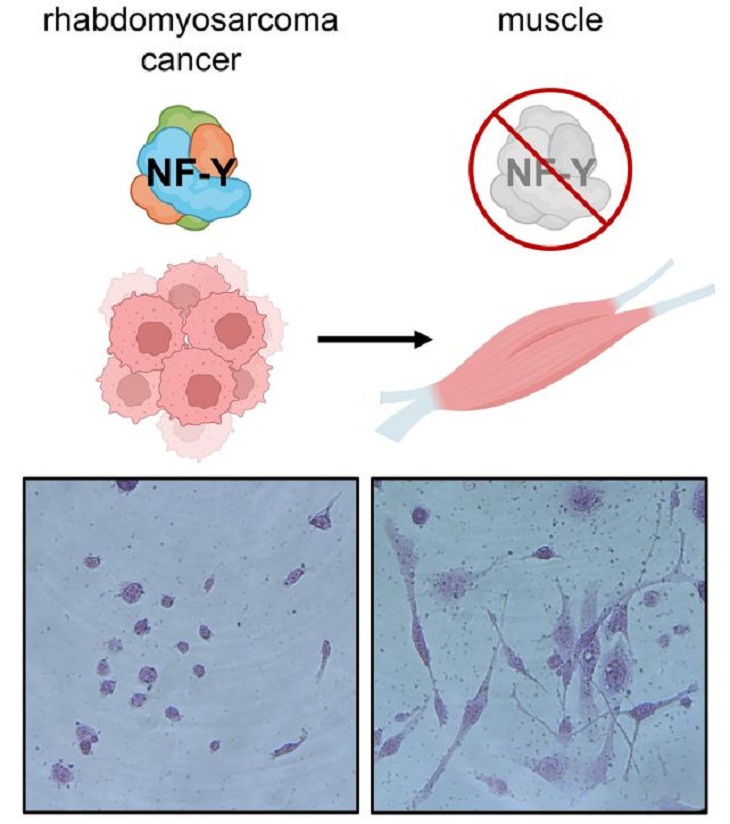
protein known as Nuclear transcription factor Y (NF-Y).
Cells with rhabdomyosarcoma create a distinct protein known as
PAX3-FOXO1, that plays a critical role in the spreading of cancer.
Essentially, the tumor is strongly reliant on this protein.
Surprisingly, the researchers discovered that inhibiting NF-Y
neutralizes PAX3-FOXO1. This halt nudges the cells forward in their
development, culminating in their metamorphosis into mature muscle cells
free of malignant remnants.
The discovery has profound implications, as
it could accelerate the development of differentiation therapies for
rhabdomyosarcoma.
Moreover, the research team has
successfully tested and validated their method on two different types of
sarcoma. They believe that their approach can be customized for
treating other forms of sarcoma and various types of cancer. This
methodology equips scientists with the necessary tools to determine how
to induce differentiation in cancer cells.
"Every successful medicine has its origin story," Vakoc says. "And
research like this is the soil from which new drugs are born."
The research has been published in the Proceedings of the National
Academy of Sciences.
This is only for your information, kindly take the advice of your doctor for medicines, exercises and so on.
https://gscrochetdesigns.blogspot.com. one can see my crochet creations
https://gseasyrecipes.blogspot.com. feel free to view for easy, simple and healthy recipes
https://kneereplacement-stickclub.blogspot.com. for info on knee replacement
https://cancersupportindia.blogspot.com for infor on cancer and health related topics
https://GSiyers home remedies.blogspot.com is the latest addition to my blogs. I'm going to add posts there, do give me your valuable feed back on my blogs. Thanks a lot, take care, be healthy and be happy.
https://gscrochetdesigns.blogspot.com. one can see my crochet creations
https://gseasyrecipes.blogspot.com. feel free to view for easy, simple and healthy recipes
https://kneereplacement-stickclub.blogspot.com. for info on knee replacement
https://cancersupportindia.blogspot.com for infor on cancer and health related topics
https://GSiyers home remedies.blogspot.com is the latest addition to my blogs. I'm going to add posts there, do give me your valuable feed back on my blogs. Thanks a lot, take care, be healthy and be happy.
Labels: breakthrough, cancer treatment, changes into mature muscle cells, inhibiting NF-Y neutralizes, rhabdomyosarcoma. protein-PAX3-FOXO1
posted by G S Iyer at 6:20 AM
0 comments
