Thursday, December 12, 2024

Box Breathing: A Healthy Technique

Over the years, we have encountered many breathing techniques that help calm the mind and body, and are even capable of helping us improve our ability to fall asleep, concentrate, and restore the balance our body needs. If you have tried such breathing techniques in the past and found them beneficial, you will probably be happy to discover a new technique – box breathing – which helps improve concentration, reduce stress, and is recommended for daily practice when you feel your mind is starting to wander or your work is taking a toll on your mental health. How do you do it, what are its benefits, and are there people who should avoid it? We will answer all these questions and more right now.

How to Perform Box Breathing? 
Box breathing is done in 4 simple steps, each lasting exactly 4 seconds: 
1. Inhale – Sit with your back straight, ensure your feet are flat on the floor, close your eyes, and take an inhale for 4 seconds through your nose. Feel how the air fills your lungs. 
 2. Hold the breath – Count to 4 at the same pace as your inhalation. 
3. Exhale – Fully exhale the air from your lungs through your nose for 4 seconds. 
4. Hold the breath – Wait for another 4 seconds. Box Breathing: How to Perform Box Breathing

You should repeat this at least 3 more times (4 in total), and it is recommended to continue for 4 minutes or until you feel calm. If this is difficult for you, you can try counting for 3 seconds instead of 4, and if you find this technique helpful and easy to perform, you can even count for 5-6 seconds. 
 
Since this breathing technique is very easy to perform in any situation, people in high-pressure jobs find many benefits in it, including soldiers, police officers, and even office workers under significant stress. This technique is actually relevant for everyone, and anyone who wants to balance their mind and regain control and focus can use it. 
 
Why is Box Breathing so Essential for Mental and Physical Health? 
Box breathing helps reset your breathing, and in moments of severe stress, this is important for both your physical and mental health. Our body undergoes processes that we do not consciously control, like the autonomic nervous system, which determines, among other things, heart rate and breathing and even affects digestion.
 
When the body feels threatened, it enters "fight, flight, or freeze" mode, releasing hormones like adrenaline and noradrenaline, leading to a chain reaction that causes the heart rate and breathing to become faster and also increases blood sugar levels. Prolonged stay in such a stress state can negatively affect health and wear out the body very quickly. 
Among the long-term effects, you can include: 
High blood pressure 
Headaches 
Heart attack 
Stroke 
 
We cannot directly control blood sugar levels or heart rate, but we can control our breathing, and calming it will affect all other body systems accordingly. Thus, box breathing helps us achieve control and balance, beneficial both in the short and long term. 
 
The Benefits of Box Breathing 
Mark Divine, an author and lecturer who was formerly a commander in the U.S. Navy SEALs, shares that this technique helped him in very stressful and challenging moments during his career. "I used it daily during training, and it helped me finish with excellence and in first place. Today, I use it in any challenging situation I encounter in daily life." Here are some of the benefits of this breathing method:

Reduces physical stress symptoms in the body

Research shows that deep breathing techniques significantly reduce the production of hormones associated with stress, such as cortisol.

In a 2017 study, participants showed lower levels of cortisol after deep breathing, as well as increased attention levels.

Divine also emphasized this. He said, “Box breathing bleeds off excess stress and gives you a handy, on-demand tool to avoid taking on any more stress than you can handle.”

Positively affects emotions and mental well-being

According to the 2017 study, breathing techniques can be useful in the reduction of anxiety, depression, and stress.

Improves future reactions to stress

Studies suggest that box breathing may have the ability to change someone’s future reactions to stress.

In an older 2013 studyTrusted Source, researchers suggested that relaxation response practices, such as meditation, deep breathing, and yoga, can alter how the body reacts to stress by changing how certain genes are switched on.

Genes have different roles within the body. The study found that relaxation response practices boosted the activation of genes associated with energy and insulin, and reduced the activation of genes linked to inflammation and stress.

According to the study, this effect occurs in both short- and long-term practitioners of these techniques. However, the effect is more significant in long-term users.

“Once someone experiences the physical, psychological, and emotional benefits of box breathing, they will want to do it daily.”

– Mark Divine
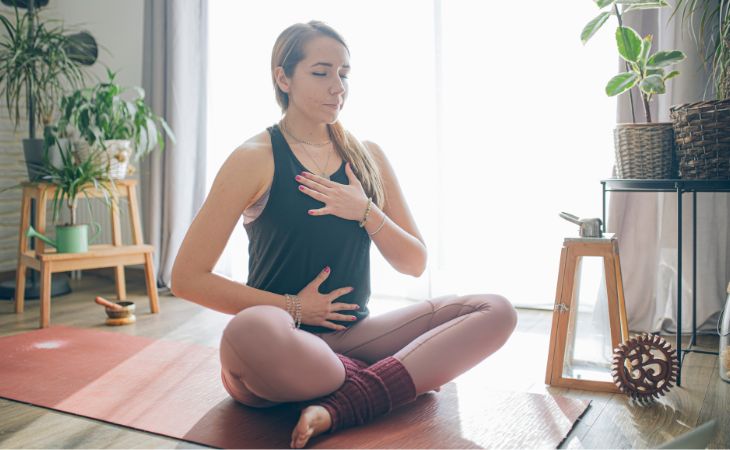
 Box Breathing: A woman practicing breathing exercises

There are a number of steps a person can take to make box breathing easier. A person can:

  • find a quiet space to begin box breathing
  • place one hand on the chest and another on the lower stomach can help
  • try to feel the air and see where it is entering, when breathing in
  • focus on feeling an expansion in the stomach, but without forcing the muscles to push out
  • try to relax the muscles instead of engaging them

Divine recommends that a person incorporate the technique into their daily routine. He says that it can be used alongside other mindfulness exercises.

 He also believes that “box breathing can be used to prepare for a stressful event, such as a speech, or to calm down during or after a stressful event.”


This is only for your information, kindly take the advice of your doctor for medicines, exercises and so on.   

https://gscrochetdesigns.blogspot.com. one can see my crochet creations  
https://gseasyrecipes.blogspot.com. feel free to view for easy, simple and healthy recipes    
https://kneereplacement-stickclub.blogspot.com. for info on knee replacement
https://cancersupportindia.blogspot.com  for infor on cancer and health related topics
https://GSiyers home remedies.blogspot.com   is the latest addition to my blogs. I'm going to add posts there, do give me your valuable feed back on my blogs. Thanks a lot, take care, be healthy and be happy.

Labels: , , ,

Friday, December 28, 2018

9 Breathing Techniques To Help For Good Sleep

Many people find it difficult to sleep. They may have tried many things including taking meds. Now, in stead of meds for everything- pain, cold, cough, sleep and so on, why not try some simple breathing exercises, which can help you to sleep better.
Here's what to remember before getting started: 
When doing the breathing exercises, it is always good to keep your eyes closed, which may help you shut out distractions. Keep your mind focused on your breath and think about the healing power of your breath. While these nine breathing exercises each have their own pros, benefits may vary slightly. Take a look to see which is the best match for you and you'll be sleeping soundly in no time: 

1. 4-7-8 breathing technique 
Here is how to practice the 4-7-8 breathing technique:
1. Allow your lips to part gently, then exhale completely, making a breathy whoosh sound as you do.
2. Press your lips together as you silently inhale through the nose for a count of 4 seconds, then hold your breath for a count of 7 and exhale again for a full 8 seconds, making a whooshing sound throughout.
3. Repeat this breathing technique for a total of four times, eventually making your way up to 8 repetitions. 

Benefits: This ancient yogic technique helps people relax as it replenishes oxygen in the body. 

2. Bhramari pranayama breathing exercise 
Follow these steps to perform the original Bhramari pranayama breathing exercise: 
1. Close your eyes and deeply breathe in and out.
2. Cover your ears with your hands and place your index fingers above your eyebrows, resting your fingers over your eyes.
3. Then, put gentle pressure to the sides of your nose and focus on your brow area.
4. Keep your mouth closed and breathe out slowly through your nose. As you do so, make the humming 'Om' sound.
5. Repeat the process for a total of 5 times. 

Benefits: This breathing exercise has been shown to quickly reduce breathing and heart rate, which tends to be very calming and is able to prepare your body for sleep. 

3. Three-part breathing exercise 
Here's what you nee to do to complete this three-part breathing exercise: 
1. Take a long, deep inhale, then exhale fully while focusing intently on your body and how it feels.
2. Once you've done this a few times, begin to slow down your exhale, ensuring that it is twice as long as your inhale. 

Benefits: Is one of the most simple breaths to perform and help keep the mind calm. 

4. Diaphragmatic breathing exercise 
To do diaphragmatic breathing exercises:
1. Lie on your back and bend your knees over a pillow or sit in a chair.
2. Place one hand flat against your chest and keep the other on your stomach, and take slow deep breaths through your nose, keeping the hand on your chest still, as the hand on your stomach rises and falls with your breaths.
3. Now, breathe in slowly through purse lips and eventually you'll be able to breathe in and out without your chest moving. 

Benefits: This technique slows your breathing and decreases your oxygen needs as it strengthens your diaphragm. 

5. Alternate nasal breathing exercise 
Tips on who to do the alternate nasal or alternate nostril breathing exercise: 
1. Sit with your legs crossed and place your left hand on your knee and your right thumb against your nose.
2. Then exhale fully and close the right nostril.
3. Inhale through your left nostril.
4. Open your right nostril and exhale through it, while closing the left. Continue this rotation for 5 minutes, finishing by exhaling through your left nostril.

Benefits: A study conducted in 2013, found that people who tried nasal breathing exercises felt less stressed afterward. 

6. Buteyko breathing
To practice buteyko breathing for sleep do this:
1. Sit in bed keeping your mouth gently closed, not pursed, and breathe through your nose at a natural pace for about 30 seconds.
2. Gently pinch your nose closed with your thumb and forefinger, and keep your mouth closed as well until you feel that you are able to breathe again.
3. Keeping your mouth closed, take a deep breath in and out through your nose. 

Benefits: Most people are unaware that they are hyperventilating and this exercise will help you reset to a normal rhythm of breathing.

7. The Papworth method 
In this breathing exercise, you focus on your diaphragm to breathe more naturally.
1. Sit up straight, and take deep, methodical breaths in and out, counting to four with each exhale (also through the nose).
2. Keep your mind fixed on your abdomen rising and falling, listening to your breath for sounds to come from your stomach. 

Benefits: This breathing exercise is great for reducing habits of yawning and sighing. 

8. Kapalbhati breathing exercise 
Also known as pursed-lip breathing, kapalbhati involves four steps:
1. Breathe in deeply through the nose, then pucker your lips as though you are going to blow on a pinwheel.
2. Through your pursed lips, exhale three times more slowly than you inhaled.
3. Repeat until you feel calm and sleepy.

Benefits: This breathing exercise relieves shortness of breath and improves ventilation by getting rid of excess carbon dioxide. 

9. Box breathing 
During box breathing focus intently on the oxygen that you are bringing in and pushing out as follows:
1. Sit with your back straight and breathe in, then push all the air out of your lungs as you exhale.
2. Inhale slowly through your nose and silently count to four as you fill your lungs with air.
3. Hold the breath to a count of four, then slowly exhale through the mouth as you focus on getting all the oxygen out of your lings. 

Benefits: This breathing technique will help keep you focused and relaxed.


THIS IS ONLY FOR INFORMATION, ALWAYS CONSULT YOU PHYSICIAN BEFORE HAVING ANY PARTICULAR FOOD/ MEDICATION/EXERCISE/OTHER REMEDIES.                                                                                
 PS- THOSE INTERESTED IN RECIPES ARE FREE TO  VIEW MY BLOG-                                                                                           https://gseasyrecipes.blogspot.com/                                                                                                                                                                             FOR INFO ABOUT KNEE REPLACEMENT, YOU CAN VIEW MY BLOG-                                               
     https:// kneereplacement-stickclub.blogspot.com/                                                                                     
  FOR CROCHET DESIGNS                                                                                                                                                                                                              https://gscrochetdesigns.blogspot.com


Labels: , , , , , , , , , , , , ,