Tuesday, October 21, 2025

Microchip gives vision to blind: Age-related macular degeneration patients able to read clearly in trial
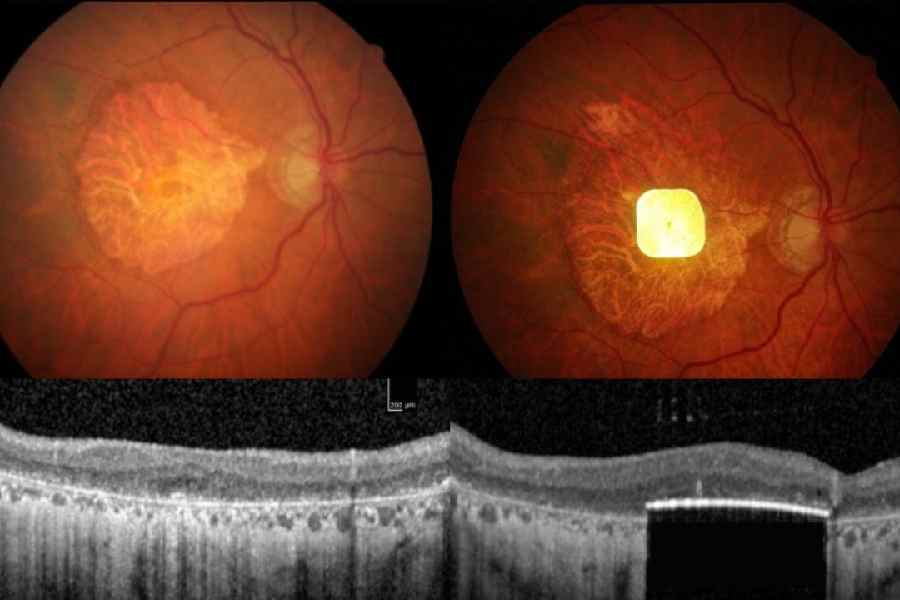
 Image of the implant in the patient's eye. Image of the implant in the patient's eye. 

A tiny electronic implant paired with special glasses has helped restore functional vision in patients with advanced dry age-related macular degeneration (AMD), an incurable cause of blindness, medical researchers announced on Monday.

Twenty-seven (84 per cent) of 32 patients with AMD who participated in a clinical trial across five countries were able to read letters, numbers and words using the implant, the researchers said, reporting their findings in the New England Journal of Medicine.

With the device, the patients were able to read on an average five lines on a vision chart. Some patients had been unable to even see the charts before they received the implants.

All previous attempts to provide vision with prosthetic devices had resulted in light perception, not form vision, which is the ability to perceive shapes and patterns, said Daniel Palanker, professor of ophthalmology at Stanford University who co-led the research.

“We are the first to provide form vision,” Palanker said in a media release from Stanford.

Advanced AMD destroys light-sensitive cells in the macula, the retina’s central part responsible for sharp vision, leading to a blurry or blank spot at the centre of sight. The disease, which often leaves peripheral vision intact, affects over five million people worldwide.

The implant, designed by Palanker and collaborator José-Alain Sahel at the University of Pittsburgh, bypasses the dead light-sensitive cells by converting light captured in the residual retina into electrical signals that are transmitted to the brain.

During the procedure, surgeons remove the vitreous jelly between the lens and the retina and implant a 2mm×2mm microchip, about half the thickness of a human hair, under the centre of the retina.

A month later the chip is activated, sending signals the brain interprets as vision, and patients undergo training to learn to focus, zoom and read again.

In the trial, 19 patients experienced temporary side effects, including ocular hypertension and sub-retinal bleeding, but they were all resolved within two months with no life-threatening events.

With digital enhancements such as zoom and higher contrast, some participants could read with acuity equivalent to 20/42 vision — on a standard eye chart, they could see letters at 20 feet that most people with normal eyesight could see from 42 feet.

Based on the trial results, Science Corporation, a US company developing advanced medical technologies, has applied for clinical-use authorisation in Europe and the US.

“While we can’t restore full 20/20 vision with the implant alone, we are now investigating methods that could further improve people’s quality of life,” Sahel said.

The implant has emerged after nearly two decades of development, including prototypes, animal trials and a first-in-human trial in 2020.

Palanker first envisioned the device in 2005 while working with ophthalmic lasers to treat eye conditions.

Currently, the device provides only black-and-white vision. Palanker and his colleagues are working on software to enable the full range of grayscale, important for face recognition.

Scientists hope to engineer future chips for higher resolution, aimed at further improvements in vision.

The global trial, led by Frank Holz of the University of Bonn, included participants from the UK, France, Italy and the Netherlands.

Mahi Muqit, an associate professor at the University College London (UCL)Institute of Ophthalmology, said: “Blind patients are actually able to have meaningful central vision restoration (with the implant), which has never been done before.”

“Before receiving the implant, it was like having two black discs in my eyes,” Sheila Irvine, one of the trial participants in the UK, said in a UCL media release.

“I was an avid bookworm, and I wanted that back…. There was no pain during the operation, but you’re aware of what’s happening,” she added.

“It’s a new way of looking through your eyes, and it was exciting when I began seeing a  letter. It’s not simple, learning to read again, but the more hours I put in, the more I pick up.”


This is only for your information, kindly take the advice of your doctor for medicines, exercises and so on.   


Labels: , ,

Saturday, March 12, 2022

Symptoms Almost Completely Disappeared with New Virus

According to a small, preliminary clinic trial, it was found that injecting a common cold-like virus into the eyes of age-related macular degeneration (AMD) patients can halt and reverse the progression of the disease. 
 
AMD is one of the leading causes of blindness in the US. Though this new finding has brought some hope in slowing down the disease, the results will need to be replicated in a much larger group of patients. Still, the early signs suggest that a single injection of the specially engineered virus can kick the body's natural immune response into action, clearing out the fluid that causes permanent vision loss. 
 
The study, conducted by researchers at Johns Hopkins Medicine in Maryland, targeted a protein called vascular endothelial growth factor (VEGF), which is overactive in people with wet AMD (a rare and more severe form of the disease, which causes new blood vessels to grow beneath the retina and leak blood and fluid into the eye). Research shows that the build-up of fluid causes permanent damage to light-sensitive retina cells, prompting them to progressively die off, leaving blind spots in the center of a person's vision. 
 
Treatments for wet AMD do exist, however, they involve getting injections in the eye once every four weeks. To maintain the benefits, you therefore have to keep up monthly injections for the rest of your life. The side effects of current medications available also include eye infections and an increased risk of stroke.
age related blindness
The team at John Hopkins demonstrated that in a handful of patients, there could be a way to halt and possibly, reverse the progression of wet AMD with a single injection. Though the preliminary study is small, results are a promising step towards a new approach that will reduce doctors visits, as well as the anxiety and discomfort due to repeated injections in the eye, and it has also been found to improve long-term outcomes. 
 
Phase 1 of the clinical trial involved 19 men and women, older than 50 years, with advanced wet AMD. The men and women were divided into five groups that received increasing doses of a viral vector called AAV2 - a common cold-like virus that has been genetically engineered to penetrate the patients' retinal cells and deposit a gene that prompts the production of a protein called sFLT01. Once the virus has deposited the gene, the cells started to secrete sFLT01 which bound to VEGF and prevented it from stimulating leakage and growth of abnormal blood vessels. The aim is for the retinal cells infected by the virus to reproduce enough sFLT01 to permanently stop the progression of AMD. 
 
Previous research has shown that sFLT01 can inactivate VEGF. However, until now, scientists had struggled to get the body to produce it on its own - instead they've had to regularly inject VEGF suppressing proteins to keep it in check.

In the clinical study, the first three groups were given the lowest doses of the AAV2 virus, and after they showed no negative side effects, the final two groups were given the maximum dose. It was reported that no severe side effects were reported in either of the groups. Furthermore, it was said that even at the highest dose, the treatment was quite safe and no adverse reactions in patients were found. 
 
The participants were selected based on their lack of response to all other standard treatment options - eight of which were unlikely to respond, even to their new treatment. From the remaining 11, four showed dramatic improvements after a single injection. It was reported that the amount of fluid in their eyes reduced from severe to almost nothing. A further two patients reported a partial reduction in the amount of fluid in their eyes. While the remaining five weren't as lucky. They experienced no improvement in vision after the injection. However, the researchers realized that their bodies naturally produced antibodies that attack the AAV2 virus. 
 
Unfortunately, it will take a much larger clinical trial to figure out if the almost 50-50 chance of success in this study is an accurate indication of how the wider population will react to treatment. Nevertheless, the development seems promising, particularly when advanced AMD is expected to rise to 5.44 million Americans by 2050. In which case, treatment that works for only half of wet AMD patients could still change hundreds of thousands of lives.

This is only for your information, kindly take the advice of your doctor for medicines, exercises and so on.   

https://gscrochetdesigns.blogspot.com. one can see my crochet creations  
https://gseasyrecipes.blogspot.com. feel free to view for easy, simple and healthy recipes    
https://kneereplacement-stickclub.blogspot.com. for info on knee replacement


Labels: , , , , , , ,