Friday, July 29, 2022

Start Pole Walking to Improve Your Heart Health

The heart is one of the body's most vital organs and is also central to life as it pumps blood throughout the body via the circulatory system. Therefore, it’s crucial to keep your heart in good health. Unfortunately, the human heart can experience a range of issues that can affect its ability to function properly. Coronary artery disease, caused by plaque buildup in the wall of the arteries that supply blood to the heart, is one such common heart problem. The CDC estimates that 20.1 million adults age 20 and older have coronary artery disease in the USA, and it was responsible for the deaths of 382,820 people in 2020.

Experts have been constantly trying to find ways to improve the health of people with coronary artery disease, and one new development has given hope in that regard. A recent study published in the Canadian Journal of Cardiology found that Nordic walking is better than other workouts for heart health. 
 
The researchers investigated the impact of different types of exercise on people with coronary artery disease. Their results revealed that Nordic walking – brisk walking with poles – improved the mental and physical health of the participants more than other types of exercises. 
 
Nordic walking to improve heart health
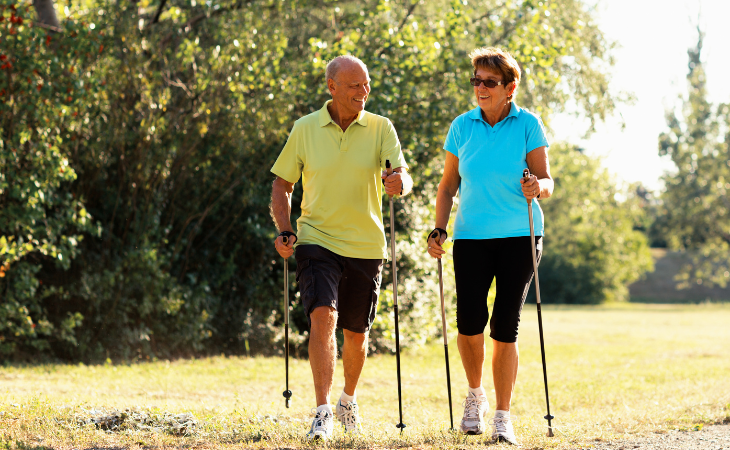
Nordic Walking Technique
The study involved 130 participants with coronary artery disease. The researchers asked them to complete a 12-week workout program, which involved one of three different types of exercises: 
 
* High-intensity interval training (HIIT) 
 
* Moderate-to-vigorous intensity continuous training (MICT) 
 
* Nordic walking. 
 
The team used a 6-minute walk test to evaluate the participants' "functional capacity," which looks at a person’s ability to complete activities of daily living. The researchers went one step further and even studied how these exercises impacted their quality of life and symptoms of depression.
 
They found that those doing Nordic walking scored better on the test than those doing high-intensity interval training and moderate- to vigorous-intensity continuous training. The study also revealed that while all the exercises positively impacted the participants’ functional capacity, quality of life, and symptoms of depression, those in the Nordic walking group experienced the greatest benefit. The researchers noted that this is because Nordic walking increased functional capacity the most. The team measured all three parameters at the start of the trial, then at 12 and 26 weeks. 
 
"If someone is looking for an alternative type of exercise, I think Nordic walking can easily be adapted for people who need Nordic walking poles, and it changes Nordic walking into a whole-body exercise," says Ph.D., of the University of Ottawa Heart Institute in Ontario, Canada. "In addition to using your legs to walk, Nordic walking also adds exercise for your upper body as well. You use your arms to move forward, and that can lead to greater energy expenditure."

Other findings from the study indicated that from the beginning to the end of the course, the participants’ physical activity went up significantly. Moreover, this improvement remained up through the 14-week observation period. 
 
The study authors do note that, while their trial had a long follow-up time, future research should examine the prolonged benefits of different types of exercise, including Nordic walking. They also say that Nordic walking gives another option for exercise that could be beneficial for everyone’s health. 
 
The basics of Nordic walkingwalking with poles
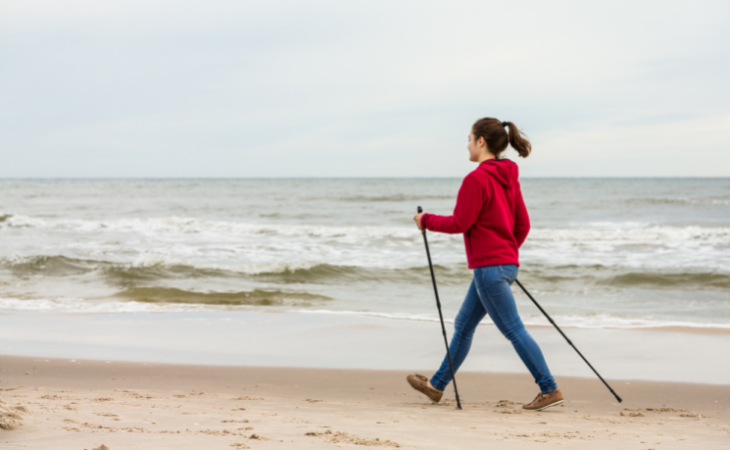
Experts say that patients with heart disease should increase exercise and physical activity. Since this new study shows that Nordic walking can be helpful for heart patients, let’s explore the basics of this workout. 
 
As we mentioned earlier, Nordic walking is a walking style that uses poles to help you move forward. As the name suggests, the activity came from Finland and has become popular all over the world. The activity requires specially-designed walking poles, which are attached to the hands through a strap. This walking style demands more effort than traditional walking, as you will be applying pressure to the poles as you walk with each step. During this workout, both your upper and lower body muscles will be stimulated more than they are during normal waking, which may lead to a considerable increase in heart rate at a given speed.

According to the Journal of Physical Therapy Science, the primary purpose of using a pole in Nordic walking is to engage the upper limb muscles, which are not normally used in walking, and to “facilitate high-intensity exercise with the minimum effort by adjusting the energy consumption of the body.” 
 
Nordic walking is guaranteed to give you a highly effective all-over workout. In addition to improving your heart health, pole walking has other benefits too. 
 
* It can improve your upper-body strength, cardiovascular endurance, and even flexibility. 
 
* It uses a lot more muscles than regular walking and burns up to 46% more calories. 
 
* It boosts your exercise capacity. This is because the activity will keep the weight off the lower body joints as the poles are supporting you and providing propulsion. But, at the same time, you will be working harder as you are bringing in your other body muscles. 
 
* It increases oxygen uptake by around 11%-23%. 
 
* It increases muscle strength as it helps people use all the muscles of the upper body and not just the lower body. 
 
* It improves balance and posture by improving upper and lower body strength and steadiness. 
 
* It can help lift your mood if you're doing the workout outdoors and somewhere scenic.  
 
Let’s now learn the basics of this technique:

Purchase a set of Nordic walking poles. 
 
Attach the poles to your wrist via pole straps. 
 
Start walking naturally. Keep shoulders relaxed and down. Lean upper body slightly forwards. 
 
As you get used to the poles, start taking longer strides than usual. 
 
Make sure you don’t change the way you typically move your arms. With each step, roll the foot from the heel to the ball of your foot. 
 
Swing your arm from your shoulder and plant your poles at an angle to get forward propulsion. 
 
Let your torso move naturally as you push off with the poles. 
 
Start by covering short distances for about 15-20 minutes. You can increase the time and distance as you get used to the new exercise.


This is only for your information, kindly take the advice of your doctor for medicines, exercises and so on.   

https://gscrochetdesigns.blogspot.com. one can see my crochet creations  
https://gseasyrecipes.blogspot.com. feel free to view for easy, simple and healthy recipes    
https://kneereplacement-stickclub.blogspot.com. for info on knee replacement

Labels: , , , , , , , ,

Saturday, August 17, 2019

Research shows how nordic walking may benefit breast cancer patients


Nordic walking, an aerobic activity performed with walking poles similar to ski poles, may benefit patients with breast cancer, according to a review of existing research.

The low-impact exercise improved swelling, physical fitness, disability and quality of life, the study authors conclude.

“The main strategy in rehabilitation for women with breast cancer is a change of habits, where physical exercise is a fundamental tool,” said study co-author.

“It’s not easy to turn a sedentary person into an amateur athlete, so sports such as Nordic walking are accepted more easily,” the author told, particularly since the activity doesn’t require expensive equipment, can be done in a group with others, and is easy to learn.

Introduced in the 1980s as a summer training exercise that was similar to cross-country, or Nordic, skiing, Nordic walking became more widespread in the 2000s. It’s now part of some exercise-based rehabilitation programs, especially in Northern Europe where it is more common, he noted.

He also owns a personal training company,  that creates physical activity programs for people with specific needs, including injuries, obesity, pregnancy, postpartum and women with breast cancer, and he specializes in Nordic walking training.

To see if this form of exercise helps women treated for breast cancer to reduce side effects like arm swelling, and offers other benefits of exercise, the researchers analyzed nine studies. Four studies were randomized controlled trials comparing Nordic walking to other activities; the other studies focused on specific effects of Nordic walking.

Periods of exercise in the studies ranged from 30 to 80 minutes and were performed on one to five days a week for up to 12 weeks.

In eight of the nine studies, Nordic walking had a positive effect on a number of breast cancer symptoms, including lymphedema, fitness, upper-body strength, disability and perceptions of pain and swelling.

A handful of studies also showed improvements in depression, self-efficacy for managing pain and improvements in physical activity levels. They didn’t find any adverse effects, and the study participants seemed to stick with the programs.

The biomechanical gesture of Nordic walking, compared to just walking, seemed to counteract some of the side effects that can come from cancer treatment, such as shoulder-arm mobility and postural problems, the study team writes.

“(Many) health professionals and therapists do not realize that there are contraindicated exercises during breast cancer rehabilitation and that alternatives such as Nordic walking can be very effective,” he said.

“Nordic walking is a structured form of physical activity which nowadays has been shown to be ‘more complete’ than basic walking,” said a researcher, who wasn’t involved in the research review.

“Another important point that is less stressed by these authors: quality of life,” he said in an email. “Nordic walking gives huge benefits because breast cancer patients are survivors, and from a socio-psychological point of view, that really impacts their life.”

Future studies should also investigate the intensity, frequency, duration, and length of exercise needed to help breast cancer patients, said another researcher, who also wasn’t involved in the review.

“What is most evident is the growing interest of the scientific community in tracking the needs, interests and preferences of patients,” he said by email.

“Offering them novel forms of physical activity that are both effective and engaging has become one of the new and stimulating research fields in cancer therapy and management.”


THIS IS ONLY FOR INFORMATION, ALWAYS CONSULT YOU PHYSICIAN BEFORE HAVING ANY PARTICULAR FOOD/ MEDICATION/EXERCISE/OTHER REMEDIES.                                    PS- THOSE INTERESTED IN RECIPES ARE FREE TO  VIEW MY BLOG-                                                                                           https://gseasyrecipes.blogspot.com/                                                                                                                                                FOR INFO ABOUT KNEE REPLACEMENT, YOU CAN VIEW MY BLOG-                                                                       https:// kneereplacement-stickclub.blogspot.com/                                                                                                                     FOR CROCHET DESIGNS                                                                                                   
                                https://gscrochetdesigns.blogspot.com


Labels: , , , , , , , ,

Saturday, February 04, 2017

World Cancer Day: Five sports for cancer patients and survivors

World Cancer Day, February 4, is an ideal opportunity to highlight the important role that sport and exercise can play in the fight against the disease. As a complement to treatments, physical activity can slow the progression of the disease, improve quality of life and reduce the risk of relapse. Here's a selection of suitable activities to try, preferably with a friend. 

Getting moving while fighting cancer or after recovery is essential for reducing fatigue (reduced by 36% on average according to several scientific studies), limiting the loss of muscle mass caused by anticancer treatments, and managing side effects.

Sport is also an excellent remedy for lifting mood and regaining mental wellbeing. It promotes sleep, stimulates immunity and helps rebuild self-esteem. After recovery, physical activity can improve survival rates by reducing the risk of metastasis and relapse. 

Three 20- to 30-minute sessions per week are recommended, as regularity is more important than intensity.

Here's a pick of suitable sports and activities, overseen by specially trained instructors from associations or clubs.
  
Nordic walking-
This low-impact stress-buster is a great alternative to power walking. It's ideal for getting out in the fresh air and getting the blood pumping. Walking with sticks requires coordinated movement, getting all muscles moving while boosting energy expenditure. Nordic walking is recommended as a preventative activity, as well as for cancer patients and survivors, particularly those affected by breast cancer. Nordic walking can be practiced at any age. Various groups, clubs and associations now offer the sport.

Nordic walking (originally Finnish sauvakävely) is fitness walking with specially designed poles. While trekkers, backpackers and skiers had been using the basic concept for decades.  Nordic Walking's concept was developed on the basis of off-season ski-training activity while using one-piece ski poles.

For decades hikers and backpackers used their one-piece ski poles long before trekking and Nordic walking poles came onto the scene. Ski racers deprived of snow have always used and still do use their one-piece ski poles for ski walking and hill bounding. The first poles specially designed and marketed to fitness walkers were produced by Exerstrider of the USA in 1988.

Compared to regular walking, Nordic walking (also called pole walking) involves applying force to the poles with each stride. Nordic walkers use more of their entire body (with greater intensity) and receive fitness building stimulation not present in normal walking for the chest, latissimus dorsi muscle, triceps, biceps, shoulder, abdominals, spinal and other core muscles that may result in significant increases in heart rate at a given pace.Nordic walking has been estimated as producing up to a 46% increase in energy consumption, compared to walking without poles.
According to the findings of the research, conducted by the group scientists from various universities*, both Nordic walking and conventional walking are beneficial for older adults. However, Nordic walking provides additional benefits in muscular strength compared to conventional walking, making it suitable for improving aerobic capacity and muscular strength as well as other components of functional fitness in a short period of time. The key points stated by the study authors are: Nordic walking, conventional walking, and resistance training are beneficial for older adults. •Nordic walking and conventional walking both improve cardio-respiratory fitness while resistance training does not. •Nordic walking provides additional benefits in upper-body muscular strength compared to conventional walking. •Nordic walking is an effective and efficient mode of exercise to improve overall fitness in older adults.

Elliptical training-
The elliptical trainer, or cross-trainer, is a machine found in most gyms, offering beneficial stamina-building exercise that's a whole body workout. It can be practiced during chemotherapy to help reduce fatigue or as a preventative activity. A study published in JAMA Oncology showed that 300 minutes of elliptical trainer reduced body fat and reduced the risk of breast cancer in postmenopausal women. This workout can be enjoyed alone or with a gym buddy.

 Dragon boat-
This paddle-powered dugout canoe is traditionally associated with Asia. The activity, which is akin to rowing, is particularly recommended for women who have previously suffered from breast cancer, as it promotes lymphatic drainage while using back muscles and working the arms. This cooperation-based team sport also relies on the strength and energy of each individual. It's a drug-free therapy that combines sport, fun and camaraderie outside in the fresh air!

 Qi gong-

This branch of traditional Chinese medicine is today recognized and used in certain hospitals, like the CHU de La Pitié-Salpêtrière in Paris, to ease the side effects of chemotherapy. Qi gong increases the uptake and absorption of oxygen from the blood. Its effect on certain enzymes has also been demonstrated. By improving the flow of internal energy throughout the body, qi gong improves well-being, reduces fatigue and fosters serenity.

Médiété®-  This activity, practiced in France, was developed by the co-founder of the French association CAMI Sport et Cancer. The technique teaches movements that are specially tailored, effective and intense, and which use all of the body's muscle and bone chains. Based on beneficial postures, Médiété® improves balance while also toning, stretching and strengthening, and teaches breathing exercises. It features choreographed routines involving a series of movements. It's touted as a good way of reconnecting with the body and clearing the head. 

  this is only for your information, kindly take the advice of your doctor for medicines, exercises and so on.
https://gscrochetdesigns.blogspot.com. one can see my crochet creations
https://gseasyrecipes.blogspot.com. feel free to view for easy, simple and healthy recipes 
https://kneereplacement-stickclub.blogspot.com. for info on knee replacement


Labels: , , , , , , , , , , , ,