Hernia - 5 Common Types and Symptoms
Hernias are more common than you think.
Hernias are extremely common, and practically anyone - men, women, and
children - can get them. In the USA alone, 1 million hernia corrections
are done each year, and those are only the cases that require surgical
repair. Around 10% of all Americans will develop a hernia during their
lifetime.
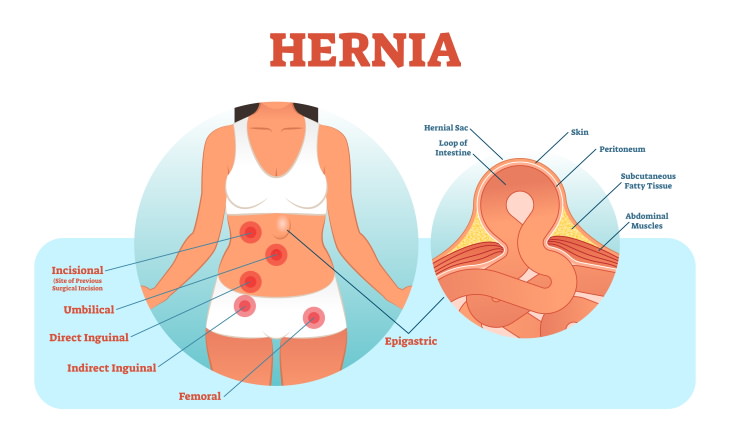

Some hernias can remain benign for years,
but others are a medical emergency. Read this guide to learn about this
often overlooked medical condition and the 5 most common types of
hernia.
General Information About Hernias
A hernia develops when an organ bulges through the muscle or any other
tissue that usually holds it in place. For instance, a piece of the
intestines may push through a weak point in the abdominal wall. Spotting
a hernia is often not difficult, as it looks like a lump under the
skin. A hernia is usually more visible when you’re standing, coughing,
or bending, and it may even vanish completely when you’re lying down.
Some hernias trigger no symptoms whereas
others can be quite painful. It all depends on the location, type, and
severity of the hernia.
If a hernia is painful and doesn’t flatten out when you’re lying down,
urgent medical attention is required to free up the intestine and
prevent complications. This is called a non-reducible hernia, and it may
become a strangulated hernia and cause gangrene. It happens when the
herniated tissue becomes trapped and starts dying off. Urgent surgery is
required to undo a strangulated hernia.
You can either be born with a hernia or develop it over time. Acquired
hernias develop whenever a person has weak muscles and they are
straining too much. Such factors as childbirth, chronic coughing,
constipation, weight gain, aging, smoking, or lifting heavy weights all
increase your risk of hernia. Men are generally more likely to develop
hernias than women, but this also depends on the type of hernia.
Depending on their location in the body, hernias are divided into many
different types. Below, we review 5 of the most common types of hernia.
The Most Common Types of Hernia
1. Inguinal hernia
Inguinal hernias occur in the groin area,
typically on the right side, and they are one of the most common hernias
- states the National Institute of Diabetes and Digestive and Kidney
Diseases. Around 27% of men and 3% of women have an inguinal hernia over
the course of their life. Most cases occur in children aged 5 or
younger and senior adults aged 75 and older. An inguinal hernia can
either contain small intestines or female reproductive organ tissue. In
most cases, inguinal hernias need to be fixed through minimally invasive
surgery, for they have a high risk of complications.
Femoral hernias are often confused for inguinal hernias, as they too
occur in the groin area. However, this type of hernia is more common in
women because their pelvis is naturally wider. A femoral hernia may
constrict the femoral artery and vein, so it usually requires surgical
treatment.
2. Incisional hernia
An incisional hernia develops after abdominal surgery. Incisional
hernias can show up months or even years after surgery. The size of the
hernia can be rather small or very large. It is estimated that 15-20
percent of patients develop these hernias following abdominal surgery.
Your risk of developing an incisional hernia following surgery go up in
the following cases:
It was an emergency surgery.
You had a complication or infection during or after surgery.
You suffer from diabetes, obesity, or kidney failure.
You take immunosuppressants or steroids.
You smoke.
If the incisional hernia is very small, it may not require surgical
removal, but larger or more complex incision hernias require surgery.
3. Hiatal hernia
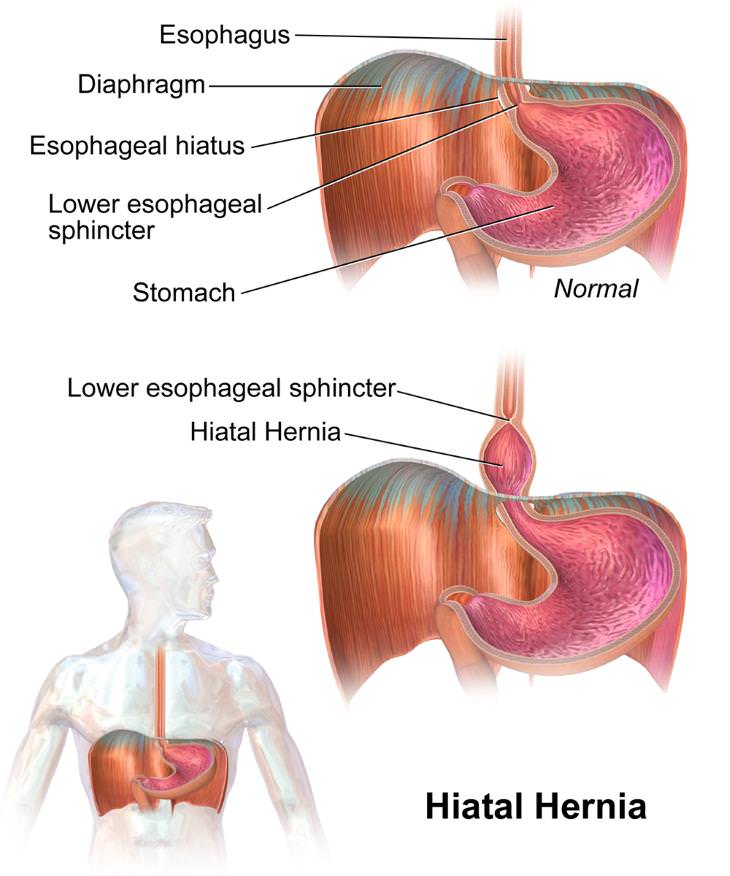
A hiatal hernia is slightly different from other hernias because it is
not visible. Hiatal hernias develop internally when the upper part of
the stomach sticks out of the diaphragm - the muscle that divides the
chest and the abdominal cavity. Due to the unique location of this
hernia, it can mimic symptoms of gastroesophageal reflux disease (GERD):
acid reflux, heartburn, and pain in the chest.
Hiatal hernias are most common in adults over age 50, pregnant women,
and overweight persons. Surgery for this type of hernia is more
complicated and is usually only recommended in more severe cases, or
when you’re experiencing many uncomfortable symptoms.
4. Epigastric hernia

The epigastric region of the abdomen - the
area below the rib cage and above the belly button - is where epigastric
hernias can occur. Epigastric hernias are formed when there’s a gap
between the abdominal muscles that lets fat tissue or intestines escape
from inside the abdomen. Epigastric hernias are more common in men, and
they account for 2%-3% of all hernias. Babies can also be born with
epigastric hernias.
An epigastric hernia may not be visible right away, but you can feel it
when you cough or strain your abdominal muscles. You may also feel pain
or tenderness in the area. Smaller epigastric hernias rarely require
surgery, but large ones or those that contain intestinal tissue are
cause for surgery.
5. Umbilical hernia
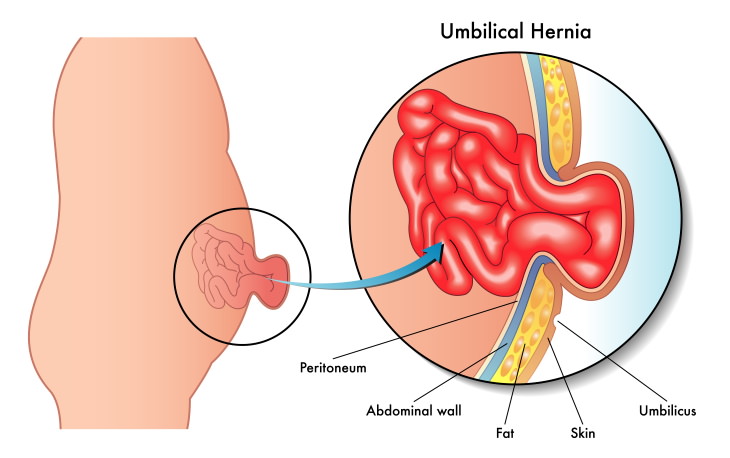
Umbilical hernias occur when the intestines
protrude in the area of the belly button. It looks like a bulge near or
in the belly button, and it usually is more apparent when you’re
straining the belly muscles or coughing. Umbilical hernias account for
around 10% of all adult hernias according to the American College of
Surgeons. Abdominal pressure caused by pregnancy, excessive weight, or
chronic coughing makes you more likely to develop an umbilical hernia.
That said, this type of hernia is even more widespread in infants -
around 20% of babies under 6 months old develop these hernias.
Fortunately, umbilical hernias in babies tend to clear up on their own
in 3-5 years. In adults, umbilical hernias do not go away on their own
and tend to get worse over time. If the umbilical hernia doesn’t cause
pain or discomfort, it does not normally require surgery.
Is Hernia a Medical Emergency?
In many cases, a small hernia may not be an
indication for immediate surgery. Keep in mind, however, that most
adult hernias won’t go away on their own accord. Only a doctor can
diagnose the hernia and assess if it requires surgical removal.
Sometimes, a hernia is a medical emergency. If you have any of these
symptoms, you may have a strangulated hernia and need to go to the
hospital immediately:
Fever.
The hernia is hard to the touch.
It looks red or inflamed.
It grew or you can no longer push it back in.
You experience sharp pain in the affected area of the abdomen,
nausea, or vomiting.