Over 65? This Easy Exercise Could Improve Muscle Strength
It’s no secret that as we age, our bodies
change—and not always in ways we’d like. One of the most noticeable
shifts is the loss of muscle mass. Research shows that people begin
losing around 3 to 8 percent of their muscle per decade after age 30.
That rate increases sharply after 65, reaching up to 15 percent per
decade. This loss particularly affects leg muscles, impacting balance,
reaction time during falls, and the ability to handle everyday
activities independently.
However, recent findings suggest that brief, intentional exercise
sessions at home can substantially improve leg strength in seniors.
Quick stair workouts show promising results
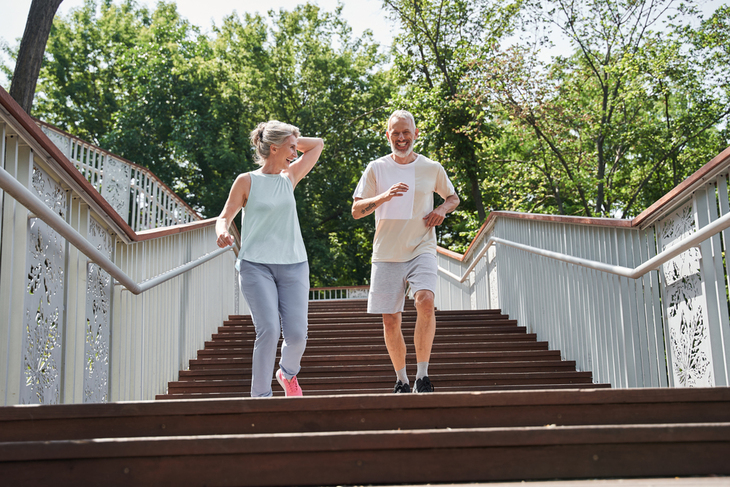
A study recently published in The Journal
of Strength & Conditioning Research examined 46 healthy adults aged
65-80 in Belgium. Researchers compared the effectiveness of traditional
leg-press machine exercises with simple stair-climbing routines.
According to The Washington Post's
coverage, both approaches - machine workouts and climbing two flights of
stairs several times twice weekly for 12 weeks - resulted in notable
gains in muscle power and functional ability.
This discovery makes strength training much more accessible for older
adults. As Evelien Van Roie, assistant professor at Hasselt University
and the study's lead author, explained to reporters, expensive gym
equipment isn't necessary to achieve meaningful results.
The 12-week stair program
During the study, participants attended
35-minute sessions twice weekly at a university lab. Each session began
with a 10-minute stationary bike warmup followed by upper-body exercises
using chest press and low row machines. Afterward, half the
participants used leg-press machines while the others performed stair
exercises.
The stair workout group progressed through three increasingly
challenging phases:
* Phase 1 (Weeks 1-4)
Four slow sets of step-ups on a box approximately one foot high,
alternating two sets per leg
* Phase 2 (Starting Week 5)
Four rapid sets of climbing two flights of six stairs, resting 45
seconds between climbs, then descending without using handrails
* Phase 3 (Final Weeks)
The same stair routine while wearing a weighted vest
Though some participants initially doubted the effectiveness of this
brief 10-minute exercise, the results proved compelling.
By the end of
the study, participants experienced:
Better muscle strength
Faster walking speed
Reduced time needed to stand up from a chair
Van Roie noted that effective exercise doesn't require lengthy sessions.
The brief but intentional stair climbing constituted a sufficient
stimulus for meaningful improvements.
Adapting the program for home use
For those wanting to try this approach at
home, experts recommend starting cautiously. They warn against
immediately attempting fast movements, as this increases injury risk.
The appropriate starting point varies by individual. Some might begin by
climbing stairs while holding a handrail for stability. Others might
practice basic step-ups or even sit-to-stand exercises from a chair.
Once at the advanced stage, a backpack containing water bottles can
substitute for a weighted vest.
Van Roie spoke about a two-step progression for adults over 65: first
building fundamental strength, then working on movement speed. As she
notes, "If you’re not able to move fast, even if you’re strong, you will
still fall down. This is something we really need to train."
Why speed matters for fall prevention
The combination of strength and rapid
response becomes increasingly important with age. Strong muscles that
can react quickly help prevent falls or minimize their impact when they
occur. This dual approach to physical fitness - building both power and
reaction time - offers practical benefits for maintaining independence.
The stair-climbing program addresses both components through its
graduated approach. The early focus on controlled movements builds basic
strength, while later phases emphasize quicker movements that improve
neuro-muscular coordination and response time.
Getting started safely
seniors exercise
Before beginning any new exercise routine,
checking with your healthcare provider is always advisable, particularly
if you have existing health conditions or mobility concerns. A medical
professional can offer personalized guidance about appropriate starting
points and progressions.
For many older adults, even modest improvements in leg strength can
translate to meaningful gains in everyday functioning and confidence.
The beauty of this stair-climbing approach is its simplicity and
accessibility - no expensive equipment required, just a staircase and
consistent practice.
Just two short sessions of intentional stair climbing per week may
improve the physical abilities of older adults within a few months,
potentially allowing them to extend their independence and quality of
life.
T