Gentle Eccentric Exercise for Stronger Joints
Here is a question you have probably never been asked. When you lift a
bag of groceries onto the counter, which is harder: the lifting up, or
the setting down? Most of us would say the lifting. And most of us, when
we set something down, simply let gravity do the work and lower it
quickly. But hidden in that gentle "lowering" half of every movement is
one of the most effective and joint-friendly forms of exercise there is.
It has a slightly technical name, eccentric exercise, but the idea
behind it could not be simpler, and it may be exactly the kind of
strength training that suits us best as we get older.
The Two Halves of Every Movement
Nearly every exercise has two parts. There is the effortful part, where your muscle shortens and you push or lift against gravity. Think of standing up out of a chair, curling a dumbbell upward, or climbing a stair. Trainers call this the concentric phase.
Then there is the other half, where your muscle slowly lengthens as you
lower back down with control. Sitting back down into the chair, lowering
the dumbbell, stepping down a stair. This is the eccentric phase, and
it is the one almost everyone overlooks. We tend to rush through it, or
let ourselves drop. Eccentric exercise simply means slowing that
lowering phase down on purpose, controlling it instead of surrendering
to gravity. That small change turns an ordinary movement into something
surprisingly powerful.
The Surprising Secret: More Strength, Less Strain
Here is what makes this so interesting. When a muscle is lengthening
under control, it can actually handle more weight and produce more force
than when it is shortening to lift. Yet at the same time, it uses less
energy, less oxygen, and keeps your heart rate lower than the lifting
half does. In plain terms, your muscles are at their strongest during
the lowering, and the work feels easier even as it does more good.
That unusual combination, more benefit for less effort, is why this kind
of exercise is so well suited to older adults, to people who tire
easily, and to anyone easing back into activity after a long break. You
do not have to huff and puff or push yourself to exhaustion to get
stronger. A gentle, controlled lowering is enough.
Why It Is So Kind to Your Joints and Tendons
This is where eccentric exercise really shines, and why it deserves a
place in your week. Your tendons are the tough, cord-like tissues that
connect your muscles to your bones, and they are what allow your joints
to move and bear weight. Unfortunately, tendons tend to weaken and
stiffen with age, which is part of why aches, strains, and injuries
become more common over the years.
The good news is that tendons respond remarkably well to the controlled, steady tension that eccentric movements provide. That gentle strain signals the tendon to rebuild and strengthen itself, becoming more resilient over time. This is no fringe idea. Physical therapists have used eccentric exercise for years to treat and prevent common tendon troubles, from Achilles pain at the heel to sore knees and tennis elbow. The classic "heel drop" exercise, which you will see below, is a standard treatment prescribed in clinics around the world.
Even better, this kind of training has been found to be safe and helpful
for people living with arthritis and tendon problems. And because the
strain on the muscle-and-tendon unit is actually gentler than in
traditional lifting, older adults tend to be less prone to injury from
it, not more. You get the reward of stronger joints without the heavy
pounding that harder workouts can bring.
Stronger tendons and muscles in the legs also mean better balance and a lower risk of falls. The very muscles that catch you when you stumble, in your thighs and calves, are the ones these movements target most directly.
A Word About Soreness
There is one thing worth knowing before you start. Eccentric exercise can leave you a little sore a day or two later, especially the first few times, when the movement is new to your muscles. This is completely normal and nothing to fear. It is not a sign of damage, and it fades on its own.
Here is the encouraging part: your body adapts quickly. After that first
session or two, the same exercise causes far less soreness, because
your muscles have already learned the movement. The secret is to start
small and light, then build up slowly over the weeks. And please
remember, you do not need soreness to benefit. The old saying "no pain,
no gain" is simply not true here. Gentle and steady wins.
The Golden Rule: Slow the Lowering
You do not need a gym, special equipment, or any prior experience to begin. The entire technique comes down to one simple habit: whenever you do a movement, slow down the lowering part and control it. A good guide is to count slowly to three, four, or even five as you lower. Do not let anything drop. That deliberate, controlled descent is the whole secret.
Below are several gentle exercises built around this idea. You can do
them all at home, and most people can manage them holding onto a sturdy
chair, counter, or railing for balance and safety.
Five Gentle Exercises to Try
The slow sit-down (for your thighs). 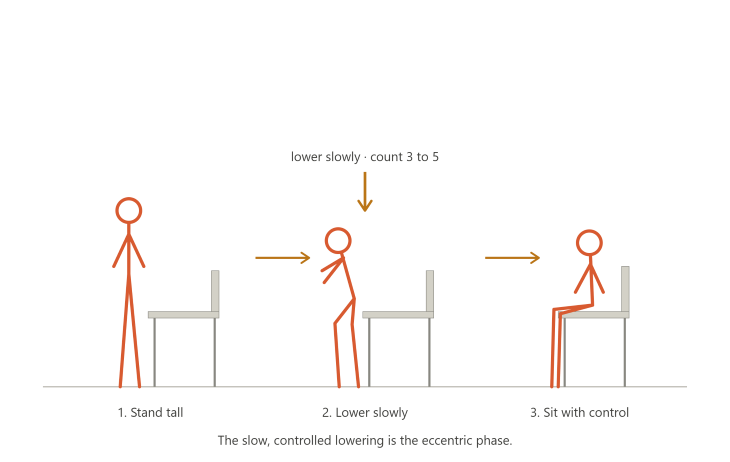
Stand in front of a sturdy
chair with your feet about shoulder-width apart. Lower yourself toward
the seat as slowly as you can, taking a count of three to five on the
way down, as if you are trying to land like a feather. Once seated,
stand back up in whatever way is comfortable, using your hands on the
armrests if you like. The slow lowering is the part that counts. This
strengthens the very muscles you use to rise from chairs and climb
stairs.
Heel drops (for your calves and ankles). Stand on the bottom step of a
staircase or a low platform, with your heels hanging off the back edge,
and hold the railing firmly. Rise up onto your tiptoes using both feet,
then slowly lower your heels down past the level of the step over a
count of three to five, until you feel a gentle stretch in your calves.
This is the famous tendon-strengthening exercise, and it also improves
the ankle stability that helps prevent falls.
Wall push-ups (for your chest, shoulders, and arms). 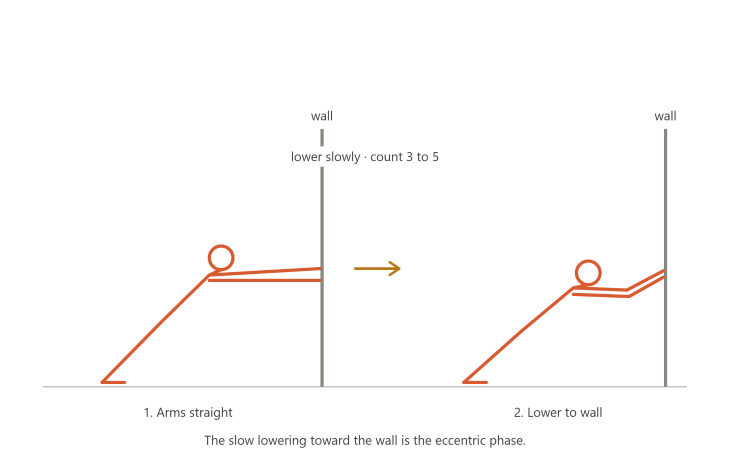
Stand an arm's
length from a wall and place your palms flat against it at shoulder
height. Slowly bend your elbows and lower your upper body toward the
wall over a count of three to five, then push yourself back to the
start. It is a gentle, joint-friendly way to keep your upper body
strong.
The chair recline (for your middle). 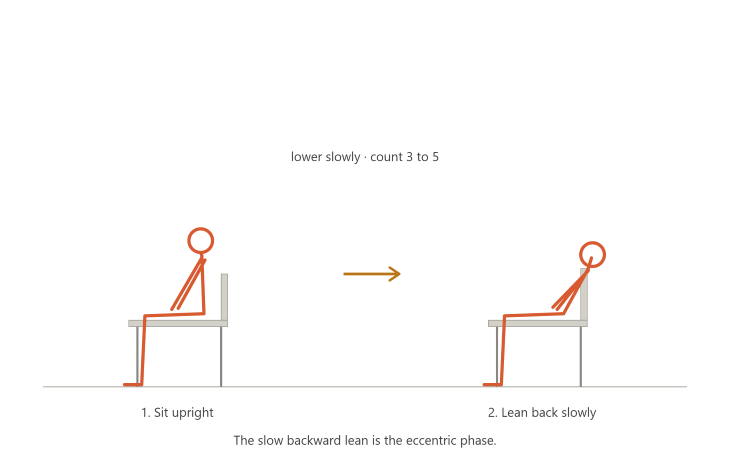
Sit toward the front of a sturdy
chair with your arms crossed over your chest or reaching forward. Slowly
and with control, lean your upper body backward just a little, lowering
as far as feels comfortable over a slow count, then use your hands on
your thighs or the chair to return upright. This gently works the core
muscles that support your back and posture.
Controlled lowering with light weights (optional). If you already use
light dumbbells or even soup cans, simply make the lowering half of each
movement slow and deliberate. Lift normally, then take three to five
seconds to lower. This one change makes a familiar exercise far more
effective.
The Downhill Bonus
Here is a delightful fact that costs you no extra time at all. Walking downhill and stepping down stairs are both naturally eccentric, because your leg muscles are lengthening under control to lower you with each step. That means going down works your muscles in this beneficial way, while feeling easier on your lungs and heart than going up.
One study even found that older women who regularly walked down stairs
saw greater improvements in their strength, blood pressure, and blood
sugar than those who walked up the same stairs. So the next time you
face a gentle slope or a staircase, take the descent slowly and with
control, and know that you are doing your muscles and joints a quiet
favor.
A Simple Way to Begin
You do not need much to see real benefits. Research has shown that just a few minutes a day of these simple movements, done at home, can meaningfully improve strength, flexibility, and even mood over a couple of months. Here is a gentle way to start:
Choose two or three of the exercises above to begin with.
Do a small number of slow, controlled repetitions of each, perhaps three to five at first. Quality matters far more than quantity.
Aim for two or three sessions a week, with a rest day in between to let your muscles recover.
Always warm up first with a minute or two of easy walking and gentle movement.
As the weeks go by and the movements feel easier, slowly add a few
more repetitions or another exercise.
Staying Safe
As with any new exercise, it is wise to check in with your doctor or a physical therapist before you begin, particularly if you have heart concerns, existing joint or tendon problems, or have been inactive for a while. Move slowly, never let a weight or your body simply drop, hold a steady support for balance, and stop if you feel any sharp or unusual pain. A little muscle soreness afterward is fine and expected; sharp pain is your signal to ease off.
The Bottom Line
For years, the message about exercise has been that it must be
exhausting and painful to be worthwhile. Eccentric exercise quietly
proves otherwise. By simply slowing down the lowering half of the
movements you already make, you can build stronger muscles and, just as
importantly, more resilient joints and tendons, all with less effort and
less strain than you might expect. It is gentle, it is doable at home,
and it fits naturally into the things your body already does every day.
Start slow, be patient with the early soreness, and let that humble
"lowering" do its quiet, powerful work.