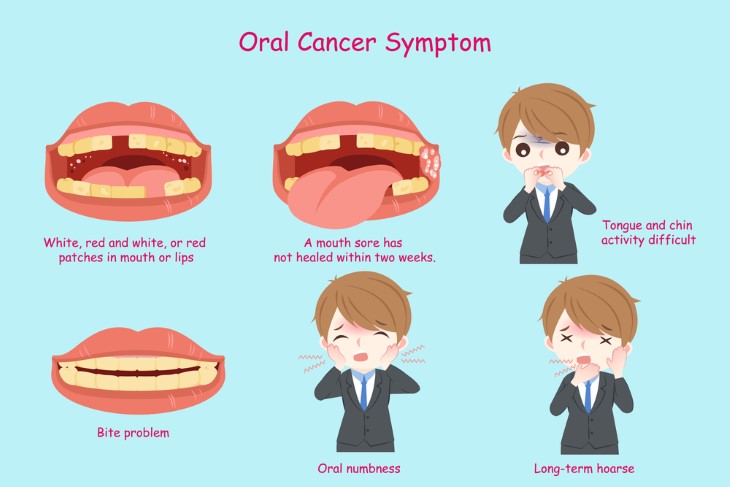
Warning Signs and Symptoms to Watch For
During your self-exam (and in general),
keep an eye out for the following common symptoms or visible signs of
mouth and throat cancer. These are the kinds of changes that could
indicate a problem (though they could also be caused by something less
serious – see next section). If you notice any of these, pay attention
and consider getting a professional evaluation:
A sore that doesn’t heal: This can be a sore on the lip, tongue, or
anywhere in the mouth that hasn’t healed after about two weeks.
Cancerous sores often persist and may even enlarge or bleed over time.
Red or white patches: A white patch (leukoplakia) or red patch
(erythroplakia) on the gums, tongue, tonsil, or lining of the mouth can
be an early warning sign. These patches are usually painless. Watch for
any persistent patch that is new for you, especially if it’s mixed red
and white.
Lump or thickening: Any lump, bump, or thick area in the cheek, on
the tongue, on the lip, or even on the throat or neck can be a warning
sign. This includes a growth in the mouth or a swollen lymph node in the
neck that doesn’t go away. It might feel like a hard knot.
Sore throat or trouble swallowing: A persistent sore throat that
doesn’t get better or a constant feeling that something is stuck in your
throat can be a symptom of throat (oropharyngeal) cancer. Likewise,
difficulty swallowing or chewing, or pain when swallowing, is a
potential warning sign. (Some people start changing their diet to softer
foods without noticing it, due to trouble swallowing.)
Changes in voice or hoarseness: An ongoing hoarse voice or a change
in your voice that lasts more than a couple of weeks could indicate a
problem in the throat or larynx. If your voice has become raspy without a
clear reason (like a cold) and it persists, get it checked.
Numbness or pain: Unexplained numbness in the tongue, lip, or other
areas of the mouth is another possible. Also, any persistent pain in the
mouth or tongue that isn’t from an obvious cause (like biting your
tongue) should be noted – oral cancers can sometimes cause pain, but not
always.
Ear pain (especially one-sided): A pain in the ear on one side,
without hearing loss, can sometimes be a referred pain from a throat
tumor. Many throat cancer patients report ear ache on one side that
doesn’t go away. If you have chronic ear pain on one side with a normal
ear exam, mention it to your doctor.
Changes in teeth or dentures: Loose teeth (if previously healthy) or
a change in the way your dentures fit can be a sign of an underlying
growth in the jaw or gum. For example, a tumor in the gum or palate
might push teeth causing them to loosen, or make dentures uncomfortable
or suddenly not fit well. If your dentist can’t find a dental cause for a
loose tooth, they might investigate for other causes.
These are some of the most common symptoms associated with mouth and
throat cancers. Having one or more of these symptoms does not mean you
have cancer – many of these signs can be caused by much less serious
issues. For instance, you could have a sore that doesn’t heal quickly
because of an infection or biting your cheek, or a persistent sore
throat from acid reflux or an allergy. However, if any symptom is
lasting more than two weeks, or is worsening, you should get it checked
by a healthcare professional.
When to Seek Professional Evaluation
It’s always better to play it safe when it comes to your health. You
should see a doctor or dentist for an evaluation if you notice any of
the warning signs above lasting more than two weeks. A two-week
timeframe is a common rule of thumb, because most minor problems (like
canker sores or mild infections) will improve in that time. If a mouth
sore, lump, or other symptom persists beyond 2 weeks (or gets bigger),
don’t wait—get it checked.
Additionally, seek medical attention sooner (right away, not waiting two
weeks) if you have a significant symptom that's worrying you – for
example, a rapidly growing lump, difficulty swallowing that interferes
with eating, or any symptom that is causing serious discomfort or
concern. Trust your instincts: if something feels off and especially if
you are in a high-risk group (like a heavy smoker over 45), schedule an
appointment with your dentist or doctor.
When you go for a professional evaluation, the provider will perform a
thorough exam of your mouth and throat. They have special tools and
expertise to assess any suspicious areas (including doing a biopsy if
needed, which means taking a small sample to test in the lab). Remember
that most often, these symptoms turn out to be caused by something other
than cancer (such as a benign ulcer or an infection). But only a
medical professional can determine that, so it’s important to get
checked. If it is cancer, catching it early greatly improves the chances
of successful treatment and cure.
Bottom line: Do your self-exams regularly, stay aware of the risk
factors and warning signs, and don’t hesitate to see a healthcare
provider if you find anything worrisome. Early detection can save lives,
and taking a few minutes to check your mouth each month is a simple,
potentially life-saving habit. If you’re ever unsure about something you
see or feel in your mouth, it’s perfectly okay to call your dentist or
doctor – they can guide you on next steps or schedule you for a quick
check. Taking charge of your oral health in this way helps ensure that
if a problem does arise, you’ll catch it as soon as possible.