10 Amazing Little-known Facts About the Human Body
We don’t often think of all of the capabilities of the human body, but
there are actually many amazing things about it that are hardly ever
given a second thought. Here are 10 amazing, but little-known, facts
about the human body:
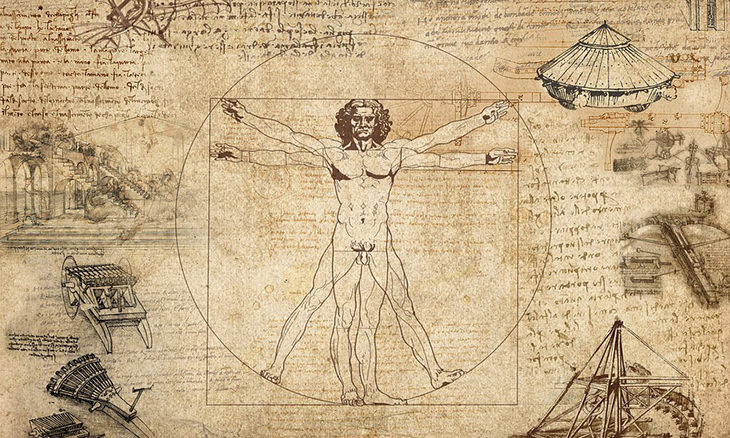
You’re likely to have seen the Vetruvian
Man, the famous sketch by Leonardo da Vinci. It’s one of the earliest
and best explorations of anthropometry, which is the scientific study of
the measurements and proportion of the human body. Did you know, for
instance, that your foot will fit neatly into your forearm? Or that your
height is equal to the span of your arms when you stretch your legs out
to the side?
1. Your body measurements equal each other
What’s more is that your height is approximately 10 times the length
from your wrist to the tip of your middle finger. Anthropometric
correlation is more than just a bit of fun – anthropologists use it to
determine how tall the owner of a particular bone is.
2. You’re tallest in the morning
NASA astronauts can be as much as two
inches taller in zero gravity, and that’s because the absence of gravity
prevents compression of the discs in the spine. The effect isn’t nearly
quite as pronounced here on Earth as it is in space, however, our
joints decompress when we lie down because gravity isn’t literally
pulling us down. As a result, we’re tallest when we wake up we get out
of bed in the morning.
3. Your body is capable of boiling water
The human body is capable of generating
enough heat in just half an hour to bring half a gallon of water to the
boil. With that being said, it regulates itself to keep itself at 98.6
degrees Fahrenheit in spite of all the biochemical reactions that occur
within it and give off a lot of heat. This same process also makes the
body electric. In fact, it gives off about 100 watts of electrical
energy when at rest, which is the same as your average light bulb. A
sprinting athlete can give off as much as 2,000 watts.
4. Your bones are stronger than steel
Inch for inch, human bones are stronger
than steel. A cubic inch of bone can withstand a weight of 19,000
pounds. To give you an idea of how strong that is, helicopters, small
jet, and semi-trucks weight about 14,000 pounds, whereas a large male
elephant weighs in at about 15,000. In addition, bone immediately begins
to repair itself when broken – steel doesn’t.
5. Your hair is as durable as rope
The story of Rapunzel allowing the prince
to climb up the tower she was imprisoned in using her tresses as a rope
is far from implausible, and that’s because a rope of hair can actually
withstand the weight of several men. A single strand of human hair can
bear about 3 ounces of weight, but if you multiply that number by the
average number of human hairs on a woman’s head, the hair would be
capable of bearing a weight of 12 tons. Furthermore, flammability aside,
hair is virtually indestructible.
6. Your heart can regulate to music

It’s quite common to hear that the human
nose can identify roughly 10,000 different smells, but a Rockefeller
University study conducted this year showed that the figure is actually
at least 1 trillion! This finding came from observing human eye
function. Despite the human eye having just three color receptors, it
can see up to 10 million colors. In contrast, the nose has 400 olfactory
receptors, so the team thought the human nose was capable of smelling
far more different scents than previously thought.
Your favorite music can make your heart
beat faster. The connection between the human heart and music is so deep
that various elite medical schools around the world are studying it in
order to develop new treatments for heart disease. Your heart can
actually be strengthened by its response to music. In essence, it
mirrors the beat of the music you’re hearing – a Mozart concerto will
slow it down, whereas an electronic song will speed it up. The response
is strongest when a person is listening to the music that they really
love.
7. You can smell and see more than you think
8. You see with your brain rather than your eyes
It’s actually your brain that’s responsible
for seeing rather than your eyes. The human eye collects information,
which it then sends to the brain for processing. Another example of such
a sensory system is the tongue, which can actually be used to reliably
relay the same information to the brain as the eye would. Sensory
substitution was pioneered in the 1960s, and it enabled people that were
born blind to see well enough to recognize photos of then-supermodel,
Twiggy. This work was recently used to help Navy SEAL orient their
bodies when they’re underwater because the senses work differently when
an individual is immersed in it.
9. Your mouth contains billions of bacteria
The average human mouth contains about the
same amount of bacteria as there are humans on this planet. What’s more
is that the bacteria form colonies and communities in here. For
instance, bacteria on the roof of your mouth is different from the
bacteria that resides underneath your tongue. Kissing for a mere 10
seconds can transfer as many as 80 million bacteria from one person’s
mouth to another. You don’t have to stop kissing, though – saliva
contains powerful antibacterial and antimicrobial compounds to kill off
bad bacteria.
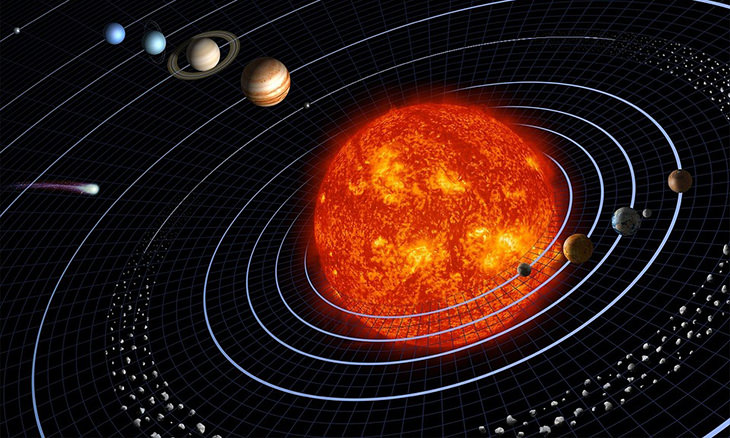
10. Your body operates like the solar system
In his famous PBS series, Cosmos,
astronomer Carl Sagan famously said: “…the cosmos is within us. We are
made of star stuff.” Despite sounding like some fanciful new age notion,
it’s actually the literal truth – scientific research and quantum
physics has proved it. The iron in the blood, the calcium in the teeth
and even the oxygen that fills the lungs were all created when novas and
supernovas exploded and began to travel through space. In fact, some of
the stuff in your cells may be more than 4 billion years old. Yep –
we’re actually made of stardust.