How to Check Your Mouth and Throat for Early Signs of Cancer
Mouth and throat cancers (also called oral
and oropharyngeal cancers) can be serious, but they are much easier to
treat if caught early. In fact, when these cancers are detected at early
stages (Stage I or II), the survival rate is over 80%. The good news is
you can perform a simple self-examination at home to look for warning
signs. This guide will explain the risk factors, show you a step-by-step
self-exam procedure, describe common symptoms to watch for, and advise
when to seek medical care.
Common Risk Factors for Mouth and Throat Cancer

Certain habits, infections, and conditions
can increase your risk of developing oral or throat cancer. Knowing
these risk factors can help you understand your level of risk:
Tobacco use – Smoking cigarettes, cigars, or pipes, as well as using
chewing tobacco or snuff, is the single biggest risk factor for
mouth/throat cancer. The more years you use tobacco, the higher your
risk.
Heavy alcohol use – Frequent, heavy
drinking also raises the risk. Alcohol and tobacco together are
especially dangerous – using both multiplies the risk of these cancers
significantly.
HPV infection – Infection with certain strains of human
papillomavirus (HPV), a common sexually transmitted virus, is linked to
throat cancers (particularly cancers of the tonsils and base of tongue).
HPV type 16 is a known cause of many oropharyngeal (throat) cancers.
Age over 45-50 – Mouth and throat cancers usually take many years to
develop. Most people diagnosed are over age 55. Risk increases as you
get older (especially after 45).
Being male – Men are about twice as likely to develop oral or throat
cancers as women. This may be due to historically higher rates of
tobacco and alcohol use in men (though the gap is closing).
Poor diet – A diet low in fruits and vegetables is associated with a
higher risk of these cancers. A healthy diet with plenty of produce may
help lower risk.
Prolonged sun exposure – Spending a lot of time in the sun without
lip protection increases the risk of lip cancer. (Using lip balm with
SPF is a good precaution.)
Weak immune system or chronic irritation – People with weakened
immunity (for example, from certain illnesses or immunosuppressant
medications) have a higher risk. Also, long-term irritation in the mouth
– such as from ill-fitting dentures or sharp/broken teeth rubbing the
cheek or tongue – has been suggested to raise risk slightly.
Keep in mind: Having one or more risk factors does not mean you will get
cancer – most people with risk factors do not develop it. Likewise,
it’s possible to get mouth/throat cancer even with no known risk
factors. However, if you have risk factors (especially tobacco or heavy
alcohol use), it’s wise to be extra vigilant about regular self-checks
and dental exams.
Step-by-Step Self-Examination Procedure
Regular self-exams can help catch early changes in your mouth or throat.
Experts recommend doing a self-exam about once a month. Pick a time
when you can spare a few minutes in a good light. This exam is easy to
do with a bright light (or flashlight) and a mirror. It helps to remove
any dentures or partials so you can see all areas. Wash your hands
before you begin, since you’ll be using your fingers to feel inside your
mouth.
Follow these steps to examine your mouth and throat:
Check the neck and face: Stand in front of a mirror and look at your
face and neck. Do you see any swelling, lumps, or asymmetry (one side
different from the other)? Using the pads of your fingers, feel both
sides of your neck—along your jawline and down the sides—for any lumps,
bumps, or tenderness. Also feel under your lower jaw (sub-mandibular
area) for enlarged lymph nodes (glands). Normal neck tissue is usually
soft and the same on both sides. If you feel a firm lump on one side
that isn’t on the other, take note of it.
Examine your lips and gums: Pull your lower lip down and use the mirror
to look at the inner side of your lip and the front part of your gums.
Look for any sores, discoloration (such as red or white patches), or
swelling. Next, use your thumb and forefinger to feel the inside of your
lip and gum for any lumps or thick areas. Repeat this on your upper lip
by lifting it up to check the inner lining of the upper lip and gums.
(If you have dentures, do this step with dentures removed.)
Check inside your cheeks: Using your
fingers, gently pull your cheek away from your teeth so you can see the
inside lining of the cheek. Look for red or white patches, sores, or any
spots that look different from the surrounding area. Then place your
index finger inside your cheek and your thumb on the outside, and feel
the cheek tissue by pressing and rolling your fingers together. Do this
for both sides. You are checking for any lumps, bumps, or tender areas
within the cheek.
Inspect the roof of your mouth: Tilt your head back and open wide to see
the roof of your mouth (the hard palate towards the front, and the soft
palate towards the back). It may help to use a flashlight here. Look
for any unusual bumps, color changes, or sores on the roof of your
mouth. You can also run your clean index finger along the roof of your
mouth to feel for any odd bumps or tenderness.
Examine your tongue (top and sides): Stick
out your tongue as far as it goes and look at the top surface. It should
be pinkish with tiny bumps (normal taste buds). Check if there are any
areas that are new, such as red or white spots or any ulcer (sore).
Next, examine the sides of your tongue – this is important, as many
mouth cancers begin on the sides of the tongue. Using a piece of clean
gauze or a washcloth, grab the tip of your tongue and gently pull it to
one side, then the other, so you can see the side edges. Look for any
lumps, rough areas, or discoloration on each side. You can use your
finger and thumb to feel along the side of the tongue for any bumps.

Warning Signs and Symptoms to Watch out forCheck underneath the tongue and floor of
mouth: Lift your tongue up to inspect the underside (the frenulum area –
where the tongue connects to the floor of the mouth). Also look at the
floor of your mouth (under the tongue). Use the mirror and maybe a
flashlight. Look for any red or white patches, swellings, or sores under
the tongue. With a clean finger, gently press along the floor of your
mouth (under the tongue) to feel for any lumps or hardened areas.
Look at the back of your throat: Open your mouth wide and say “ahh”
(this helps lift your soft palate) while looking in the mirror. Check
the back of your throat, including your tonsils and the back of your
tongue, as far as you can see. It might help to shine a flashlight
toward the back of your mouth. Look for any unusual redness, swelling,
lumps, or patches in your throat area. You might not have a perfect view
(and you don’t need to force yourself to gag), but see if anything
looks asymmetric or persistently irritated. Also note if one tonsil
seems much larger than the other or if there’s a visible growth.
Take your time and go through all the steps to cover each area of the
mouth and throat. A complete self-exam should only take about 5–10
minutes. Remember: you are looking for anything unusual for you – such
as a new spot, a change in color or texture, a lump that wasn’t there
before, or a sore that isn’t healing.
Performing this exam monthly helps you become familiar with what’s
normal for your mouth. That way, you’ll be more likely to notice if
something changes. If you do notice something odd (for example, a new
red patch or a lump) during your self-check, make a note of it. Then
check again in two weeks to see if it’s still there or has grown. In the
next sections, we’ll go over specific signs and symptoms to watch for,
and what to do if you find them.
During your self-exam (and in general),
keep an eye out for the following common symptoms or visible signs of
mouth and throat cancer. These are the kinds of changes that could
indicate a problem (though they could also be caused by something less
serious – see next section). If you notice any of these, pay attention
and consider getting a professional evaluation:
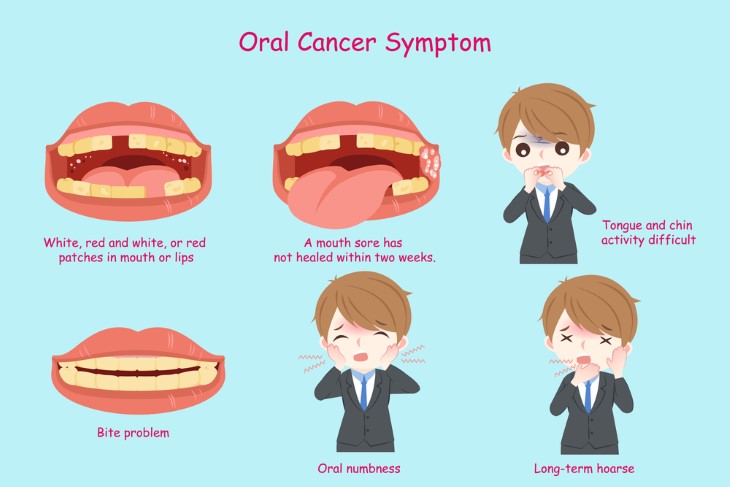
A sore that doesn’t heal: This can be a sore on the lip, tongue, or
anywhere in the mouth that hasn’t healed after about two weeks.
Cancerous sores often persist and may even enlarge or bleed over time.
Red or white patches: A white patch (leukoplakia) or red patch
(erythroplakia) on the gums, tongue, tonsil, or lining of the mouth can
be an early warning sign. These patches are usually painless. Watch for
any persistent patch that is new for you, especially if it’s mixed red
and white.
Lump or thickening: Any lump, bump, or
thick area in the cheek, on the tongue, on the lip, or even on the
throat or neck can be a warning sign. This includes a growth in the
mouth or a swollen lymph node in the neck that doesn’t go away. It might
feel like a hard knot.
Sore throat or trouble swallowing: A persistent sore throat that doesn’t
get better or a constant feeling that something is stuck in your throat
can be a symptom of throat (oropharyngeal) cancer. Likewise, difficulty
swallowing or chewing, or pain when swallowing, is a potential warning
sign. (Some people start changing their diet to softer foods without
noticing it, due to trouble swallowing.)
Changes in voice or hoarseness: An
ongoing hoarse voice or a change in your voice that lasts more than a
couple of weeks could indicate a problem in the throat or larynx. If
your voice has become raspy without a clear reason (like a cold) and it
persists, get it checked.
Numbness or pain: Unexplained numbness in the tongue, lip, or other
areas of the mouth is another possible. Also, any persistent pain in the
mouth or tongue that isn’t from an obvious cause (like biting your
tongue) should be noted – oral cancers can sometimes cause pain, but not
always.
Ear pain (especially one-sided): A pain in the ear on one side,
without hearing loss, can sometimes be a referred pain from a throat
tumor. Many throat cancer patients report ear ache on one side that
doesn’t go away. If you have chronic ear pain on one side with a normal
ear exam, mention it to your doctor.
Changes in teeth or dentures: Loose teeth (if previously healthy) or
a change in the way your dentures fit can be a sign of an underlying
growth in the jaw or gum. For example, a tumor in the gum or palate
might push teeth causing them to loosen, or make dentures uncomfortable
or suddenly not fit well. If your dentist can’t find a dental cause for a
loose tooth, they might investigate for other causes.
These are some of the most common symptoms associated with mouth and
throat cancers. Having one or more of these symptoms does not mean you
have cancer – many of these signs can be caused by much less serious
issues. For instance, you could have a sore that doesn’t heal quickly
because of an infection or biting your cheek, or a persistent sore
throat from acid reflux or an allergy. However, if any symptom is
lasting more than two weeks, or is worsening, you should get it checked
by a healthcare professional.
When to Seek Professional Evaluation
It’s always better to play it safe when it comes to your health. You
should see a doctor or dentist for an evaluation if you notice any of
the warning signs above lasting more than two weeks. A two-week
time-frame is a common rule of thumb, because most minor problems (like
canker sores or mild infections) will improve in that time. If a mouth
sore, lump, or other symptom persists beyond 2 weeks (or gets bigger),
don’t wait—get it checked.
Additionally, seek medical attention sooner (right away, not waiting two
weeks) if you have a significant symptom that's worrying you – for
example, a rapidly growing lump, difficulty swallowing that interferes
with eating, or any symptom that is causing serious discomfort or
concern. Trust your instincts: if something feels off and especially if
you are in a high-risk group (like a heavy smoker over 45), schedule an
appointment with your dentist or doctor.
When you go for a professional evaluation, the provider will perform a
thorough exam of your mouth and throat. They have special tools and
expertise to assess any suspicious areas (including doing a biopsy if
needed, which means taking a small sample to test in the lab). Remember
that most often, these symptoms turn out to be caused by something other
than cancer (such as a benign ulcer or an infection). But only a
medical professional can determine that, so it’s important to get
checked. If it is cancer, catching it early greatly improves the chances
of successful treatment and cure.
Bottom line: Do your self-exams regularly, stay aware of the risk
factors and warning signs, and don’t hesitate to see a healthcare
provider if you find anything worrisome. Early detection can save lives,
and taking a few minutes to check your mouth each month is a simple,
potentially life-saving habit. If you’re ever unsure about something you
see or feel in your mouth, it’s perfectly okay to call your dentist or
doctor – they can guide you on next steps or schedule you for a quick
check. Taking charge of your oral health in this way helps ensure that
if a problem does arise, you’ll catch it as soon as possible.